TLDR;
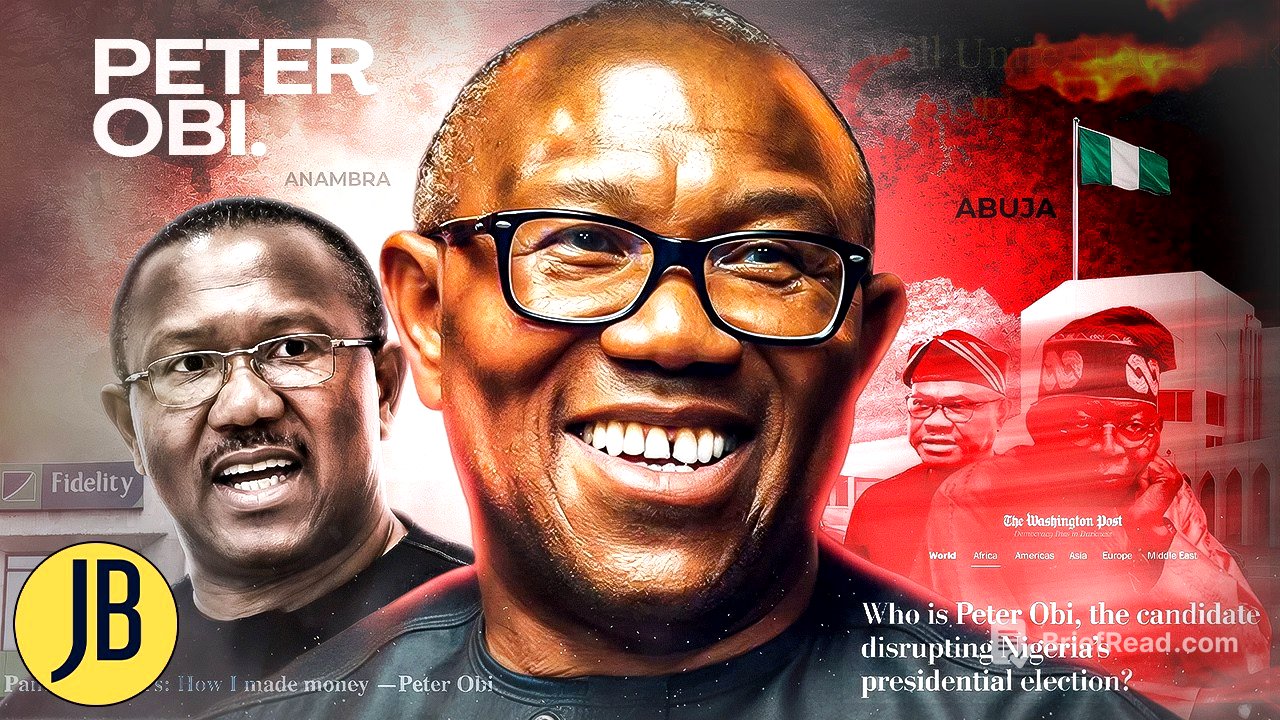
Peter Obi rises from a trading family in Onitsha to become Anambra governor, winning a long legal battle against electoral fraud and an attempted impeachment. His administration earns a reputation for careful spending and investments in education and healthcare, though disputes over state finances and offshore companies complicate his record. After leaving office, Obi moves through several parties, becomes the focus of the youth-led Obidient movement and finishes third in Nigeria’s 2023 presidential election. The account ends with his 2026 move to the Nigerian Democratic Congress, whose legal status remains unsettled.
- Obi’s governorship begins only after courts overturn a disputed election and later restore him following an unconstitutional impeachment.
- His administration cuts reconstruction costs, returns mission schools to church management and expands education and health services.
- His later political path is marked by party defections, allegations about offshore assets, a major youth-backed presidential campaign and continuing legal and political disputes.
Anambra’s Impeachment Crisis [0:00]
Armed police guard an extraordinary session of the Anambra State House of Assembly as lawmakers read 11 articles of impeachment against Governor Peter Obi. The assembly proceeds without the two-thirds majority required by the constitution and takes no vote count. The charges include using a Peugeot 406 as his official car, buying furniture from local carpenters and spending ₦43.2 million on Government House repairs when ₦298 million had been allocated. Obi refuses to accept his removal quietly, setting up a political battle with far-reaching consequences for Anambra.
Onitsha Roots, Family Upheaval and Business Success [1:44]
Peter Obi is born in Onitsha in 1961 into a family shaped by trade. His father, Josephat, owns Ideal Supermarket and is among the city’s visible wealthy residents, but the Nigerian Civil War destroys the business and claims his life when Peter is seven. His mother, Agnes—known as Madam Nado—rebuilds the family’s fortunes, raises ten children and develops businesses and properties, giving Peter a close example of persistence and careful enterprise.
Obi attends Christ the King College in Onitsha, then studies philosophy at the University of Nigeria, Nsukka, graduating in 1984. He later attends executive programmes at institutions including Lagos Business School, Harvard and Oxford, but says people should judge him by what he has managed rather than his certificates. Starting as a small trader, he builds Next International Nigeria Limited, imports and distributes consumer goods, and establishes a UK branch in 1996. He later chairs Fidelity Bank, reportedly becoming its youngest chairman, and is among its major shareholders as the bank grows and lists on the Nigerian Stock Exchange.
Anambra’s Political Crisis and the 2003 Election [5:40]
By the early 2000s, Obi is a wealthy businessman considering a run for governor in a state struggling with unpaid salaries, closed schools and power struggles. Anambra’s first civilian governor after the 1999 return to democracy, Chinwoke Mbadinuju, is backed by businessman Emeka Offor, who is said to have funded his campaign and expected influence over the state treasury. Human Rights Watch documents unpaid workers, a full academic year without schooling and conflict between Mbadinuju and Offor. Security is handed to the Bakassi Boys, a vigilante group accused of extrajudicial killings.
In 2003, PDP chieftain Chris Uba builds a powerful political network. The alleged arrangement is that a financier pays for a candidate’s election campaign and controls appointments and public money in return. Uba’s preferred candidate is Chris Ngige; Ngige later tells the Senate that a written pact set out their terms and alleges an oath was taken at the Okija shrine. Meanwhile, Chukwuemeka Odumegwu Ojukwu helps establish the All Progressives Grand Alliance (APGA), intended as a political vehicle for the Southeast. Ojukwu gives Obi its governorship ticket. APGA chairman Victor Umeh later recalls Obi bringing ₦200 million of his own money and warning that it would not be enough to defeat the PDP machine.
On 19 April 2003, INEC declares Ngige the winner. Obi challenges the result, alleging that result sheets were falsified and votes manipulated in favour of the PDP. As his legal case continues, Ngige breaks with Uba. On 10 July 2003, armed police remove Ngige at gunpoint and deliver a forged resignation letter to the assembly. Ngige survives a 12-hour siege after contacting Vice-President Atiku Abubakar and making a live radio broadcast to confirm that he has not resigned. He accuses Uba of organising the abduction; Uba denies involvement in violence and says he was enforcing their agreement.
Violence in Anambra and Obi’s First Court Victory [12:48]
In November 2004, more than a year after Ngige’s abduction, armed men attack and burn major state institutions over two days. The Anambra Broadcasting Service, House of Assembly, judicial complex, chief judge’s residence, hotels, vehicles and Government House are damaged or destroyed, with crude explosives used at the governor’s residence. The attacks take place in front of police and are shown on national television. Witnesses blame a faction allied to Uba and complicit security forces, alleging that the aim is to provoke a state of emergency and remove Ngige. Writer Chinua Achebe rejects a national honour, condemning the clique he says is turning his homeland into a bankrupt and lawless fiefdom.
Obi spends nearly three years in court while the state remains unstable. In August 2005, an election tribunal rules that Obi won the majority of lawful votes and nullifies Ngige’s election. The Court of Appeal upholds that decision on 15 March 2006, the final stage of a governorship election petition under the law at the time. Ngige accepts the judgment and asks the people of Anambra to support his successor. On 17 March 2006, Obi is sworn in as governor.
Impeachment, Reinstatement and a Supreme Court Ruling [15:33]
Obi takes office with about a year remaining before the next national election cycle, a hostile assembly dominated by the PDP and Andy Uba already positioning himself for the next governorship election. On 2 November 2006, armed police surround the assembly while lawmakers pass 11 articles of impeachment. The lawmakers fail to reach the constitutionally required two-thirds majority, and no count is taken. The next day, Obi’s deputy, Virginia Etiaba, is sworn in. A retired educationist reluctant to replace her boss, Etiaba becomes the first woman to serve as governor of a Nigerian state. During her 97 days in office, she launches road projects and signs the Child Rights Act.
Obi returns to court, and on 9 February 2007 the Court of Appeal nullifies the impeachment and restores him to office. Etiaba hands power back the same day. However, the regular governorship election takes place in April, and Andy Uba is declared the winner and sworn in on 29 May, forcing Obi out once again. Obi argues that his term began with his oath of office on 17 March 2006 and should run until 17 March 2010, so the 2007 election was held while the office was still occupied. On 14 June 2007, the Supreme Court agrees, removes Uba and restores Obi. Its ruling ties a governor’s term to the date of the oath rather than the national election calendar, moving Anambra and several other states onto separate electoral schedules.
Rebuilding Anambra’s Schools, Hospitals and Finances [20:27]
When Obi returns to Government House in 2006, several state buildings remain damaged by the 2004 arson, and the proposed repair budgets are high: ₦298 million for Government House and ₦486 million for the governor’s lodge. Obi spends ₦43.2 million and ₦81 million respectively, reducing the combined cost from ₦784 million to ₦124 million while completing the repairs. His governing approach centres on spending less, delivering services and keeping records.
Obi focuses on education, where the government says every public primary classroom has leaks or cracks, and healthcare, where no institution in the state holds accreditation. On 1 January 2009, he returns Catholic and Anglican mission schools, seized by the government during the war, to their original owners. The state continues to pay teachers’ salaries and cover capital and recurring costs, while the churches manage the schools. The policy faces resistance: the Nigerian Union of Teachers strikes on the transfer date, and some schools are given to missions that were not their original owners. The government provides ₦100 million to mission secondary schools and includes a ₦10 billion education allocation in the 2012 budget. Anambra rises from 24th in national exam rankings to first and leads WAEC senior school certificate results for three consecutive years. The programme includes more than 30,000 computers, internet access for over 500 schools and school buses, and attracts a World Bank study led by Oxford economist Paul Collier.
Healthcare investment includes more than US$50 million for voluntary-agency hospitals, a heart centre at St Joseph’s in Adazi Nkwu, a Federal Teaching Hospital built from scratch in Onitsha and the first public dialysis machine at Onitsha General Hospital. By 2014, more than 12 institutions have accreditation, compared with none when Obi first took office. In 2012, the Gates Foundation names him the best-performing governor on immunisation in Southeast Nigeria. He wins re-election in 2010, with 97,000 votes, ahead of Ngige and Andy Uba.
Obi also cultivates a reputation for personal frugality. He refuses an armoured car and drives a Peugeot 406; he uses the savings to buy cars for permanent secretaries and judges. He lets President Olusegun Obasanjo use his own lodge rather than building a new ₦500 million presidential lodge, and in 2007 writes to reject land allocated to him by the State Housing Corporation. Anambra takes no new loans during his administration, and the Debt Management Office rates it the country’s least indebted state, while the Senate calls it the most financially stable.
Financial Disputes and Offshore Company Questions [25:10]
Obi says he leaves around ₦75 billion, but his successor, Willie Obiano, calls the claim a hoax. Obiano’s government says only ₦9 billion is cash in the bank, about ₦26 billion is held in saleable bonds, and the remaining funds are tied up in investments or money already spent on federal roads. It also says the state owes contractors ₦185 billion. Obi replies that he has certified bank statements and says the ₦185 billion refers to contracts not yet carried out, rather than debts owed. He also challenges the decision to sell investments at a loss. The disagreement centres partly on how much of the portfolio could readily be spent. A Guardian fact check finds Obi’s public claim that he owed nobody at handover misleading, noting that formal debt remained even as arrears were cleared.
The account also details offshore companies disclosed through the Pandora Papers investigation by the International Consortium of Investigative Journalists (ICIJ), published by Premium Times. In November 2010, while governor, Obi sets up Gabriella Investments Limited in the British Virgin Islands, named after his daughter and incorporated through nominee directors. In 2017, it is renamed PMGG Investments—after Peter, Margaret, Gabriella and Gregory—and placed in a trust structure through a New Zealand trustee. Companies House records show Obi resigning as a director of Next International UK on 6 May 2008, 14 months after taking office. Obi says he resigned at once by giving his wife a letter and that the filing was delayed. He acknowledges not declaring the offshore companies, saying he believed jointly held family assets were exempt.
Premium Times identifies potential legal issues: public officers must give up directing private businesses, declare all assets and may not operate foreign bank accounts. The Economic and Financial Crimes Commission (EFCC) questions Obi in October 2021, but no charges follow. He leaves office in March 2014 after Willie Obiano, a former Fidelity Bank colleague, wins the APGA nomination and general election. His record includes his fiscal policies and public-service investments, alongside the offshore company and asset-declaration questions.
From APGA to the PDP and the 2019 Election [29:44]
After leaving office, Obi steps down as APGA’s national leader in August 2014, disillusioned by the party’s internal politics following Ojukwu’s death. Two months later, a delegation of Southeast PDP figures visits him in Onitsha and asks him to join the party. Obi accepts, saying APGA no longer represents its original values. Ojukwu’s widow, Bianca, calls his move a betrayal and is upset that he did not tell her. Later, commentators who had criticised the defection also condemn APGA’s subsequent sham primaries.
Before Obi joins the PDP, President Goodluck Jonathan appoints him to the presidential economic management team and makes him an honorary finance adviser, the first sitting governor to hold that role. Obi becomes deputy director-general of Jonathan’s 2015 presidential campaign, which loses to Muhammadu Buhari. Jonathan appoints Obi chairman of the Securities and Exchange Commission on 27 April 2015, shortly before leaving office. The incoming Buhari government reviews Jonathan’s late appointments and removes Obi from the post.
In 2018, Atiku Abubakar chooses Obi as his running mate, pairing a northern Muslim with a southern Christian and drawing on Obi’s reputation for frugal management. Their PDP ticket loses to Buhari in 2019: Buhari receives about 15.2 million votes, against Atiku’s 11.3 million, and the Supreme Court upholds the result.
The Obidient Movement and the 2023 Presidential Election [33:27]
The 2020 End SARS protests against police brutality, including the shooting of demonstrators at Lagos’s Lekki Toll Gate, shape a generation of young political activists. By 2022, many are looking for a political vehicle, and Obi’s governorship record circulates widely on social media. His supporters become known as the Obidients, a play on his name. INEC registers nearly 10 million new voters ahead of the 2023 election, more than 70% of them under 35.
Obi initially seeks the PDP presidential ticket in March 2022 but leaves days before the primary, accusing the party of delegate bribery, vote-buying and a clique working against him. He joins the Labour Party, whose limited national organisation, lack of governors and leadership dispute make the campaign difficult. His critics call him a political opportunist who changes parties when they no longer serve him; supporters say he leaves because each party’s internal system is rigged against him. On 8 July 2022, he names economist and former senator Yusuf Datti Baba-Ahmed as his running mate.
The campaign gains strength from the youth-led movement, with volunteer-organised marches filling cities including Makurdi, Port Harcourt, Enugu, Abuja, Kano and Ibadan. Its slogan, “We no dey give shishi” (“We do not give a penny”), reflects supporters’ claim that the movement funds and organises itself. Critics say Obi benefits from anger he did not create and from Pentecostal church networks. The support is large but uneven, concentrated in cities, the Southeast, the South-South and Christian communities, with little reach into the northern countryside.
On 25 February 2023, Bola Tinubu of the APC wins with 8.7 million votes, Atiku receives 6.9 million and Obi receives 6.1 million. Obi wins Lagos, Tinubu’s home state, takes the Federal Capital Territory with more than 60% of votes and wins Anambra with roughly 95%. INEC’s official results place him first in 11 of the 36 states, mainly in the Southeast, South-South and Middle Belt, while he receives under 1% in Katsina and Zamfara.
Obi challenges the result, citing irregularities including alleged breaches of INEC’s own rules and altered result sheets. The Presidential Election Petition Court dismisses his case on 6 September 2023, and the Supreme Court dismisses his appeal on 26 October, affirming Tinubu’s election. The courts close the legal case, while debate over the election’s fairness continues.
Labour Party Infighting and the ADC Coalition [39:20]
After the election, the Labour Party splits into factions led by national chairman Julius Abure and his deputy Lamidi Apapa. A court restrains Abure from acting as chairman, but he remains in office, while Apapa declares himself acting chairman and takes control of the party secretariat with police present. Representatives of both factions clash at the election petition court, and the Apapa faction attempts to withdraw Obi’s own legal challenge. The Nigerian Labour Congress, which founded the party, calls for a new convention, but Abure ignores it. By late 2024, the factions reconcile against Obi, leaving the party that carried six million votes at odds with its presidential candidate.
Obi remains in the party for a time, then joins a coalition forming in 2025. The group includes Atiku Abubakar, former Senate President David Mark, former APC national chairman Abdullahi Adamu, former transport minister Rotimi Amaechi and former Kaduna governor Nasir El-Rufai. They adopt the African Democratic Congress (ADC) as their vehicle, with Mark as chairman. Obi joins in July 2025, saying he has been involved in the coalition discussions from the beginning. Atiku welcomes him, but their return to the same party raises the question of who will win its presidential ticket.
The Nigerian Democratic Congress and the 2027 Uncertainty [41:31]
By early 2026, Obi’s supporters accuse Atiku’s team of using money to influence delegates ahead of the ADC primary. The Obidient movement rejects what it calls a “dollarised primary”. Having already been Atiku’s running mate and having left the PDP over alleged vote-buying, Obi resigns from the ADC on 2 May 2026, citing a toxic environment. Within weeks, he joins the newly registered Nigerian Democratic Congress (NDC), buys its only presidential nomination form and is cleared as its sole aspirant. A special convention in Abuja confirms him as the party’s candidate on 30 May. Victor Omei, who had warned Obi 23 years earlier that he lacked the money to defeat the PDP in Anambra, moves the motion. Obi selects Rabiu Kwankwaso as his running mate, hoping Kwankwaso’s Kwankwasiyya movement will help overcome his limited support in the North; Obi describes him as a partner, not a deputy of lesser importance.
The NDC’s own legal status is uncertain. A Federal High Court orders INEC to register it in December 2025, recognising its founder’s constitutional right to freedom of association. On 26 June 2026, the same court reverses its earlier ruling after the Peace Movement Party argues it was not heard in the original case and challenges the NDC’s use of a logo in its registration documents. The judge sets aside the registration judgment and orders a fresh hearing. The NDC says it has not been deregistered, appeals and seeks a stay of execution. Its leader, former Bayelsa governor Seriake Dickson, says the party’s candidates have already been uploaded to INEC’s portal, but the party’s status and ability to contest in 2027 remain unresolved.
In an interview released in early July 2026, Obi alleges a coordinated campaign against opposition figures and says his businesses have been deliberately frustrated. He suggests he may not live to contest, without directly accusing anyone. The presidency dismisses the claim as a fabricated appeal for sympathy. At 65, Obi says he is not desperate to become president and wants Nigeria to work, while his next political steps remain caught up in the country’s unresolved party and electoral struggles.