TLDR;
Terra Industries is building drones, surveillance systems and ground vehicles in Nigeria to help protect infrastructure and strengthen security across the Global South. Founded by two young Nigerian engineers, the company says it designs its systems for local conditions and makes around 70% of its components in-house. After beginning with modest funding and working products, it raised $52 million and now protects assets valued at $11 billion. The video also examines questions about foreign investment, surveillance and who controls the use of African-built defence technology.
- Terra aims to reduce reliance on imported security equipment and build local manufacturing capability.
- Its products include long-endurance aircraft, drone interceptors, unmanned ground vehicles and AI-enabled surveillance towers.
- The company prioritises practical engineering, field experience and production at scale.
- Its founder says the founders retain control of Terra, while investors provide funding and experience.
- The video raises a central question: if Africa builds its own weapons, who decides how they are used?
A Nigerian-built response to drone warfare [0:04]
FPV drones — small, fast, relatively cheap aircraft controlled through a first-person-view headset — have caused many deaths in Russia’s war in Ukraine and changed modern warfare in a short time. Terra Industries developed the Karma 19 to counter this threat. The company was founded in Nigeria by a 23-year-old and aims to build defensive infrastructure for the Global South, including drones, sentry towers and ground vehicles.
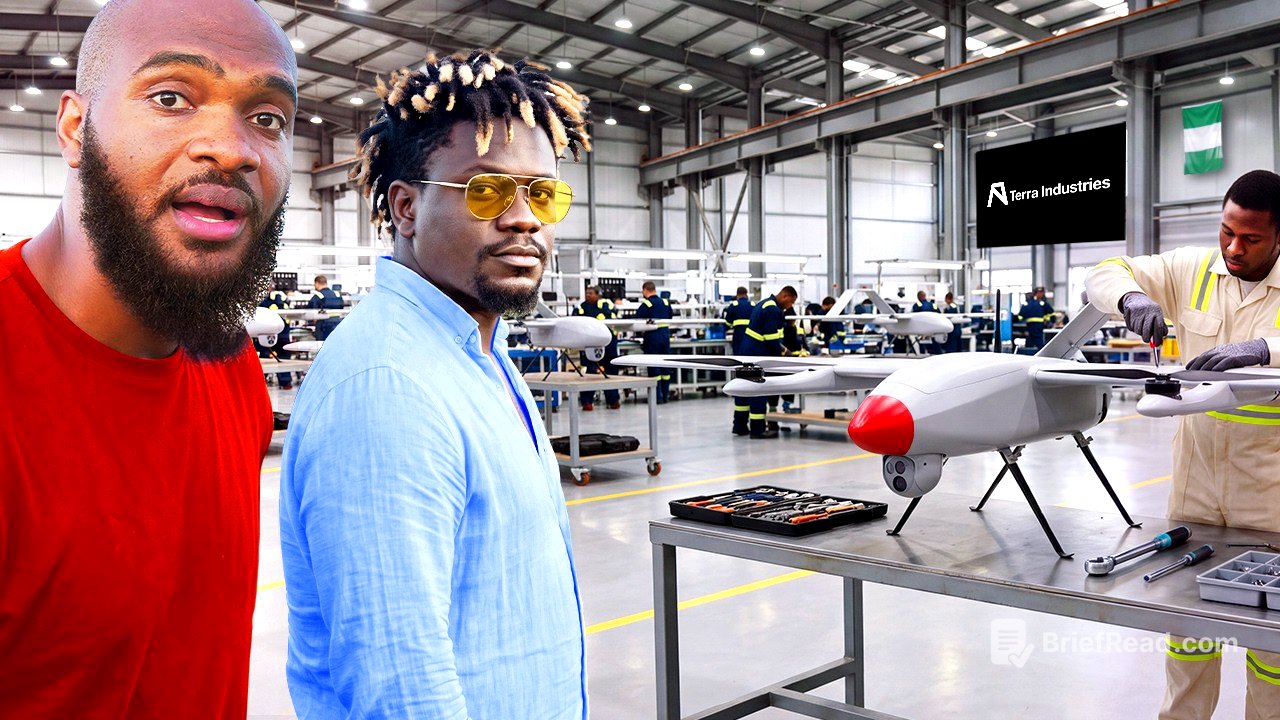
The video opens with a demonstration of a drone in flight before visiting Terra’s first production facility. The 15,000-square-foot site is the company’s smallest; it also has a 34,000-square-foot facility in Ghana and plans for more. Terra’s founder says that the company grew from discussions about robotics and engineering between him and his co-founder, whom he met on Twitter. They initially considered working on bionics, but Russia’s war in Ukraine led them to reassess the importance of defence technology.
Why security systems need to fit the Global South [3:35]
Terra’s founders questioned whether countries in the Global South could continue relying on foreign powers for security. The company’s founder distinguishes between conventional, state-on-state warfare, which he says is common in the West, and asymmetric conflict involving non-state groups such as terrorist organisations and cartels. In the Global South, he argues, security also needs to focus on protecting infrastructure and resources.
Imported systems may not suit local conditions. Extreme heat, dust and wind can cause equipment designed elsewhere to overheat or malfunction, while customers may wait months for replacement parts such as batteries. Terra’s goal is to create a defence company able to develop, maintain and adapt its products locally rather than depend on distant suppliers.
The founder’s upbringing and personal turning point [5:13]
The founder describes growing up in Port Harcourt in a single-parent household with his mother and sister. He rejects the idea that he is a “nepo baby”, saying his family lived simply, although his mother prioritised sending the children to good schools and encouraged them to take risks. He left school at 15 after an accident left him blind in his right eye.
The injury happened on his birthday when friends were throwing sandals and slippers at him. He raised a bucket to protect his face, but a sandal struck it and a broken piece penetrated his head, damaging his eye and leaving him briefly in a coma. He says he had been depressed and felt repeatedly unsuccessful before the accident, but waking up alive gave him a renewed sense of purpose and changed his outlook.
Ground vehicles and automated surveillance [9:35]
Terra’s Duma is an unmanned ground vehicle designed to detect improvised explosive devices (IEDs). A ground-penetrating radar (GPR) at the front can detect objects beneath the surface, reportedly up to 10 metres away; the system can also be used for mineral exploration. It has a range of around 10 kilometres, can operate on tracks or wheels, includes ballistic material and can carry up to 800 kilograms. Terra says its own turrets can also be mounted on it, allowing it to be remotely operated during tasks such as clearing a minefield.
The company also develops sentry towers fitted with AI-powered cameras. These stationary systems can observe areas from several kilometres away, with the cameras and software able to identify features such as faces and vehicle number plates. Connected towers can share identifying information, allowing other cameras in the area to recognise a person or vehicle. Terra began by selling to private infrastructure operators, such as mining and oil companies, whose shorter procurement processes helped the company build revenue and credibility.
Local manufacturing and practical engineering [14:34]
Terra says it manufactures around 70% of its products in-house, while importing sensors and advanced chips because Africa does not yet have an advanced semiconductor industry. Its production includes drone fuselages made through injection moulding, printed circuit boards (PCBs), electronic speed controllers (ESCs) and lithium-ion battery packs. The company does not yet make the individual battery cells, but its founder says it wants to integrate more of the supply chain over time, including potentially producing lithium batteries.
The factory uses 3D printers and computer numerical control (CNC) machines to make components, including parts for counter-drone systems. The founder describes this production model as important for scaling output and reducing dependence on foreign suppliers. Terra’s engineers are Nigerian, and its defence systems are developed with input from people who have field experience. The founder says the company values practical skills over formal qualifications: 45% of its workforce have no university degree, and many were recruited for hands-on engineering ability and trained on the job.
Raising $52 million and addressing questions of ownership [19:44]
Terra initially raised about $500,000 from African investors and had to bootstrap its operations. It later raised $52 million, which the video describes as the largest seed round in African history at the time. The founder says the capital is intended to help the company reach its next milestones, not to make him personally wealthy, and that Terra will need to raise substantially more to meet its ambitions.
The interviewer asks how the company can remain African when much of its funding comes from abroad. The founder says Terra needed investors with experience building large engineering and industrial businesses, since the company’s work combines manufacturing, commercial deployment, training and geopolitics. He says that he and co-founder Max retain control of the company. He also clarifies that Palantir is not a Terra investor or partner: one of Terra’s investors is 8VC, founded by Palantir co-founder Joe Lonsdale, but Terra has no formal relationship with Palantir.
The founder says the company secured major investment by showing proof of work rather than relying on a pitch deck. Terra had already built its factory, started limited production, developed products such as the Acha 1 and gained customers before raising the $52 million. He denies any affiliation with the CIA and attributes investor interest to both the global increase in defence spending and the commercial opportunity to supply security systems to regions building their own defence industries.
Testing Terra’s aircraft and its wider ambitions [27:39]
The team tests two aircraft on open ground about 40 minutes from Abuja: the Acher X, designed to remain airborne for up to 15 hours, and the Karma 19, built to intercept other drones. The Acher X’s long flight time is intended to support surveillance across large areas, including the Sahel. During the demonstration, the interviewer controls the camera while the aircraft flies autonomously, with automated software analysing and identifying potential threats.
Terra says that it wants to produce surveillance and intelligence, surveillance and reconnaissance (ISR) systems at industrial scale and at a fraction of the cost of traditional options. ISR has often been associated with expensive satellites and large budgets, but the company aims to make similar capabilities more accessible to governments and businesses in the Global South. The video concludes that manufacturing defence equipment is closely tied to national sovereignty: countries cannot be fully independent if others control whether their equipment is supplied or maintained. It leaves viewers with the question of how African-made weapons and surveillance systems will be governed and who will decide where they are used.