TLDR;
This presentation explores the complex figure of Frederick II, examining the difficulty in separating historical fact from legend. It analyses how his contemporaries and later historians contributed to his mythologisation, and considers his relationships with Islam and the Crusades. The talk highlights the conflicting contemporary views of Frederick, from being seen as the Antichrist to being admired as "Stupor Mundi" (the wonder of the world), and how these perceptions shaped his legacy.
- Explores the difficulty in separating historical fact from legend in the figure of Frederick II.
- Analyses how contemporaries and historians contributed to his mythologisation.
- Considers his relationships with Islam and the Crusades.
- Highlights conflicting contemporary views, from Antichrist to "Stupor Mundi".
Introduction: Honour and Aims [0:11]
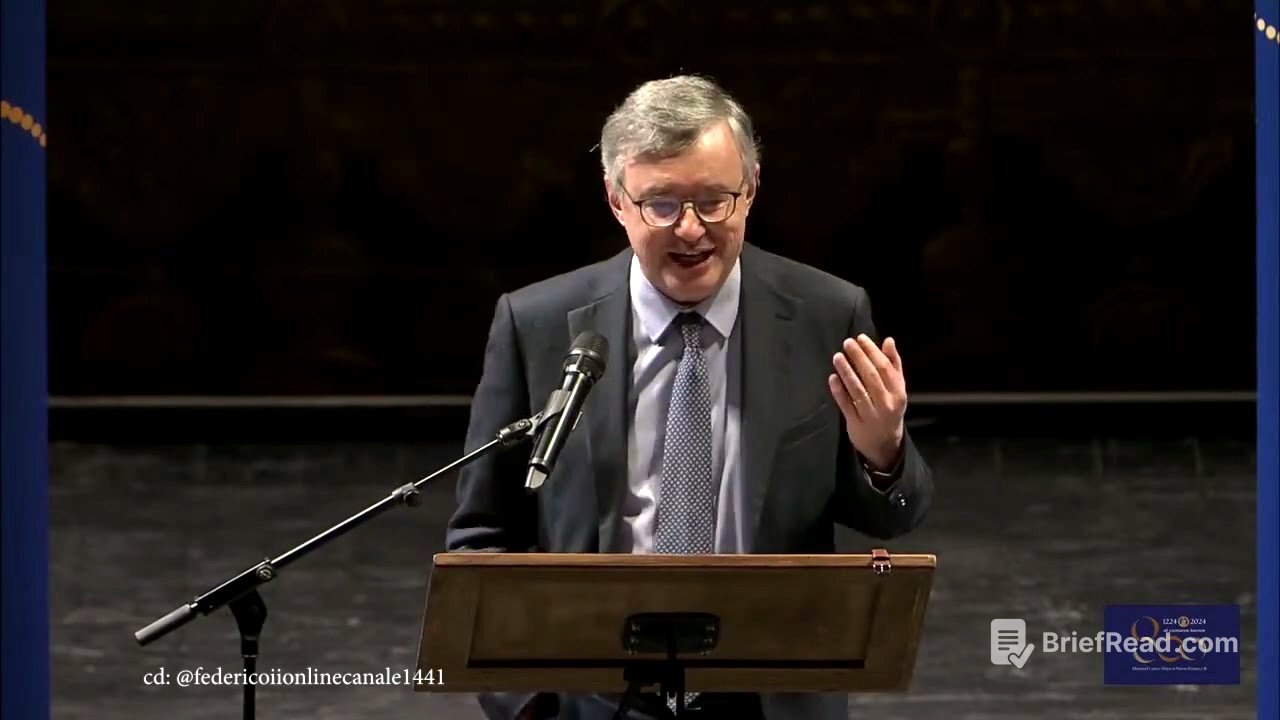
The speaker expresses his honour at presenting at the 800th-anniversary celebration of a distinguished university. He outlines the presentation's aim: to explore the blurred lines between the historical figure of Frederick II and the legends surrounding him. The speaker intends to demonstrate how even Frederick's contemporaries contributed to this myth, and how 20th-century historians further transformed him into a myth. Additionally, the presentation will touch on Frederick's relationship with Islam and the Crusades, aspects that continue to fascinate and contribute to his mystique.
Contemporary Perceptions: A Polarising Figure [1:50]
Pope Gregory IX described Frederick II as a "beast" from the sea, accusing him of considering Jesus an imposter and favouring Islam over Christianity. However, Frederick, born in Jesi, considered himself a devout Christian, even referring to Jesi as "my Bethlehem". He saw himself as persecuted by the popes, comparing his suffering to that of Christ. As a Christian emperor, Frederick enacted harsh laws against heretics, aligning religious and imperial authority, prescribing that heretics should be burned at the stake. The stark contrast between Frederick's self-image and the Pope's depiction highlights the propaganda battles surrounding him.
Historical Facts: The Making of an Emperor [6:31]
Frederick II was born in 1194 and died in 1250. He inherited the Norman Kingdom of Sicily from his mother, Constance d'Altavilla, and the Kingdom of Germany and Italy from his father, Henry VI of Swabia, making him a candidate for the imperial crown. However, papal consent was crucial for becoming emperor, a challenge that defined Frederick's political life. The speaker references Carlo Magno's coronation, highlighting the inherent tension between imperial and papal power. Frederick initially aligned with the papacy, with Pope Innocent III acting as his tutor and helping him secure the empire, leading to him being called "Puer Apuliae" (the boy from the South).
The Shifting Sands of Papal Relations [10:47]
The relationship between Frederick II and the papacy deteriorated as Frederick sought to assert his own authority. While Pope Innocent III initially supported him, later popes viewed Frederick with suspicion, even considering him the "beast of the Apocalypse". This conflict led to a division in how Frederick was perceived, with some admiring him and others viewing him with horror. Despite this, Frederick was called "Stupor Mundi" (the wonder of the world) by some, particularly the English chronicler Matthew Paris, who admired him as a ruler who changed the world.
Salimbene's Contradictory Views: A Glimpse into Medieval Perceptions [14:34]
Salimbene da Parma, a Franciscan friar, provides a complex view of Frederick II. While acknowledging the Church's condemnation of Frederick as a heretic and a corruptor of the earth, Salimbene also describes him as a man of value, pleasant, cheerful, and full of initiative. Salimbene admired Frederick's knowledge of languages and his potential, lamenting that his conflict with the Church led to his downfall. Salimbene, influenced by Joachim of Fiore's prophecies, initially suspected Frederick of being the Antichrist, especially during the emperor's conflicts with the Pope.
The Disappointment of 1250: Shifting Perspectives [21:56]
The year 1260, predicted by some Joachimites as the end of the world, passed without incident, but the real disappointment for Salimbene and others came in 1250 with Frederick II's death. This event shattered their belief that Frederick was the Antichrist, leading to a re-evaluation of his character. Salimbene, reflecting on Frederick's intellectual curiosity, acknowledges his extraordinary qualities. However, this curiosity also fuelled tales of bizarre experiments attributed to Frederick, such as attempting to discover the original language by raising children in isolation, which supposedly led to their deaths.
Historical Interpretations: Burckhardt and Kantorowicz [27:33]
The speaker transitions to discussing historical interpretations of Frederick II, noting how historians have contributed to his legend. Jacob Burckhardt, the historian who "invented" the Renaissance, saw Frederick as the first modern man emerging from the darkness of the Middle Ages. Ernst Kantorowicz, a 20th-century historian, presented Frederick as a German hero embodying Nietzsche's concept of the "superman". Kantorowicz, despite his own background as a German nationalist of Jewish heritage who was later exiled by the Nazis, portrayed Frederick as a distinctly German figure, even likening him to Mephistopheles.
Kantorowicz's Legacy and Modern Perspectives [34:12]
Kantorowicz's interpretation of Frederick II as a "superman" is now viewed critically. Modern historians recognise Frederick as a man of his time, operating within the context of 13th-century European politics. While Frederick was undoubtedly a significant figure who strengthened his power, created new institutions, and enacted laws, these actions were part of a broader trend among European rulers. His legal code, the Constitutions of Melfi, and his founding of the University of Naples, were exceptional but not entirely unique.
Frederick and Islam: Tolerance and Contradictions [37:08]
Frederick II is often portrayed as a ruler of great tolerance who governed a multi-ethnic empire and engaged in dialogue with Muslims. While Palermo, the capital of his kingdom, had a significant Arab influence under his predecessors, this influence had diminished by Frederick's time. Although Frederick spoke Arabic and employed Arab scholars, the extent of his tolerance is debated. Jacob ben Abba Mari, a Jewish scholar, dedicated translations to Frederick and expressed hope for the Messiah's arrival during his reign.
Scientific Curiosity and Muslim Contacts [39:43]
Frederick II surrounded himself with scientists like Michael Scot, who had studied Arab culture in Toledo. He also maintained diplomatic relations with Muslim rulers, seeking their scholars' insights on scientific and philosophical questions. However, some historians, like David Abulafia, argue that Frederick's scientific interests were superficial. Ibn Sabin, a Muslim scholar from Morocco, criticised Frederick's philosophical inquiries as showing "weakness of instruction".
The Reality of Arab-Christian Relations in Sicily [45:35]
Frederick's relationship with the Arabs in Sicily was complex and contradictory. Despite his efforts to ensure equal justice for all subjects, including Muslims and Jews, the Arab population faced discrimination and rebellion. Many Arabs retreated to the mountains, leading to a state of endemic rebellion. Frederick responded with harsh measures, relocating the Arab population from Sicily to Lucera in Puglia, creating a Muslim colony. He then repopulated Sicily with immigrants from Northern Italy, including the ancestors of Corleone.
The Lucera Colony: A Haven or a Ghetto? [51:06]
The Saracen colony of Lucera in Puglia became a significant settlement with mosques and a distinct Muslim identity. These warriors accompanied Frederick in his campaigns. While some view Lucera as an example of enlightenment, others see it as a form of oriental despotism. The Pope viewed Frederick's fondness for Lucera with suspicion, suggesting he maintained a harem there.
Frederick and the Crusades: Diplomacy and Discontent [52:58]
Frederick II's involvement in the Crusades is another area where history and legend intertwine. Despite committing to the Crusades, Frederick's actions were met with suspicion by the Pope, who excommunicated him. Frederick negotiated with the Sultan of Egypt, al-Kamil, exchanging gifts and discussing political matters. Despite being excommunicated, Frederick eventually secured Jerusalem for the Christians through diplomacy, although he was unable to participate in religious ceremonies there.
The Treaty of Jerusalem: A Diplomatic Triumph or a Sacrilege? [58:41]
Frederick II's diplomatic efforts resulted in a treaty that returned Jerusalem to Christian control, while maintaining Muslim control over the Temple Mount. However, the Patriarch of Jerusalem criticised Frederick for not engaging in violence and for his friendly relations with the Muslims. The Pope, viewing Frederick's actions as sacrilegious, placed Jerusalem under interdict, forbidding Christian worship. Despite the criticism, Frederick and al-Kamil remained friends, and Muslim chroniclers portrayed Frederick favourably.
Muslim Perspectives and the Enduring Enigma [1:01:50]
Muslim chroniclers viewed Frederick II as a great friend of Islam, emphasizing his Sicilian heritage and the presence of Muslims at his court. They claimed that Frederick privately expressed his lack of interest in the Crusades and only participated due to his imperial obligations. An anecdote recounts how Frederick insisted on the restoration of the muezzin's call to prayer in Jerusalem, demonstrating his respect for Muslim customs. The presentation concludes by highlighting the difficulty of separating fact from legend in Frederick II's story. Even legends, when believed, become historical facts, shaping perceptions and contributing to the enduring myth of Frederick II.