TLDR;
This video provides an overview of the Chicano movement, focusing on a desegregation case in Sacramento and the broader historical context of anti-Mexican racism and resistance to integration. It explores the concept of self-determination within the movement, highlighting the parents' opposition to busing and their desire for equitable resources and culturally relevant education.
- The Chicano movement emerged as a political and cultural renaissance in the 1960s and 70s, unifying various community efforts.
- Resistance to desegregation was rooted in the desire for community control, cultural preservation, and equitable resources rather than mere proximity to white students.
- The concept of self-determination was central to the Chicano movement, with communities seeking to define their own educational and cultural paths.
Introduction [0:02]
The instructor welcomes everyone to week 11, noting that there was no video for week 10 due to the Google Vids assignment, which is still open for a one-week grace period. The Google Vids assignment involves creating visuals for testimonials by incorporating personal photos, family pictures, and relevant imagery. The voice-over component will be addressed soon, but students are encouraged to experiment with the Google Vids tools and voice recording features. This week's focus is on the Chicano movement, which is the origin of the course title, "Chuco Studies." The lecture will specifically examine a desegregation case in Sacramento.
Setting the Stage: Washington Elementary Case [1:52]
The video sets the stage for an article discussing a desegregation case at Washington Elementary in Sacramento in 1968. The school was predominantly Mexican and located in the Washington Barrio. In the late 1960s, the school board voted to close Washington Elementary as part of integration efforts following Brown versus Board of Education. The plan was to bus students to a white majority school about 12 miles away. However, 97% of the parents at Washington Elementary voted against this desegregation effort.
Historical Context: Anti-Mexican Racism [4:13]
The video provides a historical backdrop of anti-Mexican racism in the United States, starting with the Treaty of Guadalupe Hidalgo in 1848, which ended the Mexican-American War. American settlers and courts often did not recognize the treaty, leading to a land grab of Mexican-owned land. There were also deportation efforts similar to modern ICE raids during the Great Depression, where both Mexican and Mexican-American citizens were deported. The Bracero program from the 1940s to the 1960s exploited Mexican laborers, who faced poor living conditions and discrimination. Segregation was also prevalent, with the creation of Mexican schools and racist violence. Landmark cases like the Lemon Grove incident in 1931 and Mendes versus Westminster in California challenged segregation, preceding the Brown versus Board of Education decision.
The Chicano Movement: A Political and Cultural Renaissance [7:19]
The Chicano movement emerged in the 1960s and 70s as a political and cultural renaissance, consolidating various community efforts. Before this movement, incidents were happening in silos at the community level. The Chicano movement was a nationalist movement that brought people together, holding nationwide conferences to unify local efforts. Sacramento was deeply involved in this movement. The Brown versus Board of Education decision in 1954 legally ended segregation, but real integration efforts didn't occur until the 1960s and 70s.
Resistance to Brown vs. Board of Education [8:55]
Despite the Supreme Court's ruling, there was significant resistance to Brown versus Board of Education, particularly from white parents who formed the anti-busing movement. They advocated for neighborhood schools to maintain segregation, leading to white flight to the suburbs and the creation of segregated communities. Legal equality did not undo social and economic racism. In Sacramento, redlining from the 1930s to the 1960s, which involved discriminatory lending practices, further segregated neighborhoods. From 1954 to 1968, 19 of 20 new schools were built outside city limits for white suburban families, protecting white property values but not equity.
Key Events and Philosophies of the Chicano Movement [12:31]
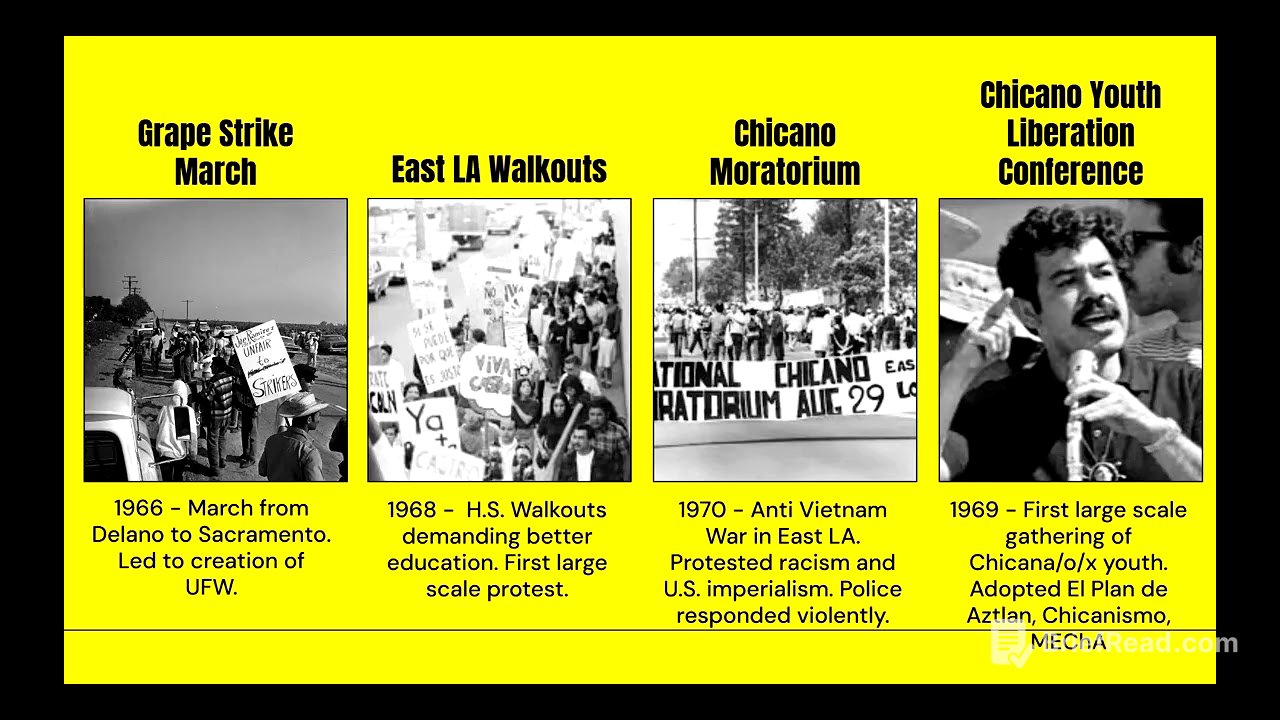
The Chicano movement involved key events such as the grape strike, the march from Delano to Sacramento, and the East LA walkouts, where high school students demanded better education and protested against being punished for speaking Spanish. Chicanos were disproportionately drafted into the Vietnam War, leading to protests. Conferences like the Chicano Youth Liberation Conference aimed to unify these efforts. The movement was inspired by the Black Power struggle and sought to liberate ethnic Mexicans from racism, poverty, and political powerlessness, emphasizing self-determination.
Self-Determination and the Parents' Resistance [14:43]
The concept of self-determination was central to the Chicano movement but was also used by the parents of Washington Elementary to resist busing. They rejected the idea that Mexican children would improve simply by being near white students, highlighting the misconception that integration solely meant physical proximity. The real goal of integration was to provide black and brown children with the same resources as white students. The parents believed that desegregation reinforced racial hierarchies and assimilation rather than justice. They saw their neighborhood school as the safest and most convenient option, valuing bilingual instruction and cultural programs that reflected their lives.
Community Control and Cultural Preservation [17:33]
The parents at Washington Elementary valued community control and parent involvement in their neighborhood school. They feared that busing would lead to the loss of their language, culture, and safety, viewing it as an assimilationist tactic. They saw their neighborhood as a center of family and community, not a problem to fix. They questioned why their school had to close and why white students were not being bused to their school instead. While outside voices described the barrio as poor, residents saw it as a source of strength and care. Their demand was not separation but funding and respect to strengthen their community. Self-determination meant deciding for themselves what education should look like, emphasizing bilingual instruction and cultural relevance.
Additional Resources and Assignments [20:48]
The instructor provides links to videos about student protests that fueled the Chicano rights movement, focusing on the East LA walkouts. The video also mentions the creation of the United Farm Workers (UFW) and the recent allegations of abuse against Cesar Chavez, which have led to community discussions and the removal of monuments. For week 11, students have a knowledge check-in quiz covering the material from past weeks after spring break.