TLDR;
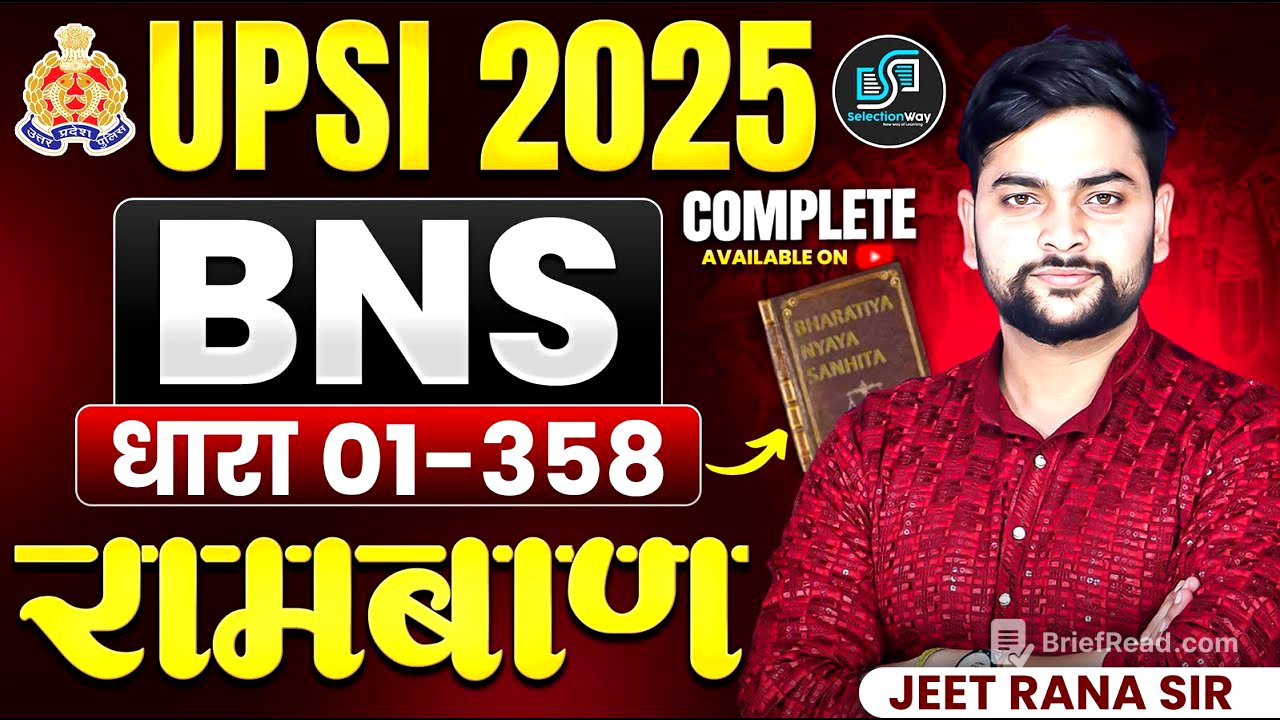
This YouTube video transcript provides a comprehensive overview of the Bharatiya Nyaya Sanhita (BNS), the new criminal code in India, intended to replace the Indian Penal Code (IPC). It explains the key changes, definitions, and provisions within the BNS, comparing it with the older IPC and highlighting new additions. The video also covers various offences, their classifications, and corresponding punishments under the BNS, with a focus on offences against women, children, and the state.
- Introduction to Bharatiya Nyaya Sanhita (BNS)
- Key definitions and changes from IPC
- Offences and punishments under BNS
- Special provisions for women and children
- Offences against the state and public order
Introduction to BNS and its Significance [0:00]
The video introduces the Bharatiya Nyaya Sanhita (BNS) as a crucial topic for the Uttar Pradesh Sub Inspector recruitment exam, highlighting its importance not only for the exam but also for practical application in law enforcement. It emphasises the need to understand the BNS to assert one's rights and maintain authority both before and after selection. The BNS is presented as a comprehensive resource, covering all sections from 1 to 358, and is described as essential for exam preparation.
Overview of the Syllabus and Key Areas [2:27]
The discussion broadens to cover the entire syllabus for the Uttar Pradesh Sub Inspector exam, including the Bharatiya Nagarik Suraksha Sanhita (BNSS) and minor acts. The speaker explains that 50 marks out of the total 100 are allocated to the BNS and the Constitution. He directs viewers to a playlist on the channel for acts related to women, children, and scheduled castes, promising to cover the remaining General Studies topics on YouTube.
Defining 'Substantive Law' (मूल विधि) and its Importance [5:39]
The video defines 'Substantive Law' (मूल विधि) as the collection of laws necessary to uphold the rights and duties granted by the Indian Constitution. It uses Article 21, the right to life, as an example, explaining how the BNS provides articles to protect this right against actions like assault or abduction. The definition is also provided in English, emphasising that it is a collection of acts and laws that enhance administration and law and order within a state.
Expansion and Changes in the BNS Syllabus [9:06]
The discussion moves to the expansion of the syllabus, noting the changes from the old syllabus, which included the IPC and the Criminal Procedure Code (CrPC), to the new syllabus featuring the BNS and BNSS. The speaker clarifies that 'minor acts' refer to other relevant legislations. He explains that these changes were implemented after 1 July 2024, and defines a sub-inspector's role as a station in-charge responsible for registering complaints and maintaining law and order.
Historical Background of Law Formation in India [12:12]
The video provides a historical context, starting with the first Law Commission in India in 1834 during the British era. The commission's primary function was to maintain law and order by creating and enforcing acts. Although the commission could create laws, it could not introduce new laws independently, as this power rested with the British legislature. The first chairman of the Law Commission was Thomas Babington Macaulay (TB Macaulay), who announced the Indian Penal Code (IPC) in 1860.
Implementation and Replacement of the IPC by the BNS [15:51]
The discussion continues with the announcement of the IPC in 1860 by TB Macaulay, noting that it was not implemented until 1 January 1862, due to the absence of established courts. The video highlights that the IPC is no longer in effect and has been replaced by the BNS, with the next page providing further details on the BNS.
Enactment and Implementation of the BNS [19:03]
The video details the enactment of the BNS, which was presented in the Lok Sabha on 11 August 2023, by Home Minister Amit Shah, with the aim of introducing legal reforms and updated laws. The BNS was passed by both houses on 21 December 2023, and received presidential approval on 25 December 2023. It was officially implemented on 1 July 2024, replacing the IPC of 1860, the CrPC of 1973, and the Indian Evidence Act of 1872.
Key Changes: Sections and Chapters in IPC vs. BNS [26:14]
The video compares the structure of the IPC and the BNS, noting that the IPC 1860 had 23 chapters and 511 sections, while the BNS 2023 has 20 chapters and 358 sections. The reduction in the number of sections is attributed to the resettlement of some sections and the introduction of new offences.
New Provisions Added in the BNS [32:10]
The video outlines several new provisions added in the BNS, including the definition of a 'child' (बालक) as anyone below 18 years of age, the recognition of digital records as evidence, and the inclusion of transgender individuals in the definition of gender. It also introduces Section 48, which addresses abetment of crime outside India, and Section 69, which deals with sexual relations based on false promises, punishable with up to 10 years of imprisonment.
Additional New Sections in BNS: Offences and Punishments [42:17]
The video continues to detail new sections in the BNS, including Section 73, which prohibits publishing court proceedings without permission, and Section 353, which addresses spreading false rumours, punishable with up to 3 years of imprisonment. It also covers Section 77, which criminalises voyeurism against both women and men, and Section 95, which addresses the hiring of children for criminal activities.
Further New Sections in BNS: Crimes and Definitions [51:39]
The video details additional new sections in the BNS, including Section 86 on cruelty, Section 103 on death by mob, and Section 106 which addresses causing death by negligence on the road, with penalties up to 10 years. It also covers Sections 111, 112, and 113, which define organised crime, small organised crime, and terrorist organised crime, respectively.
More New Sections in BNS: Injury and Kidnapping [1:00:52]
The video continues with new sections in the BNS, including Section 117 on grievous hurt leading to permanent disability, and Section 137 on child abduction, which now applies equally to males and females under 18. It also covers Section 152 on threatening the unity and integrity of the country, and Section 195(2) on threats to public servants preventing public disorder.
Final New Sections in BNS: Public Order and Property [1:10:36]
The video details the final new sections in the BNS, including Section 304 on snatching, Section 197D on spreading false news to disrupt national unity, and Section 324(3) on harming government property. It also covers Section 341(3) on forging government stamps and Section 341(4) on the misuse of government seals, concluding with Section 358, which formally repeals the IPC of 1860.
Chapter 1 of BNS: Preliminary Information [1:19:25]
The video begins a section-by-section analysis of the BNS, starting with Chapter 1, which includes Sections 1 to 3. Section 1 covers the short title, extent, and commencement of the BNS, noting that it is called the Bharatiya Nyaya Sanhita 2023 and came into effect on 1 July 2024, during the 74th year of the Republic of India. It applies to all Indian territories, including जल, थल, वायु (water, land, and air), and is applicable to both Indian citizens and foreigners within Indian boundaries.
Scope and Limitations of BNS Application [1:22:33]
The video explains the scope and limitations of the BNS, noting that it applies to Indian citizens whether they are in India or abroad, and to offences committed on Indian ships or aircraft. However, it does not apply to armed forces personnel or constitutional post holders like the President and Governors, who are covered by separate laws and articles such as Article 361.
BNS Section 2: Definitions - Act, Animals, and Counterfeit [1:41:38]
The video begins a detailed review of Section 2 of the BNS, which provides definitions for key terms. It defines 'Act' as both a single action and a series of actions, and 'Animals' as any living creature other than humans. It also defines 'Counterfeit' as creating something that resembles another item with the intention to deceive, providing the example of a fake watch.
BNS Section 2: Definitions - Child, Court, and Death [1:47:03]
The video continues its review of Section 2 of the BNS, defining 'Child' as any person under the age of 18, regardless of gender. It defines 'Court' as any body that conserves or interprets the law, and 'Death' as the death of a human being.
BNS Section 2: Definitions - Dishonesty and Documents [1:55:21]
The video continues its review of Section 2 of the BNS, defining 'Dishonesty' as any action that causes wrongful gain or loss, and noting that this definition was previously found in IPC Section 24. It also defines 'Documents' as any record containing letters, symbols, or marks that can be used as evidence, including digital records, referencing the Shyamacharan case of 1961 and the Boraiya case of 1984.
BNS Section 2: Definitions - Gender, Good Faith, and Government [2:08:19]
The video continues its review of Section 2 of the BNS, defining 'Gender' to include male, female, and transgender individuals, and 'Good Faith' as any action done with due care and caution for the benefit of others. It also defines 'Appropriate Government' as either the central or state government, depending on the context.
BNS Section 2: Definitions - Harbour, Injury, and Illegality [2:13:35]
The video continues its review of Section 2 of the BNS, defining 'Harbour' as providing shelter, food, or assistance to someone, and 'Injury' as any harm caused to a person's body, mind, reputation, or property. It also defines 'Illegal' as anything that is against the law, prohibited, or grounds for civil action.
BNS Section 2: Definitions - Judge, Life, and Local Law [2:18:14]
The video continues its review of Section 2 of the BNS, defining 'Judge' as the decision-making authority in a court, 'Life' as human life, and 'Local Law' as any law applicable only in a specific area within India.
BNS Section 2: Definitions - Man, Month, and Movable Property [2:23:15]
The video continues its review of Section 2 of the BNS, defining 'Man' to include any male person, 'Month' and 'Year' as per the Gregorian calendar, and 'Movable Property' as any property that can be moved, excluding land and anything permanently attached to it.
BNS Section 2: Definitions - Number, Oath, and Offence [2:24:48]
The video continues its review of Section 2 of the BNS, defining 'Number' as singular or plural, 'Oath' as a declaration made before assuming a position, and 'Offence' as any act that violates the BNS, with exceptions outlined in Part 3.
BNS Section 3: Definition of Offences and Exceptions [2:53:47]
The video begins a discussion of Section 3 of the BNS, which defines offences and their exceptions. It explains that each section of the BNS defines a specific offence and that Part 3 of the BNS outlines exceptions to these offences. It also notes that once a term is defined within the BNS, that definition applies throughout the entire code.
BNS Section 3: Property Possession and Illegal Omission [2:59:16]
The video continues its discussion of Section 3 of the BNS, defining 'Possession of Property' and explaining that it does not necessarily imply ownership. It also defines 'Illegal Omission' as the failure to perform an act that one is legally obligated to do.
BNS Section 3: Common Intention and Criminal Knowledge [32:08]
The video continues its discussion of Section 3 of the BNS, defining 'Common Intention' and explaining that if a crime is committed with a shared intention, all involved are equally guilty. It also defines 'Criminal Knowledge' and explains that if a crime requires specific knowledge, all individuals with that knowledge are equally liable.
BNS Section 3: Provisions and Exceptions [46:47]
The video continues its discussion of Section 3 of the BNS, explaining that providing shelter to someone is a crime, and outlining exceptions to the BNS, such as actions performed under legal obligation or by individuals with unsound minds.
BNS Section 3: Exceptions to the Law [1:32:03]
The video continues its discussion of Section 3 of the BNS, outlining exceptions to the law, such as actions taken in self-defence, actions by judges performing their duties, and actions taken under the orders of a public servant.
BNS Section 4: Types of Punishments [3:15:18]
The video begins a discussion of Section 4 of the BNS, which outlines the types of punishments that can be imposed under the code, including the death penalty, life imprisonment, imprisonment, forfeiture of property, fines, and community service.
BNS Section 5: Alteration of Punishment Form [3:21:39]
The video discusses Section 5 of the BNS, which allows the appropriate government (either central or state) to alter the form of punishment, and notes that the President or Governor can also do so under Articles 72 and 161, respectively.
BNS Section 6: Calculation of Life Imprisonment [3:24:26]
The video discusses Section 6 of the BNS, which specifies that life imprisonment is generally calculated as 20 years, unless explicitly stated otherwise, such as in cases of rape or murder where it is specified as "absolute life imprisonment."
BNS Section 7: Determination of Punishment Form [3:26:39]
The video discusses Section 7 of the BNS, which states that the form of punishment is determined by the court, which decides whether the imprisonment will be rigorous or simple, and sets the minimum and maximum terms.
BNS Section 8: Fine and its Recovery [3:29:05]
The video discusses Section 8 of the BNS, which addresses fines and their recovery. It states that if a fine is not specified, it should not be excessive. If a person fails to pay a fine, they may be subject to imprisonment for a term not exceeding one-fourth of the maximum imprisonment term. If the fine is not paid at all, the individual may face imprisonment or community service.
BNS Section 9: Punishment for Act or Series of Acts [3:43:44]
The video discusses Section 9 of the BNS, which states that the punishment for an act or series of acts will be the same as the punishment for a single act.
BNS Section 10: Punishment in Case of Doubt [3:46:40]
The video discusses Section 10 of the BNS, which states that in cases of doubt regarding the appropriate punishment, the minimum punishment will be applied.
BNS Section 11: Solitary Confinement [3:49:53]
The video discusses Section 11 of the BNS, which addresses solitary confinement. It explains that solitary confinement is only applicable with rigorous imprisonment and that the maximum duration of solitary confinement depends on the length of the sentence. For a sentence of six months, the maximum solitary confinement is one month; for a sentence between six months and one year, it is two months; and for a sentence of more than one year, it is three months.
BNS Section 12: Procedure for Solitary Confinement [3:54:05]
The video discusses Section 12 of the BNS, which outlines the procedure for imposing solitary confinement. It specifies that solitary confinement cannot exceed 14 days at a time and is only applicable when the sentence is more than three months. If the sentence is less than three months, the maximum solitary confinement is seven days.
BNS Section 13: Punishment for Subsequent Offences [3:56:40]
The video discusses Section 13 of the BNS, which addresses punishment for subsequent offences. It states that if an individual commits an offence under Part 10 or Part 17 of the BNS and the sentence is more than three years, a subsequent conviction will result in a sentence of at least 10 years or life imprisonment. Part 10 deals with offences related to counterfeit currency, and Part 17 deals with offences against public order.
BNS Section 14: Act Done by a Person Bound by Law [4:02:56]
The video discusses Section 14 of the BNS, which states that an act done by a person bound by law or due to a mistake of fact is not an offence.
BNS Section 15: Act of Judge When Acting Judicially [4:06:09]
The video discusses Section 15 of the BNS, which states that an act done by a judge in the exercise of their duties is not an offence, provided it is done in good faith.
BNS Section 16: Act Caused by Accident [4:08:41]
The video discusses Section 16 of the BNS, which states that an act caused by accident while performing a lawful act in a lawful manner is not an offence.
BNS Section 17: Act Likely to Cause Harm [4:11:33]
The video discusses Section 17 of the BNS, which states that an act likely to cause harm is not an offence if it is done without criminal intent and to prevent greater harm.
BNS Section 101: Death by Mob [52:58]
The video discusses Section 101 of the BNS, which addresses death by mob. It defines a mob as a group of five or more persons and states that if a mob commits murder, the punishment can be either the death penalty or life imprisonment.
BNS Section 106: Causing Death by Negligence [54:30]
The video discusses Section 106 of the BNS, which addresses causing death by negligence. It states that if a person causes death by negligence while driving, the punishment can be up to five years of imprisonment. It also notes that Section 106(2), which deals with hit-and-run cases, was not initially implemented but was later added.
BNS Sections 111, 112, 113: Organised Crime [58:02]
The video discusses Sections 111, 112, and 113 of the BNS, which address organised crime. It defines organised crime as a crime committed by a group of people with a plan, and notes that the punishment for organised crime is more severe than for unplanned crime. It also covers small organised crime and terrorist organised crime.
BNS Section 117: Grievous Hurt [1:00:54]
The video discusses Section 117 of the BNS, which addresses grievous hurt. It defines grievous hurt as any injury that causes permanent disability and notes that the punishment for grievous hurt caused by a mob is more severe.
BNS Section 137: Child Abduction [1:03:35]
The video discusses Section 137 of the BNS, which addresses child abduction. It notes that the definition of a child has been updated to include anyone under the age of 18, regardless of gender.
BNS Sections 152 and 195(2): Offences Against the State [1:06:12]
The video discusses Section 152 of the BNS, which addresses acts that threaten the unity and integrity of the country, and Section 195(2), which addresses threats against public servants attempting to prevent public disorder.
BNS Section 304: Snatching [1:10:54]
The video discusses Section 304 of the BNS, which addresses snatching. It notes that snatching was previously treated as a case of theft, but is now a separate offence under the BNS.
BNS Section 197D: Spreading False News [1:12:06]
The video discusses Section 197D of the BNS, which addresses spreading false news that can harm the unity and integrity of the nation.
BNS Section 324(3): Harm to Public Property [1:13:35]
The video discusses Section 324(3) of the BNS, which addresses harm to public property.
BNS Section 341(3) and (4): Forgery [1:15:06]
The video discusses Section 341(3) and (4) of the BNS, which address forgery.
BNS Section 358: Repeal of IPC [1:16:59]
The video discusses Section 358 of the BNS, which formally repeals the IPC of 1860.
BNS Section 2: Definitions - Act and Animals [1:42:33]
The video discusses Section 2 of the BNS, which defines 'Act' as both a single action and a series of actions, and 'Animals' as any living creature other than humans.
BNS Section 2: Definitions - Counterfeit and Child [1:47:27]
The video discusses Section 2 of the BNS, which defines 'Counterfeit' as creating something that resembles another item with the intention to deceive, and 'Child' as any person under the age of 18.
BNS Section 2: Definitions - Court and Death [1:52:58]
The video discusses Section 2 of the BNS, defining 'Court' as any body that conserves or interprets the law, and 'Death' as the death of a human being.
BNS Section 2: Definitions - Dishonesty [1:56:02]
The video discusses Section 2 of the BNS, defining 'Dishonesty' as any action that causes wrongful gain or loss.
BNS Section 2: Definitions - Documents [1:59:30]
The video discusses Section 2 of the BNS, defining 'Documents' as any record containing letters, symbols, or marks that can be used as evidence, including digital records.
BNS Section 2: Definitions - Gender and Good Faith [2:08:19]
The video discusses Section 2 of the BNS, defining 'Gender' to include male, female, and transgender individuals, and 'Good Faith' as any action done with due care and caution for the benefit of others.
BNS Section 2: Definitions - Harbour and Injury [2:13:18]
The video discusses Section 2 of the BNS, defining 'Harbour' as providing shelter, food, or assistance to someone, and 'Injury' as any harm caused to a person's body, mind, reputation, or property.
BNS Section 2: Definitions - Illegality [2:17:31]
The video discusses Section 2 of the BNS, defining 'Illegal' as anything that is against the law, prohibited, or grounds for civil action.
BNS Section 2: Definitions - Judge and Life [2:19:59]
The video discusses Section 2 of the BNS, defining 'Judge' as the decision-making authority in a court, and 'Life' as human life.
BNS Section 2: Definitions - Local Law [2:21:35]
The video discusses Section 2 of the BNS, defining 'Local Law' as any law applicable only in a specific area within India.
BNS Section 2: Definitions - Man and Month [2:23:15]
The video discusses Section 2 of the BNS, defining 'Man' to include any male person, and 'Month' and 'Year' as per the Gregorian calendar.
BNS Section 2: Definitions - Movable Property [2:23:59]
The video discusses Section 2 of the BNS, defining 'Movable Property' as any property that can be moved, such as cars, pouches, and gold.
BNS Section 2: Definitions - Number and Oath [2:24:48]
The video discusses Section 2 of the BNS, defining 'Number' as singular or plural, and 'Oath' as a declaration made before assuming a position.
BNS Section 2: Definitions - Offence [2:26:35]
The video discusses Section 2 of the BNS, defining 'Offence' as any act that violates the BNS, with exceptions outlined in Part 3.
BNS Chapter 2: Punishments - Sections 4, 5, and 6 [3:15:18]
The video begins a discussion of Chapter 2 of the BNS, which covers punishments. It discusses Section 4, which outlines the types of punishments that can be imposed, including the death penalty, life imprisonment, imprisonment, forfeiture of property, fines, and community service. It also discusses Section 5, which allows the appropriate government to alter the form of punishment, and Section 6, which specifies that life imprisonment is generally calculated as 20 years.
BNS Chapter 2: Punishments - Sections 7 and 8 [3:26:39]
The video continues its discussion of Chapter 2 of the BNS, discussing Section 7, which states that the form of punishment is determined by the court, and Section 8, which addresses fines and their recovery. It notes that if a fine is not specified, it should not be excessive, and that if a person fails to pay a fine, they may be subject to imprisonment or community service.
BNS Chapter 2: Punishments - Sections 9, 10, and 11 [3:43:44]
The video continues its discussion of Chapter 2 of the BNS, discussing Section 9, which states that the punishment for an act or series of acts will be the same as the punishment for a single act, Section 10, which states that in cases of doubt regarding the appropriate punishment, the minimum punishment will be applied, and Section 11, which addresses solitary confinement.
BNS Chapter 2: Punishments - Section 12 [3:54:05]
The video discusses Section 12 of the BNS, which outlines the procedure for imposing solitary confinement. It specifies that solitary confinement cannot exceed 14 days at a time and is only applicable when the sentence is more than three months. If the sentence is less than three months, the maximum solitary confinement is seven days.
BNS Chapter 2: Punishments - Section 13 [3:56:34]
The video discusses Section 13 of the BNS, which addresses punishment for subsequent offences. It states that if an individual commits an offence under Part 10 or Part 17 of the BNS and the sentence is more than three years, a subsequent conviction will result in a sentence of at least 10 years or life imprisonment.
BNS Chapter 3: General Exceptions - Section 14 [4:02:56]
The video discusses Section 14 of the BNS, which states that an act done by a person bound by law or due to a mistake of fact is not an offence.
BNS Chapter 3: General Exceptions - Section 15 [4:06:09]
The video discusses Section 15 of the BNS, which states that an act done by a judge in the exercise of their duties is not an offence, provided it is done in good faith.
BNS Chapter 3: General Exceptions - Section 16 [4:08:41]
The video discusses Section 16 of the BNS, which states that an act caused by accident while performing a lawful