TLDR;
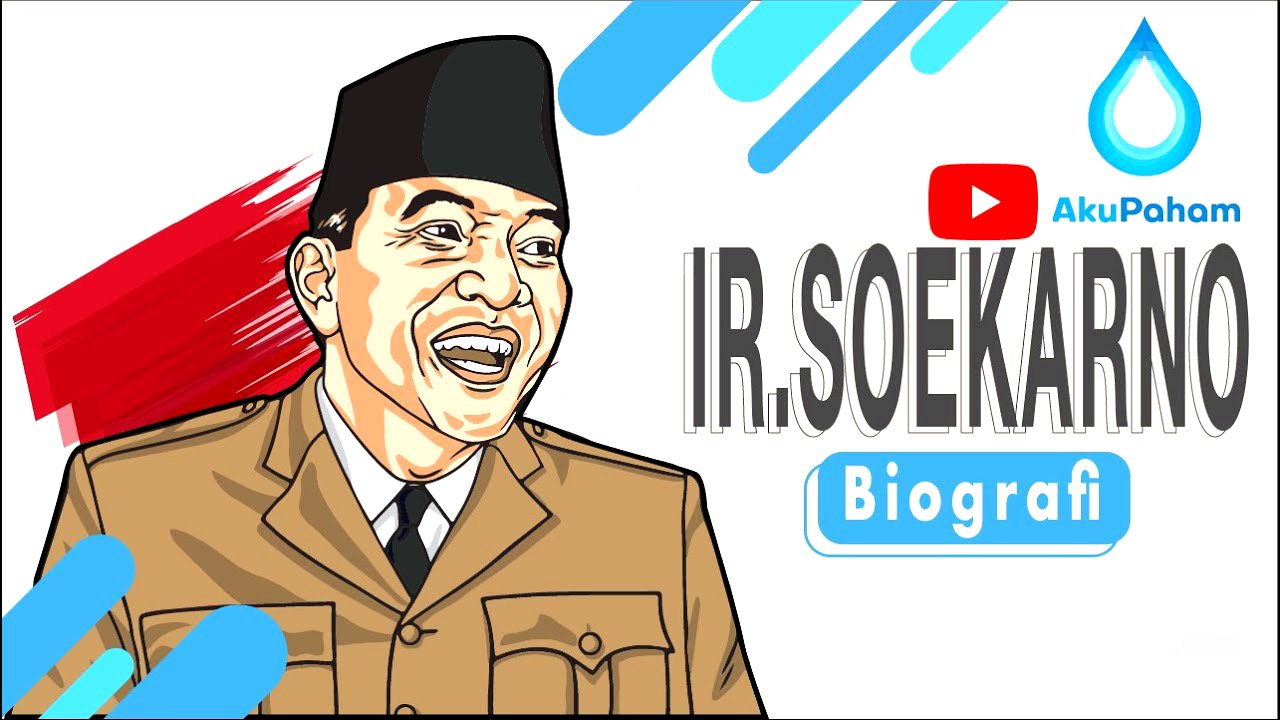
This video recounts the life and struggle of Indonesia's first president, Soekarno, from his impoverished childhood to his pivotal role in achieving Indonesian independence. It highlights his education, political activism, imprisonment, and eventual leadership, as well as key events during his presidency and his eventual downfall.
- Early life and education shaped his nationalist ideals.
- Soekarno's political activism led to imprisonment and exile.
- He played a crucial role in Indonesia's independence and early presidency.
Early Life and Education [0:44]
Soekarno, originally named Kusno Sostro di Harjo, was born on 6 June 1901, in Surabaya. He was nicknamed "Putra Sang Fajar" (Son of Dawn) due to his birth at sunrise. Growing up in poverty, his family often subsisted on cassava and ground corn. At 11, he suffered from typhoid, dysentery, and malaria, leading his parents to rename him Soekarno, believing it would improve his health. In 1915, at 14, he attended a Dutch school, HBS, in Surabaya, where he was the only native Indonesian student. While in Surabaya, Soekarno lived with Hose Cokro Aminoto, a friend of his father and leader of the Islamic Union Party, where he was exposed to Indonesian independence movements, fostering his nationalism.
Political Awakening and Activism [2:22]
In 1921, at the age of 20, Soekarno began studying at THS (now ITB), graduating five years later as a civil engineer. In 1927, he formulated the Marhaenism doctrine, an ideology combining socio-nationalism, socio-democracy, and belief in one God. He also founded the PNI (Indonesian National Party) with the goal of Indonesian independence. At 28, in 1929, he was arrested and imprisoned for the first time in Bancai, Bandung. The following year, he was moved to Sukamiskin Prison in Bandung, where he wrote his famous defence plea, "Indonesia Accuses".
Imprisonment, Exile, and Return [3:33]
In 1931, at 30, Soekarno was released from prison and resumed advocating for Indonesian independence. A year later, he joined the Partindo party. However, in 1934, he was re-imprisoned and exiled to Ende, Flores. After four years, in 1938, he was transferred to Bengkulu. He was finally released in 1942, coinciding with the Japanese occupation of Indonesia.
Independence and Early Presidency [4:20]
In 1945, Soekarno formulated Pancasila, the UUD (Constitution), and the Proclamation text. On 15 August 1945, he learned of Japan's surrender, creating a power vacuum. The next day, Soekarno and Hatta were abducted by PETA soldiers in the Rengasdengklok incident. On 17 August 1945, they proclaimed Indonesia's independence. The following day, Soekarno was unanimously elected as the first President of Indonesia by the PPKI, with Muhammad Hatta as Vice President.
Challenges and Downfall [5:20]
On 18 September 1948, a communist rebellion occurred, and President Soekarno ordered the Indonesian military to reclaim Madiun from the PKI. On 30 September 1960, he presented the Pancasila formulation at the UN General Assembly in New York, delivering a 90-minute speech titled "To Build the World A New," which resonated globally. On 30 September 1965, Soekarno learned of the assassination of generals by the PKI, known as the G30S PKI movement. On 11 March 1966, he granted Soeharto, then Commander of the Army, a mandate to ensure governmental stability, formalised in the Super Semar document.
End of Power and Death [6:31]
At the age of 65, on 22 February 1967, Soekarno was forced to step down as president and was replaced by Soeharto. He died at the age of 69 on 21 June 1970, in Jakarta, due to kidney failure. The video concludes with Soekarno's famous quote: "Hang your dreams as high as the sky and dream as high as the sky. If you fall, you will fall among the stars."