TLDR;
This video explores how to categorise sports based on dominant skill sets and movement patterns, providing a foundational understanding for coaches and athletes. It highlights the importance of needs analysis in optimising performance by understanding the specific requirements of different sports. The video covers reactive ability and agility, endurance and stamina, strength and power, balance and coordination, and team coordination and communication. It also examines movement dominance, including single movements, repetitive movements, combinations of movements, and movements based on incoming targets.
- Categorising sports by dominant skills and movements aids in targeted training.
- Understanding biomechanical principles optimises athletic performance.
- Needs analysis is crucial for tailoring training programs to specific sports.
Reactive Ability and Agility [0:00]
Reactive ability and agility are crucial in sports like squash, tennis, and cricket, where athletes must quickly respond to the ball's trajectory. These skills involve understanding the ball's height, landing point, and any deviations. Developing these skills is also valuable for talent identification, allowing athletes to excel in sports that require swift reactions and rapid directional changes. Spatial awareness and hand-eye coordination are important, but reactive ability and agility are the dominant skills.
Endurance and Stamina [3:42]
Endurance and stamina are key in sports like road biking, where sustaining energy levels for prolonged physical exertion is essential. Athletes need to develop muscular endurance and proper pacing and breathing techniques to optimise performance. Breathing efficiency is particularly important, alongside optimising gear such as the bike's saddle height and wheel configuration.
Strength and Power [5:29]
Strength and power are dominant in sports like weightlifting and powerlifting, where the emphasis is on maximum strength and explosive power. Training programs for these sports should focus on developing strength and explosive power with good technique to achieve mechanical efficiency. Gymnastics also requires a high strength-to-weight ratio and body control to perform various movements efficiently.
Upper and Lower Body Strength [7:24]
Rowing exemplifies sports requiring upper body strength, where the back, shoulders, and arms are crucial for generating oar speed. Muscular strength in these areas is needed to propel oars through the water with a technique focused on generating power. Conversely, sprinting relies on lower body power and strength, with the major muscles of the hips, quads, hamstrings, and glutes generating explosive power. Plyometric training, muscular strength, and muscular endurance are vital for sprinters.
Balance and Coordination [10:14]
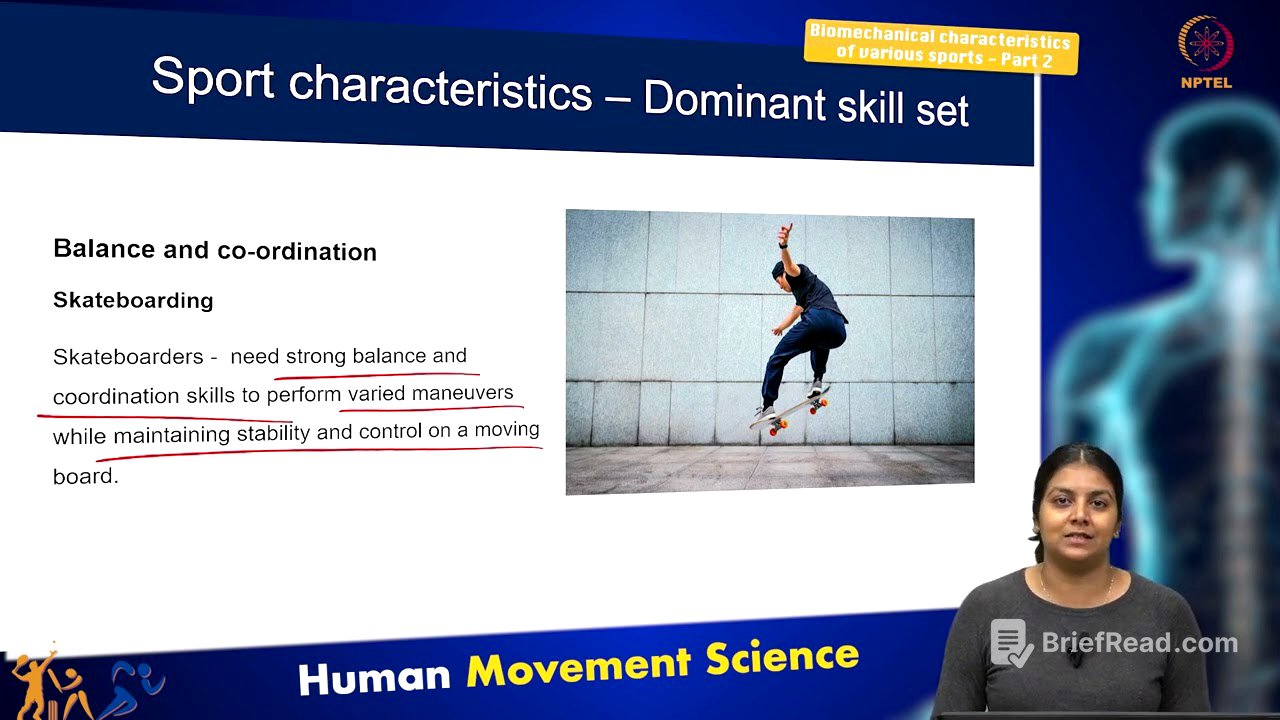
Balance and coordination are dominant in sports like gymnastics and skateboarding. Gymnasts need exceptional balance and coordination to perform intricate routines on apparatus such as beams and rings, combining these skills with muscular strength. Skateboarders require strong balance and coordination to perform tricks and maneuvers, stabilising their bodies through various ranges of motion while maintaining control on the board. Efficiency in movement is crucial to reduce fatigue and the risk of injury.
Team Coordination and Communication [12:59]
Team coordination and communication are essential in group sports like basketball, football, volleyball and netball. In basketball, players must coordinate their movements and communicate effectively to execute offensive and defensive strategies. Similarly, football players must work together, demonstrating coordinated movements and understanding each other's strengths to make informed decisions and strategies.
Single-Movement Dominance [14:34]
Single-movement dominance is seen in sports like javelin, which involves one explosive movement to propel the javelin as far as possible. Achieving optimal distance requires good technique and precision, considering biomechanical characteristics such as release angle and javelin trajectory kinematics.
Repetitive Movements [16:31]
Repetitive movements are characteristic of sports like swimming and cycling. Swimmers repeatedly perform strokes over a distance, requiring consistent and efficient arm movements, rhythmic breathing patterns, and good control to maintain speed and endurance. Cyclists repeat pedalling motions, optimising cadence and power output to maintain high speeds throughout a race.
Combination of Movements [18:30]
Combination of movements is evident in sports like golf and archery. Golfers use a consistent swing technique but vary the club angle, posture, and force application based on the distance and direction of the target. In archery, the skill of drawing and releasing the bowstring remains constant, but adjustments to body posture and aim are needed based on environmental conditions like wind speed and lighting.
Movements Based on Incoming Target [21:13]
Movements based on incoming targets are seen in sports like baseball and cricket batting. Baseball batters adjust their stance and swing based on the incoming trajectory and speed of the pitch. Cricket batters adapt their stance and stroke based on the type of delivery (fast, spin, or medium-paced) and the field placement to score maximum runs. Training involves situational scenarios to develop decision-making skills and dynamic adjustments.
Implications and Biomechanical Performance Analysis [23:44]
Understanding movement characteristics provides insights into the coordination of body segments, the application and transmission of forces, the timing of muscle activation, and acceleration and deceleration patterns. Biomechanical performance analysis involves applying mathematical and mechanical principles to understand and optimise movement performance through needs analysis. This requires knowledge of appropriate tools, techniques, and statistical approaches to analyse movement and develop versatile athletes.