TLDR;
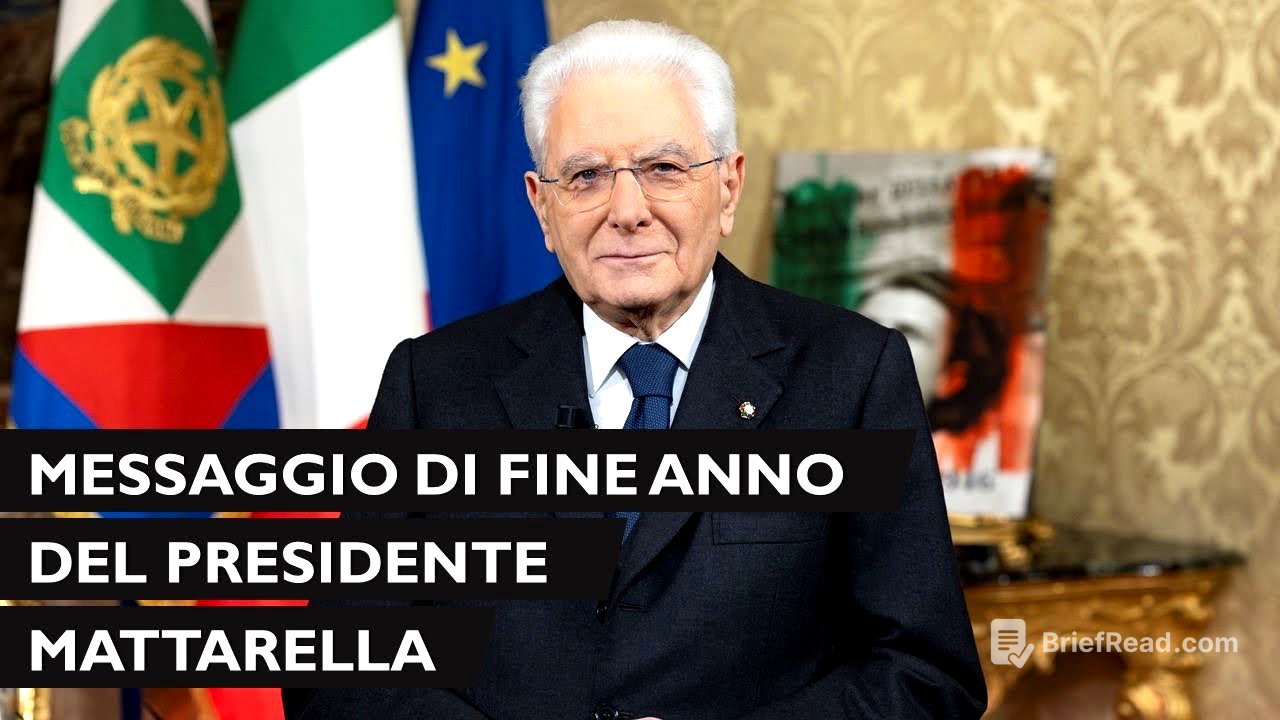
The President of the Italian Republic delivers a New Year's address reflecting on the past year's challenges, particularly focusing on the desire for peace amidst global conflicts. The speech commemorates the 80th anniversary of the Republic, highlighting key moments and figures that have shaped Italy's identity, including the role of women, the creation of the Constitution, economic development, and the fight against terrorism and organised crime. The President underscores the importance of social cohesion, addressing inequalities, and upholding the values enshrined in the Constitution, urging citizens, especially the youth, to actively participate in building a better future.
- Desire for peace amidst global conflicts.
- Commemoration of the 80th anniversary of the Republic.
- Importance of social cohesion and addressing inequalities.
- Call to uphold constitutional values and active citizen participation.
Introduction: Reflections on the Past Year and Hopes for Peace [0:00]
The President opens the address by acknowledging the difficulties of the past year and expressing hope for a better future. A primary focus is the yearning for peace, particularly in light of the devastation in Ukraine and Gaza, where bombings and destruction have caused immense suffering, leaving civilians without essential resources during harsh winter conditions. The President laments the incomprehensible denial of peace by those who believe they are stronger, asserting that peace is a way of thinking that involves living together with respect, without imposing one's will on others. This mindset begins in daily life and extends to international relations, national communities, and individual interactions.
The Pope's Call for Disarmament of Words and Rejection of Hate [1:34]
The President references Pope Francis's call to reject hatred, violence, and opposition, and instead embrace dialogue, peace, and reconciliation, particularly during the Christmas season and the Jubilee of Hope. The Pope emphasised the need to disarm words, a call the President urges everyone to heed. The President warns against turning every situation into an excuse for verbal clashes and baseless accusations, which undermine the foundation for a peaceful mindset. He encourages people to reject feelings of helplessness and recognise their capacity to contribute to freedom and peace, which are foundational to the Republic and require dialogue and civic responsibility.
Celebrating 80 Years of the Republic: A Historical Retrospective [2:52]
The upcoming year marks the 80th anniversary of the Republic, a period of significant historical importance. The President proposes a journey through an imaginary album of the Republic's history, starting with the symbolic moment when women were first allowed to vote, signifying national unity and establishing the Republic's democratic character. The Assembly was able to create a synthesis of high value, while political dialectics developed between convergences and contrasts, resulting in the Italian Constitution, which has inspired and guided the country for decades. The Republic is portrayed as a turning point, not a state that dominates its citizens, but one that recognises inviolable rights, personal freedoms, and community autonomy.
Key Moments in the Republic's Development: Europe, Reforms, and Labour [4:39]
The President highlights the early steps of Italian democracy after the war, its dynamic growth, and its engagement with the world. The signing of the Treaties of Rome in 1957 is noted as a crucial moment, positioning Italy at the forefront of European construction. The Marshall Plan and transatlantic relations are identified as pillars of reconstruction. A period of significant reforms, including agrarian reform and housing plans, transformed Italy. The economic miracle brought forth the importance of factory workers and infrastructure development, with labour serving as a fundamental driver of progress.
Social Progress and Cultural Identity [5:55]
The President emphasises the importance of the Workers' Statute, which recognised rights, dignity, and trade union freedom, underscoring the need for workplace safety and fair wages. The establishment of the National Health Service, guaranteeing universal and free healthcare, is highlighted as a crucial achievement of the welfare state, centred on human dignity and equality. The expansion of the pension system is also mentioned as a condition to be preserved. The contribution of culture, art, cinema, literature, and music to national identity is recognised, along with the role of public broadcasting (RAI) in ensuring pluralism and popular engagement with the Republic's institutions.
Dark Chapters: Terrorism and the Fight Against the Mafia [7:09]
The address acknowledges the dramatic period of bombings and terrorism, remembering the victims, including magistrates, journalists, and law enforcement officials, who fell victim to violent ideologies. Despite being called the "night of the Republic," Italy prevailed, with institutions proving stronger than terror due to the unity of political and social forces in defending the Republic's founding principles. The President also recognises the role of sports, highlighting memorable athletes and the 1960 Rome Olympics, which first introduced Paralympic participation, contributing to the country's growth, joy, pride, and sense of belonging.
Triumphs and Ongoing Challenges: Remembering Falcone and Borsellino [8:48]
The President pays tribute to Giovanni Falcone and Paolo Borsellino, symbols of legality and the fight against the mafia, whose example continues to inspire future generations. The speech reflects on years of tension and change leading into the new century and millennium, noting profound shifts in language, lifestyles, and currency. The 80 years of the Republic are likened to a mosaic, with its full meaning only understood when viewed from a distance.
Italy's Transformation and Global Role [9:47]
The President acknowledges past contradictions, such as low education levels and high emigration rates, but celebrates Italy's transformation into a leading manufacturing and exporting nation, renowned for its creativity. Italy is appreciated worldwide for its lifestyle, beautiful landscapes, artistic treasures, and culinary culture. The country plays a significant role on the international stage, with its military contributing to security and peace, albeit with sacrifices, such as the loss of aviators in a humanitarian mission in Congo in 1961. The President affirms that the Republic's history is a global success story, a source of pride resulting from the dedication of many generations.
The Strength of Social Cohesion and Constitutional Values [11:10]
The President stresses that the principles and values enshrined in the Constitution 80 years ago must be lived and demonstrated daily, making them a reality in everyday choices. Social cohesion, freedom, and democracy have enabled Italy to become the great nation it is today. Legitimate debates have contributed to concrete achievements that have improved people's lives, turning rights and duties into tangible realities. Reflecting on collective achievements is essential for facing the future with confidence and renewed commitment.
Addressing Current Challenges and the Role of the Republic [12:19]
The President acknowledges the old and new challenges, including poverty, inequality, injustice, corruption, tax evasion, and environmental crimes, which threaten social cohesion. He emphasises that the Republic belongs to everyone, calling on each citizen to take responsibility. The speech recognises the uncertainty of the international context and the increasing interconnectedness of the world, from the economy and environment to technology, pandemics, and terrorism.
A Message to the Youth: Embrace Responsibility and Shape the Future [13:43]
The President expresses confidence in democracy's strength and addresses the youth, urging them not to accept negative stereotypes. He encourages them to be demanding, courageous, and to choose their future, feeling as responsible as the generation that built modern Italy 80 years ago. The address concludes with best wishes for the new year.