TLDR;
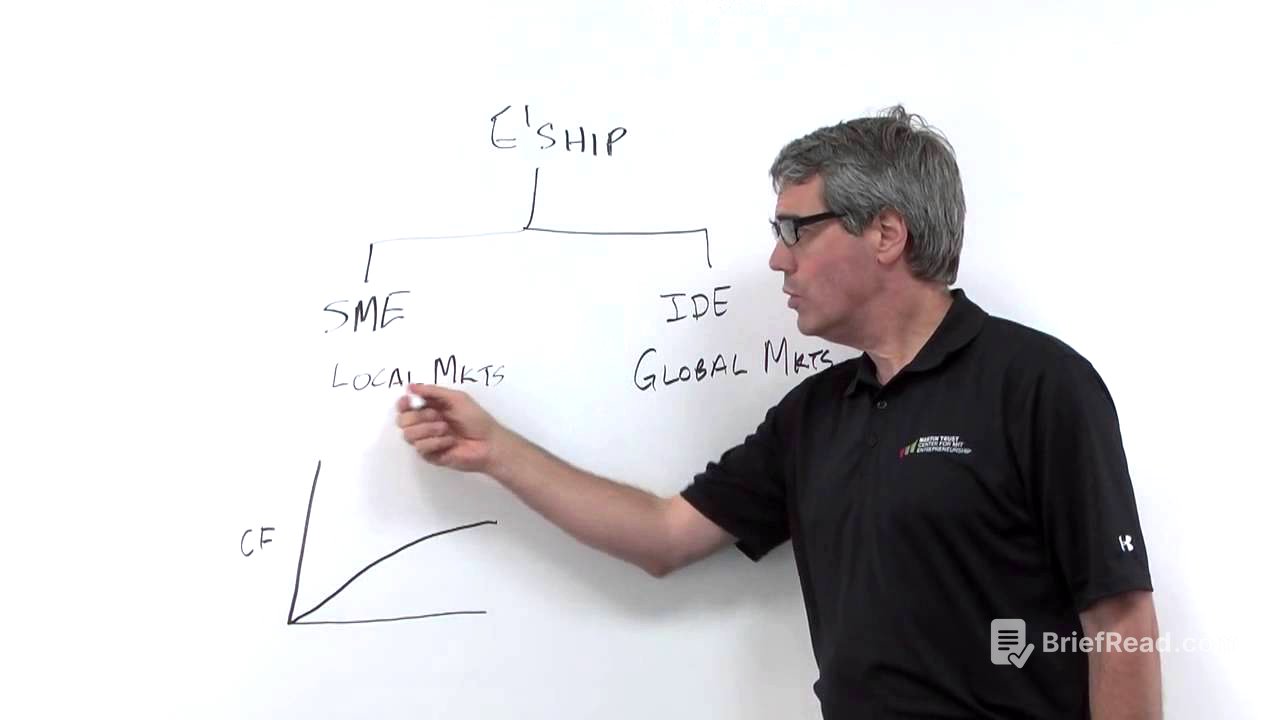
The lecture distinguishes between two types of entrepreneurship: Small and Medium Enterprise (SME) entrepreneurship and Innovation-Driven Enterprise (IDE) entrepreneurship. SME focuses on local markets with linear growth and limited cash flow, while IDE targets global markets, requires significant capital investment, and aims for exponential growth through innovation. The speaker highlights that the skills, training, and risk profiles differ significantly between the two, comparing them to different sports like basketball and baseball.
- SME: Local focus, linear growth, owner-controlled.
- IDE: Global focus, exponential growth, requires external investment.
Introduction to Entrepreneurship [0:05]
The lecture begins by defining entrepreneurship and immediately distinguishes between two fundamental types: Small and Medium Enterprise (SME) entrepreneurship and Innovation-Driven Enterprise (IDE) entrepreneurship. SME entrepreneurship involves small companies that typically remain local, focusing on serving local needs with services like dry cleaning, nail salons, or restaurants. These businesses exhibit linear growth and are often owner-managed. In contrast, IDE entrepreneurship targets global or super-regional markets, requiring substantial capital investment to fuel exponential growth.
SME vs IDE [0:33]
SME businesses generally experience linear growth with limited cash flow, whereas IDE businesses often incur initial losses before achieving exponential growth. IDEs rely on unique innovations to address broader markets, necessitating external shareholders and a different management approach compared to the owner-controlled SME model. The speaker emphasises that while both types are important, the training, skills, and underlying systems required for each differ significantly.
Key Differences and Risk [3:22]
The lecture draws an analogy to basketball and baseball to illustrate the differences between SME and IDE entrepreneurship. While there may be some crossover in skills, the training and risk profiles are distinct. IDEs require individuals skilled in managing multiple stakeholders and driving innovation. Although IDEs carry more risk, they have the potential to generate significant job growth, even with a smaller number of successful ventures, whereas SMEs are more geographically distributed and numerous.