TLDR;
This module explores the application of human movement science principles in sports, integrating functional anatomy, biomechanics, and motor control. It covers movement analysis considerations from biomechanics, functional anatomy, and coaching science perspectives, emphasising the importance of understanding these principles for athletes, coaches, and sports scientists in enhancing performance and preventing injuries.
- Application of human movement science to sport and parasport.
- Integration of biomechanics, motor control, functional anatomy, and coaching science.
- Movement analysis considerations for performance enhancement and injury prevention.
Introduction to Human Movement Science in Sports [0:00]
The module introduces the application of human movement science principles in sports, building upon fundamental movements, exercise, and the integration of functional anatomy, biomechanics, and motor control. It aims to demonstrate how these fields apply to sporting examples, including parasport. The learning outcomes include applying human movement science principles to sport, considering important factors, analysing sporting skills, and understanding the application of these principles to parasport. The course provides a brief overview of these principles, focusing on the philosophy and perspective of human movement science, rather than in-depth calculations and variables.
Integrated Disciplines in Sports [3:27]
The field of human movement science plays a crucial role in sport performance, training intervention, and injury prevention. Principles derived from biomechanics (kinematics and kinetics), motor control, and functional anatomy are integrated. While physiology is also important, the course focuses on muscle and skeletal physiology, with additional sport science units available for detailed information. Coaching science principles are touched upon, highlighting the significant implications of integrating these disciplines for athletes, coaches, and sports scientists. Human Movement Science (HMS) integrates coaching science, biomechanics, motor control, and functional anatomy, requiring sports scientists and performance analysts to have a comprehensive understanding of these fields.
Movement Analysis Considerations: Biomechanics [4:16]
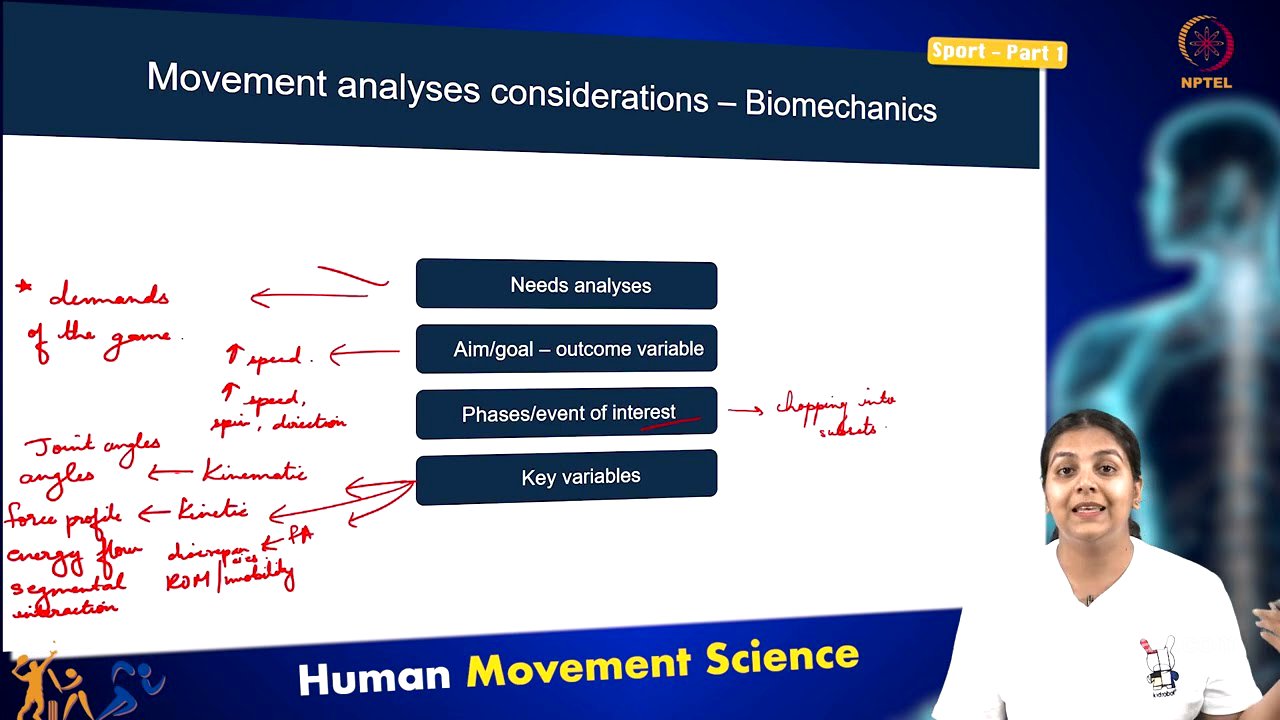
When analysing movement from a biomechanics perspective, the initial step is needs analysis, which involves understanding the demands of the sport, including physiological, psychological, and mechanical aspects. Following needs analysis, the next step is to define the goal or outcome variable, such as increasing speed for a fast bowler or improving speed, spin, or direction for a table tennis forehand. The skill is then broken down into phases and sub-phases, identifying events of interest within these phases. Key variables, such as kinematic (joint angles) and kinetic (force production, energy flow, segmental interaction) variables, are identified and anatomical variables like range of motion and mobility are considered.
Tools and Techniques in Biomechanical Analysis [9:23]
Achieving key variables involves using various tools and techniques, including video cameras for qualitative analysis and 3D motion capture systems for quantitative analysis. Computer simulation models are also used to understand performance or injury patterns, enabling simulation and predictive modelling. Data collection is followed by statistical analysis, focusing on mean, distribution, and correlation to identify movement patterns related to performance, injury risk, or technique compromises. Evaluating technique and understanding fundamental movements, such as catching or throwing, helps in designing a solid foundation for adopting sport skills. Equipment adaptations, such as grip size and string tension in tennis rackets or handle size and weight in cricket bats, are also important considerations.
Movement Analysis Considerations: Functional Anatomy [17:57]
From a functional anatomy perspective, movement analysis involves understanding the interaction of the musculoskeletal and nervous systems in producing movement. Key considerations include identifying joint actions and major joints involved, as well as the muscles involved and their roles (prime mover, antagonist, stabiliser). The type of muscle contractions (concentric, eccentric, isometric) is also analysed. Assessing muscle strength and the range of motion, mobility, and flexibility required for specific movements is crucial. Anatomical discrepancies, such as limited abilities or limb length differences, are important considerations that need to be identified early.
Movement Analysis Considerations: Coaching Science [23:43]
In coaching science, session planning is crucial, starting with defining the aim or goal of the session and the skills to be focused on. The focus can be technical (improving technique, accuracy, consistency) or tactical. Setting the intensity, frequency, and workload is important, and drills or gameplay are designed accordingly. Coaches need to balance training and communicate with strength and conditioning coaches to avoid overloading athletes. Differentiating between technique, skill, and style is important for technique improvement. Teaching cues should align with the athlete's learning style, and feedback should be tailored to their needs. Progression involves increasing intensity or complexity, while regression involves revisiting technique.