TLDR;
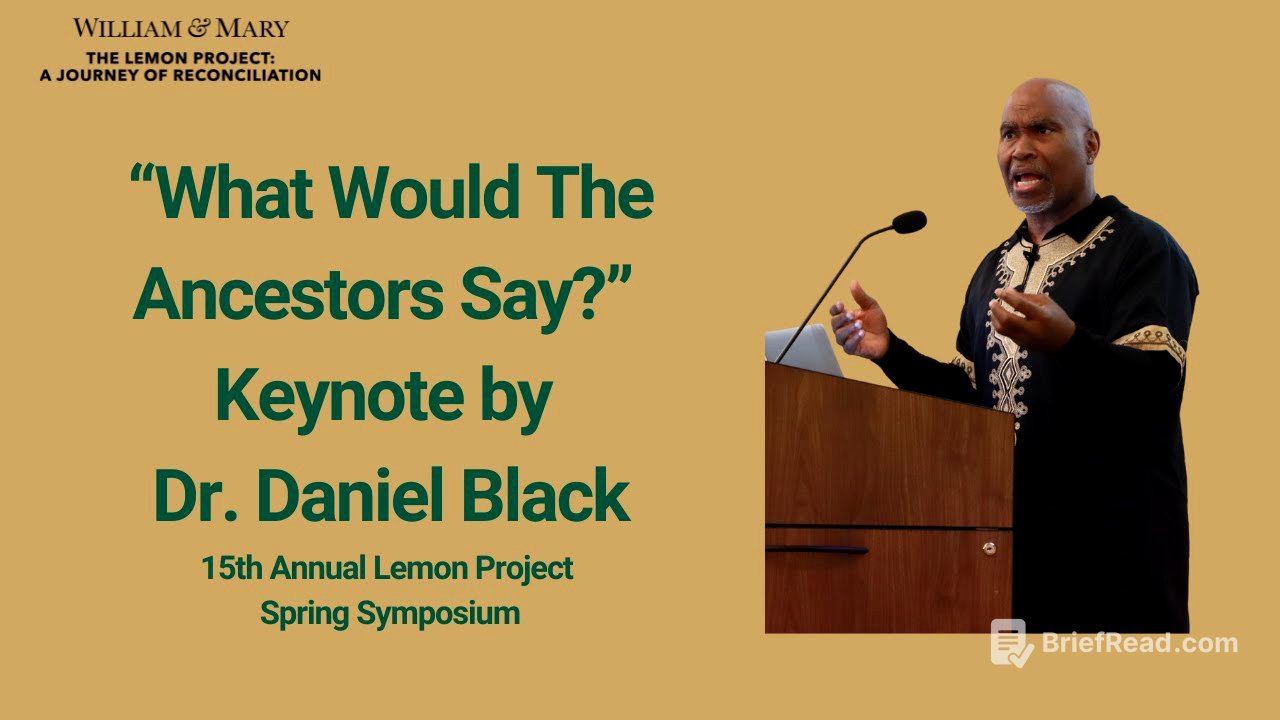
Daniel Black's speech emphasizes the resilience and inherent strength of Black people, highlighting their ability to innovate, adapt, and maintain their identity despite centuries of oppression. He argues that Black people do not need permission to have a revolution, as their very existence and cultural expressions are acts of resistance. Black underscores the importance of remembering and teaching Black history, fostering community, and reclaiming agency in the face of systemic challenges.
- Black people don't need permission to have a revolution.
- Black people are stronger in death than in life.
- The most frightening thing in America is a conscious black mind.
- Black people must reclaim agency in the face of systemic challenges.
Introduction [0:04]
Daniel Black begins by humorously noting the warm Atlanta weather and contrasting the expressive atmosphere of HBCU gatherings with the quieter environments of other speaking engagements. He expresses his enthusiasm for the topic of enslaved people speaking, emphasizing the significance of providing a voice to ancestors who have long been silenced. Black reflects on the historical context of enslaved people being educated by their captors, questioning the intentions and perceptions of those involved.
You Don't Need Permission to Have a Revolution [1:47]
Black asserts that the ancestors would say, "You don't need permission to have a revolution." He describes the historical context of the capture, enslavement, and dehumanization of African people, highlighting the captors' attempts to destroy Black identity, culture, and spirit. Black emphasizes that despite these efforts, the captors underestimated the strength and resilience of Africans, who are stronger in death than in life and whose seeds will bloom wherever they are planted.
They Didn't Know Whom the Hell They Had Captured [4:57]
Black continues to emphasize the captors' ignorance of the true nature and strength of the people they enslaved. He explains that Africans embraced Jesus and understood the rules of resurrection. He notes that changing names did not erase their identities, as they created their own nicknames and turned the captors' language to their own purposes. Black highlights that Africans knew God before their captors and retained their cultural identity and practices, adapting and transforming them in the new land.
We Are the Way Makers [8:53]
Black emphasizes the transformative power and adaptability of Black people, who, despite being brought to a new land, recreated their culture and traditions. He notes that they transmuted and synthesized materials, creating new forms of expression and innovation. Black asserts that Black people are way makers, dream shakers, heavy load sharers, and mighty spirit carriers, who understood the agreement between the earth, rain, wind, and sun, and knew it would be honored anywhere on the planet.
Ain't Nothing in the World Going to Destroy Black People [10:30]
Black lists various attempts to destroy Black people, including the invasion of Africa, the Middle Passage, slavery, and ongoing systemic oppression. He declares that none of these attempts will succeed because God sends an angel to cover Black people. Black emphasizes the power of Black people singing, dancing, and conjuring, which brings strength, joy, and spiritual power. He asserts that Africans were sent on a mission to teach the world that hope, freedom, and love cannot be destroyed.
The Most Frightening Thing in America Is a Conscious Black Mind [13:55]
Black states that the most frightening thing in America is a conscious Black mind, highlighting the sacrifices made by ancestors for the right to read, write, and think freely. He emphasizes that knowledge is power and that Black people have historically written their way to liberty. Black asserts that Black people do not need permission to have a revolution or to believe in their own humanity and equality.
Educating Our Children Is Our Job [15:34]
Black emphasizes that educating Black children is the responsibility of Black people themselves, not public schools. He highlights the importance of teaching children about their history, beauty, and the sacrifices made by their ancestors. Black asserts that only Black people can truly convey the depth of their heritage and the dreams they hold for their children.
The Secret to Black Agency [16:58]
Black states that the secret to Black agency is knowing that America will not agree for Black people to have a revolution, but they will have it anyway. He calls on the audience to figure out their role in the revolution, whether it be gathering books, teaching children, writing songs, creating dances, giving money, voting, or supporting Black youth. Black emphasizes the need for soldiers in this battle who will fight against unrighteousness and believe in the worth of their children.
Why I Write [20:33]
Black explains that he writes because he once believed he was ugly, but then wrote himself into beauty. He writes to tell the truth, to set the world free, and to create a world full of gods. Black writes to soothe wounds, love the rejected, and give sight to the blind. He seeks to create a world where Black youth can dance at what they see in the mirror and elders can know their lives were not in vain.
Without Forgiveness, There Is No Liberty [22:44]
Black emphasizes the importance of forgiveness as the only seed of transformation, which ushers one through chaos and pain without the weight of empty promises. He writes to give readers permission to take their joy back and to tell the world "no fucking way" when it tries to convince them they are not supposed to be free. Black writes to strengthen the strong, fortify the weak, and pay homage to those who declared "I am black, and I am beautiful" long before anyone agreed.
We've Not Seen the Fullness of Love Yet [23:49]
Black expresses that we have not yet seen the fullness of love or set it free in our hearts to heal and walk among our pains. He writes to encourage justice to fight on, knowing that winning happens in many ways, and to remind us that we are watchmen of this planet, stewards of mercy and kindness who owe each other unconditional love. Black concludes by stating that we shall rise one day like the sun and be whatever God has been hiding from us, urging the audience to read.
Q&A - Favorite Book and Isaac's Song [33:47]
In the Q&A session, Black declines to name a favorite book, comparing it to choosing a favorite child. He discusses his current book tour for "Isaac's Song," which explores ancestral healing and renegotiating memories of elders. The book tells the story of Isaac, who realizes as an adult that his father's love for him took forms he didn't understand as a child. Black emphasizes that ancestors can be both marvelous and in need of correction.
Q&A - Pulling Our People Out of the Fire [39:22]
In response to a question about how to help Black people in the current political climate, Black advises against overreacting, noting that Black people have faced similar challenges throughout history. He suggests resurrecting freedom schools to teach Black children their history, independent of public schools. Black emphasizes the importance of taking tangible action and utilizing existing community spaces like churches.
Q&A - I Have to Write Again [41:20]
A member of the audience shares that Black's words have inspired her to write again after many years. Black encourages her to get her work out there and not be afraid of people knowing her business. He emphasizes that a writer must be unafraid of nakedness, metaphorically walking around the world and letting people look however they want. Black asserts that anything one is willing to cover up will inhibit their voice.
Q&A - The Role of the Cultural Arts [44:34]
Black discusses the role of cultural arts, particularly dance, in Black communities. He argues that the arts are not just for entertainment but are a place where battles happen, especially since Black people were often excluded from other academic arenas. Black emphasizes that dance is what mouths cannot say, boldly expressing what is too dangerous for others to speak. He notes that movement is how Black people have learned to stay alive in a place committed to their destruction.
Q&A - Revival of Being a Baptist [48:13]
An audience member thanks Black for reviving her soul and spirit, expressing that his words connected her to her history and helped her navigate feelings of anger. She states that she felt like she was in a revival of being a Baptist, appreciating the spiritual and emotional impact of Black's message.
Q&A - How Does One Move Forward? [48:50]
A young audience member expresses frustration with fighting for a place that doesn't love Black people and questions whether to have children in such a world. Black advises her not to give her power away, comparing Black people to ants who consistently rebuild their ant hills despite disturbances. He encourages her to have children, as they will carry on the legacy of resistance and excellence. Black emphasizes that love will cover her kids more than any power structure could harm them.
Q&A - Influential Ancestors and Elders [55:40]
An audience member asks about influential ancestors and elders, prompting Black to share stories about Dr. Jeffrey L. Woodyard, Ann Crowfoot, Sonia Sanchez, and Malefi Asante. He recounts how Ann Crowfoot, his white English teacher, gave him James Baldwin's "If Beale Street Could Talk," which inspired him to write. Black also highlights the influence of the Black church in teaching confidence and self-worth, noting that it was the starting point for many prominent Black leaders.
Q&A - Decolonization From a Legal Perspective [1:02:27]
A law student asks about decolonization from a legal perspective and how young lawyers can get involved. Black advises her not to be surprised that she's not getting that perspective at her current institution and emphasizes that it's not the oppressor's job to free Black people. He encourages her to get the law degree, connect with like-minded individuals, and create a law firm that fights for what they believe in. Black reminds her that the law was never made to free Black people and that she must learn to navigate the legal system strategically.
Q&A - How to Get Involved in the Revolution at 94 Years Old [1:07:33]
In response to a question from a 94-year-old woman about how to get involved in the revolution, Black advises her to find all the children she can and tell them her story. He emphasizes that someone who has lived a whole century has seen more than most can imagine and that her story is a valuable contribution to the revolution.