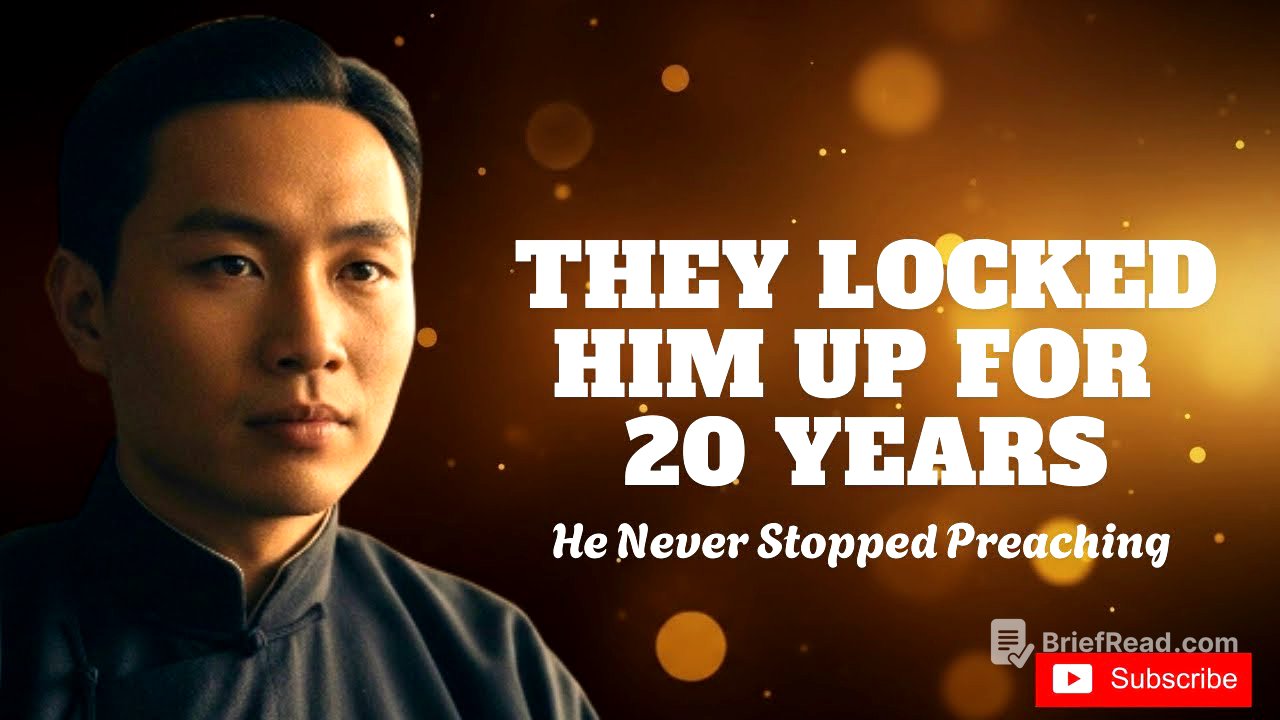
TLDR;
This video tells the story of Watchman Nee, a significant Christian figure in 20th-century China. It highlights his conversion, ministry, imprisonment, and unwavering faith. The video emphasizes the depth of his spiritual life, his focus on Christ, his embrace of the cross, and God's faithfulness. It concludes by challenging viewers to examine their own faith and commitment to Christ.
- Watchman Nee's profound spiritual depth and unwavering faith in Christ.
- The transformative power of embracing the cross in daily life.
- God's faithfulness in Nee's life and the growth of Christianity in China.
- The challenge to viewers to examine their commitment to Christ and live out their faith.
Introduction [0:00]
The video introduces Watchman Nee as one of the heroes of faith, emphasizing that God remembers those who walk by faith and that their stories demonstrate God's reality, power, and the enduring impact of faith. It sets the stage for recounting the story of a believer whose life exemplified these truths.
Early Life and Conversion [0:35]
Watchman Nee was born in China in 1903 into a family with a strong Christian background. His mother's deep prayer life significantly influenced him. He was originally named Nei Shuzhu, but he later changed it to Tishung, meaning "Watchman's Bell," reflecting his calling to warn others. At 17, he attended a revival meeting led by Dory Yu, where he committed his life to Jesus Christ, marking a radical transformation.
Ministry and Encounters [3:00]
Following his conversion, Watchman Nee devoted himself to studying the scriptures and theological works. Within a year, he began preaching, demonstrating an anointing that drew people to him. He had a gift for elucidating deep spiritual truths and revealing dimensions of Christ. In 1924, during an evangelistic mission in Mewa, Nee confronted the worship of a local idol called the Tuang. He prophesied that God would send rain during the idol's procession, which occurred, leading many villagers to turn to Christ.
Friendship with Margaret Barber [6:35]
In 1923, Watchman Nee formed a significant friendship with Margaret Barber, a British missionary. She deepened his understanding of the cross and the inner working of the cross in a believer's life, including death to self and the resurrection life of Christ. These truths became foundational to Nee's teachings.
Growth and Opposition [7:34]
By the late 1920s, Watchman Nee's ministry expanded across China through local churches that gathered in homes, known as the "local churches" or "little flock movement." However, this growth also brought opposition, with critics questioning his methods and doctrines. He faced public dismissal and exclusion from ministry, but he responded with quiet study and prayer, emerging with even greater spiritual depth.
The Spiritual Man [8:32]
During a period of quiet reflection, Watchman Nee wrote "The Spiritual Man," a three-volume exposition on the spiritual life. This work provides a detailed analysis of the human spirit, soul, and body, illustrating how the Holy Spirit transforms a life from within. It is considered a profound work of practical Christian theology.
Travels and World War II [9:13]
In 1934, Watchman Nee traveled to Europe and Britain, engaging with Christian leaders and theologians. His understanding of spiritual truths impressed many. During the Japanese invasion of China and World War II, Nee continued to minister, providing spiritual guidance and pointing people to the kingdom of God amidst chaos.
Factory Business and Return to Ministry [10:32]
In 1942, Watchman Nee temporarily left full-time ministry to help his brother's struggling chemical factory. This decision was aimed at supporting both his brother and a network of co-workers. Despite criticism, Nee's actions were driven by a practical desire to meet a need. After the business stabilized, he returned to full-time ministry, leading to renewed growth in the churches.
Arrest and Imprisonment [11:25]
As the Communist Party gained control in China, Watchman Nee chose to stay despite opportunities to leave. In April 1952, he was arrested on fabricated charges, with his real crime being his influence over millions of Chinese citizens. He was sentenced to 15 years in prison and never walked free again.
Life in Prison and Death [13:22]
During his 20 years in prison, Watchman Nee maintained his faith, prayed, studied scripture, and encouraged other prisoners. He refused to renounce his faith despite facing increased pressure and suffering. On May 30, 1972, he died in prison at the age of 69. A note found among his belongings declared his belief in Christ as the Son of God who died for the redemption of sinners.
Legacy and Lessons [15:52]
Watchman Nee's life teaches several important lessons. First, depth in the Christian life is possible through the Word, prayer, and fellowship with the Holy Spirit. Second, the cross is not just a doctrine but a way of living through daily death to self. Third, God is faithful, as evidenced by the continued impact of Nee's writings and the growth of Christianity in China. Finally, Nee's choice to stay with his flock challenges believers to prioritize faithfulness over comfort and to stand firm in their faith.
Challenge to Viewers [19:11]
The video concludes by challenging viewers to consider their own commitment to Christ. It asks whether they will give everything to Him, allow the cross to work deeply in them, stand firm in their faith, and go against the tide of compromise. The life of Watchman Nee serves as a summons to live out a genuine, transformative faith.