TLDR;
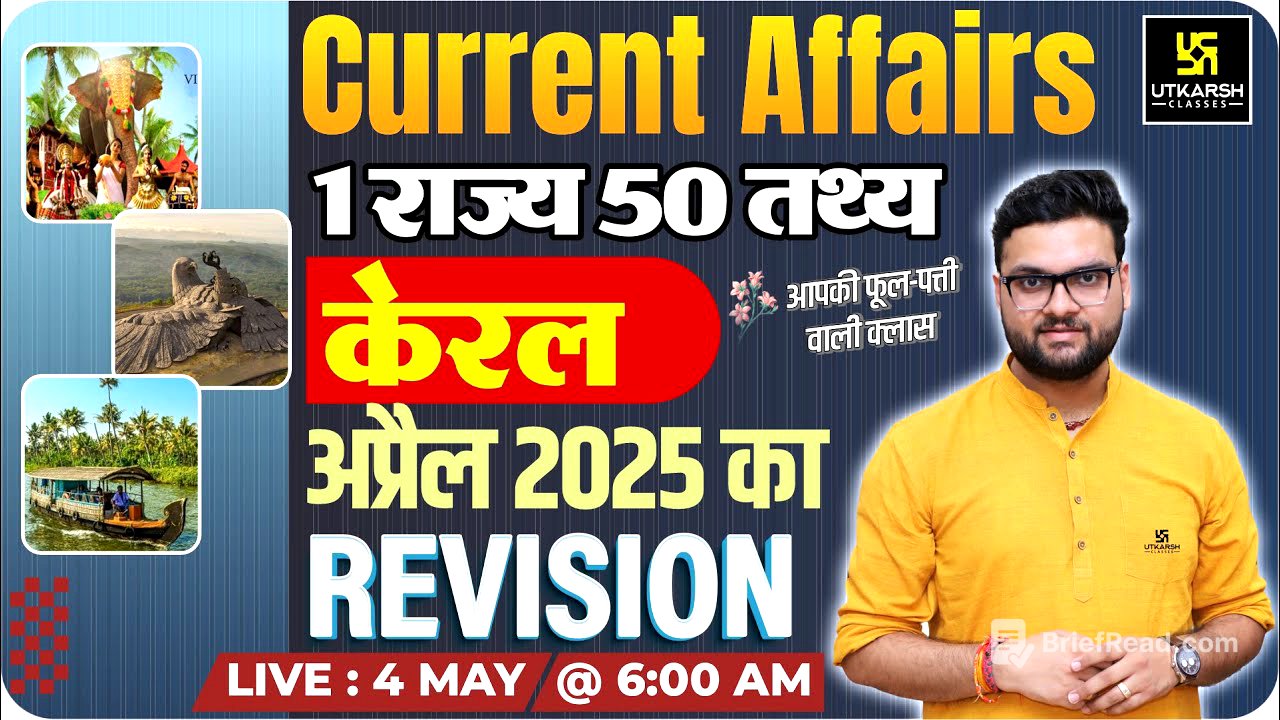
This YouTube video by Utkarsh Classes provides a comprehensive overview of the Census 2011 of India and a review of current affairs from April, followed by a detailed look at the state of Kerala. The video begins with an introduction to the importance of the Census 2011, then covers key facts and figures, including population statistics, growth rates, density, literacy rates, and demographic distributions across states and union territories. It also includes a rapid-fire revision of current events and concludes with a detailed exploration of Kerala, covering its history, geography, culture, and key figures.
- Census 2011 data, including population, growth rates, and literacy.
- Review of April's current affairs.
- Detailed overview of Kerala's history, geography, and culture.
Introduction to Census 2011 [0:14]
The video starts with an introduction emphasizing the importance of perseverance and continuous revision for exam preparation. The main topic is the Census 2011, a crucial subject for various competitive exams. The initial census efforts began in 1872 during the time of Lord Mayo, but a systematic, decennial census started in 1881 under Lord Ripon. The officer in charge of conducting the census is known as the Census Commissioner. W.C. Plowden was the first Census Commissioner of India. The Census 2011 was the 15th census in the series and the 7th since India's independence in 1947. The decade between 1911-1921 is known as the "Great Dividing Decade" because it was the only decade when the population declined due to famines and epidemics. The slogan for the Census 2011 was "Our Census, Our Future."
Key Population Statistics [2:19]
In 2011, India's population was 121.09 crore, making it the second-most populous country after China. The population growth rate from 2001 to 2011 was 17.7%. Women constituted 48.53% of the population, while men made up 51.47%. Rajasthan was the largest state by area, and Goa was the smallest. Among Union Territories, Ladakh was the largest, and Lakshadweep was the smallest. Uttar Pradesh had the highest population (16.51% of India's total), followed by Maharashtra, Bihar, and West Bengal. Sikkim had the lowest population (0.05%). Meghalaya recorded the highest decadal population growth (27.9%), while Nagaland experienced negative growth (-0.6%).
Population Density and Demographics [8:03]
The population density of India, according to the 2011 census, was 382 persons per square kilometer. Bihar had the highest population density at 1106 persons per square kilometer, while Arunachal Pradesh had the lowest at just 17 persons per square kilometer. Delhi was the most densely populated Union Territory, with a density significantly higher than Bihar. Kerala had the highest sex ratio, with 1084 females per 1000 males, while Haryana had the lowest at 879. In child sex ratio (0-6 years), Arunachal Pradesh topped with 972 girls per 1000 boys, while Haryana had the lowest at 834.
Literacy and Rural-Urban Distribution [13:02]
The literacy rate in India in 2011 was 73%, with 80.09% for males and 64.60% for females. Kerala had the highest literacy rate at 94%, while Bihar had the lowest. Himachal Pradesh had the highest rural population, with 90% of its population living in villages, while Goa had the highest urban population, with 62% residing in cities. Maharashtra had the largest urban population in terms of absolute numbers. Uttar Pradesh had the highest Scheduled Caste (SC) population, while Punjab had the highest percentage of SC population. Madhya Pradesh had the highest Scheduled Tribe (ST) population, while Mizoram had the highest percentage of ST population.
Summary of Key Census Data [18:10]
The video summarizes key census data, highlighting that Uttar Pradesh has the highest population, while Sikkim has the lowest. Bihar has the highest population density, while Arunachal Pradesh has the lowest. Meghalaya has the highest population growth rate, while Nagaland has a negative growth rate. Kerala has the highest literacy rate, while Bihar has the lowest. Uttar Pradesh has the highest SC population, while Punjab has the highest percentage. Madhya Pradesh has the highest ST population, while Mizoram has the highest percentage. Kerala has the highest sex ratio, while Haryana has the lowest.
April Current Affairs Revision [20:50]
The video transitions to a rapid-fire revision of current affairs from April, covering various topics such as international agreements, sports achievements, economic developments, and cultural events. Some highlights include:
- IIM Ahmedabad's international campus in Dubai.
- The International Air Transport Association meeting in New Delhi.
- The theme for the 2025 International Yoga Day.
- The launch of the Bhagirath app for water conservation by Uttarakhand.
- The inauguration of the Startup Mahakumbh in Delhi.
- The selection of James Anderson for the British Knighthood.
- The establishment of the Black Box Lab in Delhi.
- The designation of Telangana as the first state to implement the SC classification act.
- The appointment of Sourav Ganguly as the chairman of the ICC Men's Cricket Committee.
- The launch of the Q Shield quantum-based platform in India.
- The designation of the Indira Gandhi International Airport in Delhi as the ninth busiest airport in the world.
- The selection of Payal Kapadia for the Officer of the Order of the Arts and Letters by France.
Introduction to Kerala [1:00:58]
The video then shifts focus to the state of Kerala, providing an overview of its districts, history, and key facts. Kerala was formed on November 1, 1956, and is considering changing its name to Keralam. Thiruvananthapuram is its capital. E.M.S. Namboodiripad was the first Chief Minister, and Ramakrishna Rao was the first Governor. The state has 14 districts. Idukki is the largest district by area, while Alappuzha is the smallest. Mallapuram has the highest population. The state has 140 assembly seats, 20 Lok Sabha seats, and 9 Rajya Sabha seats.
Kerala's Geography and Key Figures [1:03:41]
Anamudi is the highest peak in Kerala and also in the Western Ghats, with a height of 2695 meters. Tamil Nadu and Karnataka are its neighboring states. The sex ratio is 1084, the highest in India, and the literacy rate is 94%, also the highest in India. The state bird is the Great Hornbill, and the state animal is the elephant. Kathakali is the state folk dance. Key tourist spots include the houseboat cruises and the Nehru Trophy Boat Race in Alappuzha, also known as the Snake Boat Race. Thiruvananthapuram is famous for the Padmanabhaswamy Temple and the Vikram Sarabhai Space Centre. Thrissur is known as the cultural capital of Kerala.
Religious Sites and Prominent Personalities [1:06:01]
Important religious sites in Kerala include the Sabarimala Temple, famous for the Makaravilakku festival, the Sri Padmanabhaswamy Temple, and the Attukal Bhagavathy Temple, known for the Attukal Pongal festival, the largest religious gathering of women in the world. Key personalities from Kerala include E.M.S. Namboodiripad, the first non-Congress Chief Minister of India, Dr. Verghese Kurien, the father of the White Revolution in India, K.R. Narayanan, a former President of India, and Kesavananda Bharati, associated with the landmark Supreme Court case on the basic structure of the Constitution.
Judicial Figures, Athletes, and Geographical Boundaries [1:08:40]
Anna Chandy was the first female judge in any High Court in India, while M. Fathima Beevi was the first female judge of the Supreme Court of India. Anju Bobby George is known for winning a bronze medal at the World Athletics Championships. P.T. Usha, also known as the Golden Girl and the Flying Angel of India, is the current president of the Indian Olympic Association. The northernmost point of Kerala is Kasaragod, the southernmost is Thiruvananthapuram, the easternmost is Idukki, and the westernmost is also Kasaragod.
Ramsar Sites, World Heritage Sites, and Cultural Elements [1:10:38]
Ashtamudi Lake and Vembanad Lake are the Ramsar sites in Kerala. The Western Ghats are recognized as a World Heritage Site. Kutiyattam and Mudiyettu are listed as intangible cultural heritage elements. Alappey Green Cardamom and Wynad Robusta Coffee are the GI-tagged products from Kerala.
Folk Dances, Festivals, and Protected Areas [1:12:03]
The classical dances of Kerala are Kathakali and Mohiniyattam. Important folk dances include Theyyam, Mudiyettam, Padayani, Kolkali, and Pulikali. Key festivals celebrated in Kerala are Onam, Makaravilakku, Vishu, Thrissur Pooram, Attukal Pongal, and Vallam Kali (Snake Boat Race). Parambikulam Tiger Reserve and Periyar Tiger Reserve are the tiger reserves in Kerala, known for their elephant populations. The Nilgiri Biosphere Reserve and Agasthyamalai Biosphere Reserve are the UNESCO-recognized biosphere reserves in the state. The video concludes with a promise to cover Rajasthan in the next session.