TLDR;
This training video discusses the "Inchworm Theory," which focuses on understanding performance ranges in self-improvement. It outlines how personal performance varies between highs and lows and how to manage and improve both ends of this spectrum to achieve real progress. Key points include:
- Understanding the range of performance: A-Game (best) vs. C-Game (worst).
- The importance of balancing pushing forward and pulling back to improve overall performance.
- Practical steps on how to identify and expand your performance range.
The Inchworm Theory [0:00]
The video begins by introducing the Inchworm Theory, which compares personal performance to an inchworm that moves back and forth. This theory helps explain self-development by clarifying that individuals do not just have a fixed level of performance but instead operate within a range, with peaks (A-Game) and troughs (C-Game). By understanding this model, viewers can differentiate between exceptional performances and consistent, everyday improvements.
Why Self-Improvement Feels So Inconsistent [0:42]
The narrator explains that people often feel inconsistent in their self-improvement journey due to fluctuations in performance. The struggle to maintain discipline, productivity, and stability often leads to frustration. By reframing performance as a range, individuals can recognize that they may experience highs and lows, allowing for a clearer understanding of their progress, leading to insights on areas needing focus.
Your A-Game vs. Your C-Game [1:35]
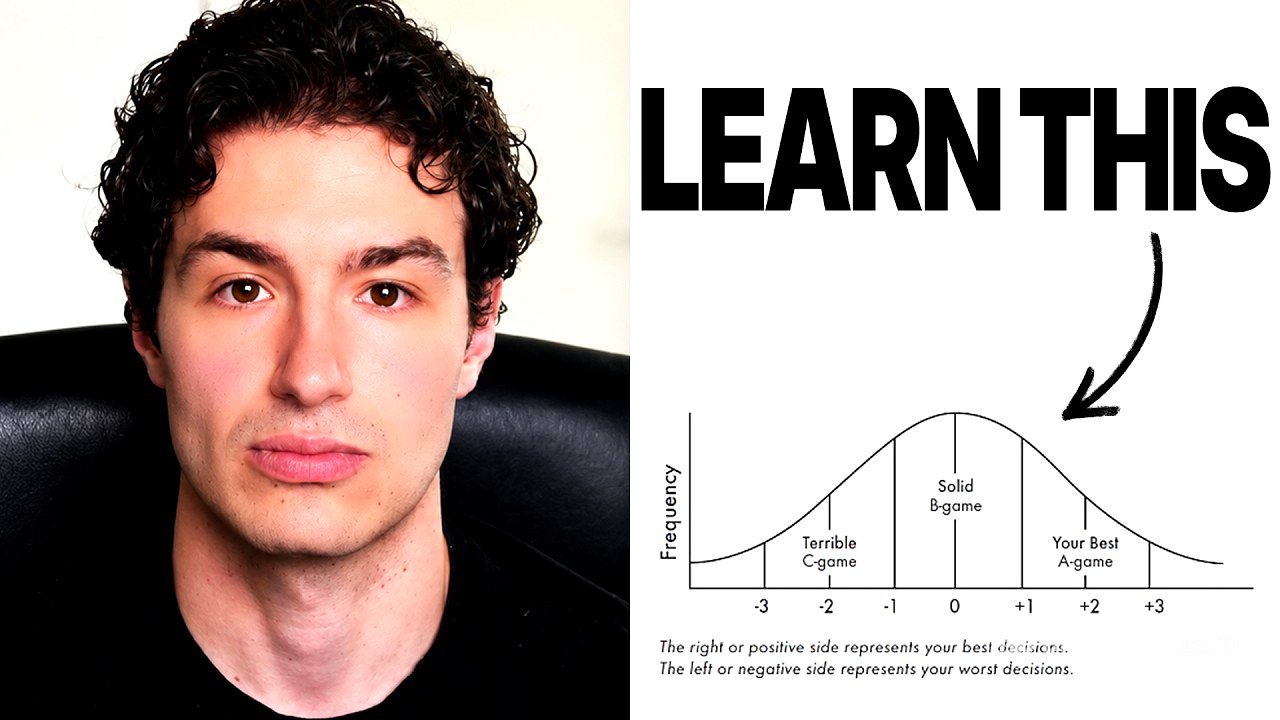
This chapter delves deeper into defining and distinguishing the A-Game from the C-Game. The A-Game represents peak states of productivity, focus, and health, while the C-Game is characterized by poor decisions and habits. The importance of measuring progress by both ends of this performance range is emphasized, as improvement can occur in the C-Game that directly affects overall performance.
Why Your Performance Will Always Fluctuate [4:18]
The video discusses the inevitability of performance fluctuations caused by various external and internal factors, such as stress, sleep, and emotional state. Understanding that these fluctuations are normal can help alleviate the pressure people feel to remain consistently high-performing. Instead of solely focusing on maximizing high performance, the focus should also be on steadily improving lower performance levels.
The Performance Bell Curve [5:05]
The performance bell curve concept illustrates how most of one’s performances cluster around a typical average, with fewer instances at either extreme. Drilling down into this model allows individuals to recognize patterns in their performance, encouraging a holistic approach to improvement that includes both high and low periods.
Why a New Peak Isn't a New Normal [6:54]
Achieving a new peak performance can be misleading, as it does not necessarily indicate a permanent shift in one’s abilities. The video emphasizes the importance of understanding that accessing a peak performance should not be mistaken for establishing a new normal. Focus should be on making new peaks repeatable through consistent practice and correction of weaker behaviors.
The Two Jobs of Self-Improvement [8:33]
Self-improvement comprises two main objectives: pushing the front forward by developing new skills or behaviors and pulling the back forward by correcting weaknesses. Both aspects are necessary for sustained growth and should be addressed in tandem to create a well-rounded development strategy.
Map Your Current Performance Range [11:22]
In this chapter, viewers are encouraged to assess their current performance range by identifying specific A-Game and C-Game behaviors. Instead of vague labels like "productive," participants should write down concrete actions they take in both states, allowing for clear identification of areas needing focus.
How to Expand Your A-Game [13:42]
Expanding the A-Game involves deliberately practicing at levels that push beyond one's normal performance, thereby raising the ceiling for what can be achieved. This requires exposure to challenging situations and conditions that foster growth, whether in work, health, or relationships.
Knowledge Only Matters When Behavior Changes [15:30]
The essence of knowledge in personal development is emphasized as being relevant only when it translates into behavior change. Simply learning concepts isn’t sufficient; individuals must actively apply their knowledge to achieve improvements.
Test Your Performance Under Pressure [17:18]
The narrator highlights the necessity of testing one's performance under various pressure conditions to determine its reliability. The goal is to ensure that new skills can be maintained even in less-than-ideal circumstances, fostering true resilience and confidence.
The Trap of Constantly Chasing New Highs [18:03]
This segment warns against the pitfalls of chasing continual new highs without solidifying earlier achievements. By focusing solely on accumulating peaks, individuals may overlook necessary corrections to weaker behaviors that prevent lasting growth.
How to Raise Your C-Game [21:37]
Improving the C-Game is crucial for overall performance. The narrator discusses the importance of consistently working to correct and mitigate behaviors that lead to low performance, thus raising the baseline when challenges arise.
Why Recovery Speed Matters [23:34]
Recovery time from setbacks is analyzed to illustrate how a quick return to normal performance indicates progress. Individuals who manage to bounce back swiftly from poor performances demonstrate improved baseline stamina and resilience.
Identify Your Triggers and Warning Signs [24:45]
This chapter emphasizes the importance of recognizing triggers and early warning signs that lead to C-Game behaviors. By pinpointing these signals, individuals can take proactive steps to intervene before a downturn.
Build Habits That Survive Bad Days [25:32]
The narrator encourages viewers to build robust habits that provide a safety net during challenging days. These habits should be practical and achievable even when motivation is low, ensuring stability amidst life's unpredictability.
The C-Game Flaw Audit [27:57]
Conducting a flaw audit helps identify recurring weak habits associated with low performance. It enables individuals to focus on specific behaviors that lead to difficulties, aiding targeted improvement efforts.
How to Compress Your Performance Range [30:34]
Reducing the gap between the highs and lows aids in achieving consistent performance. By addressing both ends of the performance range, individuals can find a middle ground that enhances overall stability in their lives.
Build Your Own Self-Improvement Cycle [34:51]
This chapter outlines the step-by-step process of creating a personalized self-improvement cycle tailored to individual needs. By integrating methods to improve both the A-Game and the C-Game, viewers are encouraged to reflect regularly on their progress.
Review + Action Items [36:54]
In the conclusion of the video, the narrator summarizes key concepts and outlines actionable steps participants can take to implement the Inchworm Theory into their self-development journey. Viewers are encouraged to document their performances, identify specific goals for improvement, and monitor their progress over time.