
TLDR;
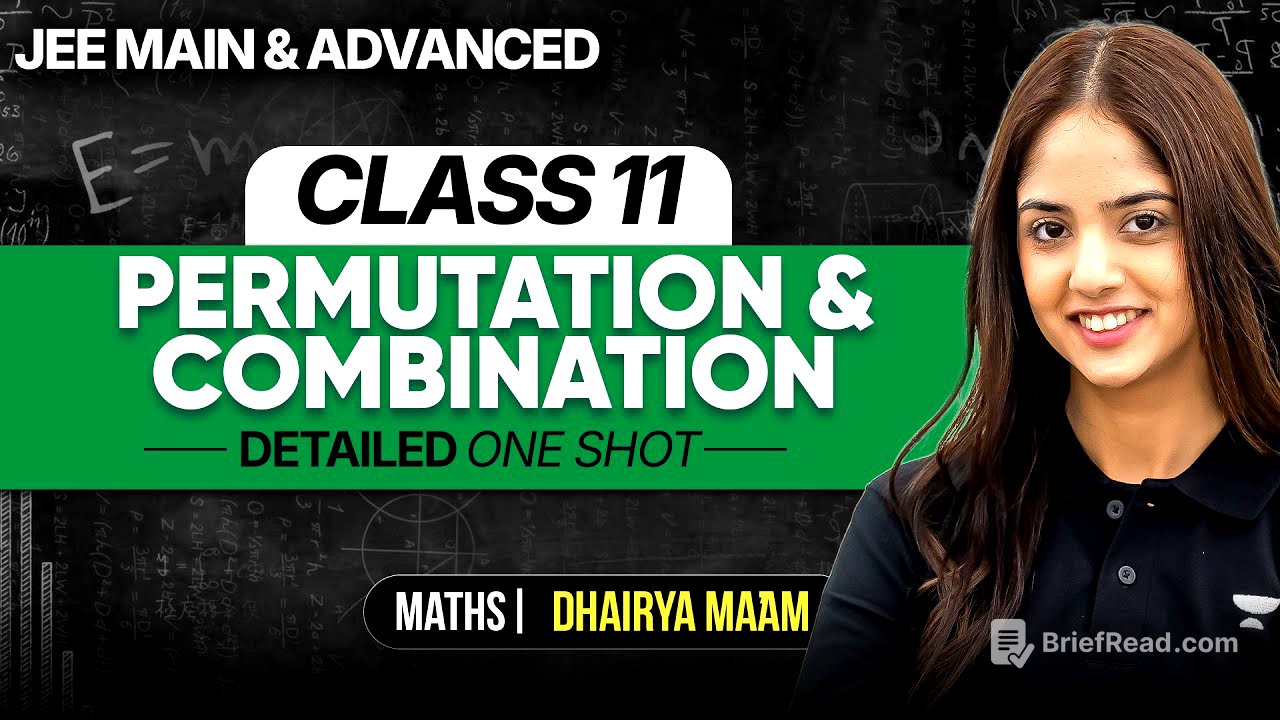
This video discusses combinatorics, focusing on permutations and combinations, factorials, and principles of counting. It covers various techniques used to solve combinatorial problems, emphasizing understanding over rote memorization.
- Covers the basics of combinatorics, definitions, and different methods to count outcomes.
- Discusses factorial notation and its application in combinatorial problems.
- Presents principles such as the fundamental principle of counting, combinations, and permutations with detailed examples and techniques.
Introduction [2:13]
The lecture starts with an overview of combinatorics, focusing on permutations and combinations while taking a break from coordinate geometry. It's highlighted that there'll be a detailed exploration of the techniques involved in permutations and combinations (P&C), based on student demand. The instructor reassures that understanding rather than memorization will be emphasized throughout this session.
Combinatorics [8:38]
Combinatorics is defined as counting methods involving the arrangement and selection of objects. The importance of understanding conditions and types of problems in counting is emphasized. The instructor provides examples, such as counting chairs in rows as a basis for understanding how combinatorial counting works.
Factorial [30:53]
The factorial of a natural number is introduced, detailing its computation by multiplying numbers from 1 to that number. The importance of factorial in combinations and permutations is explained, alongside problem-solving techniques.
Fundamental Principle [1:33:42]
The fundamental principle of counting is introduced, which states how to calculate the total outcomes by multiplying the number of choices available at each step. This principle is illustrated with practical examples involving problems requiring logical thinking rather than formula memorization.
Break [1:56:18]
A brief intermission allows participants to refresh before continuing with more complex combinatorial topics.
Permutations [2:59:57]
Permutations are explored in detail, where the instructor elaborates on how to arrange distinct objects. The format for calculating permutations is discussed, including practical examples of applying these calculations to real-world scenarios.
Combinations [4:14:57]
The concept of combinations is explained as a selection process without regard to order. The instructor presents the formula for combinations and provides examples to illustrate how to apply it in various situations, clarifying when to use combinations versus permutations.
Circular Permutation [4:27:36]
This section discusses circular permutations where arrangements around a circle are addressed. The unique aspects of circular arrangements versus linear arrangements are highlighted, including important formulas and how to derive them.
Division into Groups [4:48:25]
The instructor elaborates on how to divide distinct and identical objects into groups. Steps for calculating the total number of ways to group items, including the application of formulas considering repetitions, are presented.
Inclusion-Exclusion Principles [5:08:46]
The inclusion-exclusion principle is explained as a method for calculating the number of elements in the union of multiple sets, focusing on subtracting overlapping elements to prevent double counting. Detailed examples clarify the application of this principle.
Break [5:26:12]
Participants take another break to recharge before delving into the more advanced topics that follow, solidifying their understanding of the principles learned.
Multinomial Theorem [1:56:18]
The multinomial theorem is introduced, expanding upon the concepts of the binomial theorem. Its applications in combinatorial counting problems are illustrated by practical examples, highlighting its value for solving complex combinatorial scenarios.






![Digimon: The Movies | Teaser trailer (Movie Collection 1) [Discotek Media]](https://wm-img.halpindev.com/p-briefread_c-10_b-10/urlb/aHR0cDovL2ltZy55b3V0dWJlLmNvbS92aS9ReGV2NUhEX1pRRS9ocWRlZmF1bHQuanBn.jpg)