TLDR;
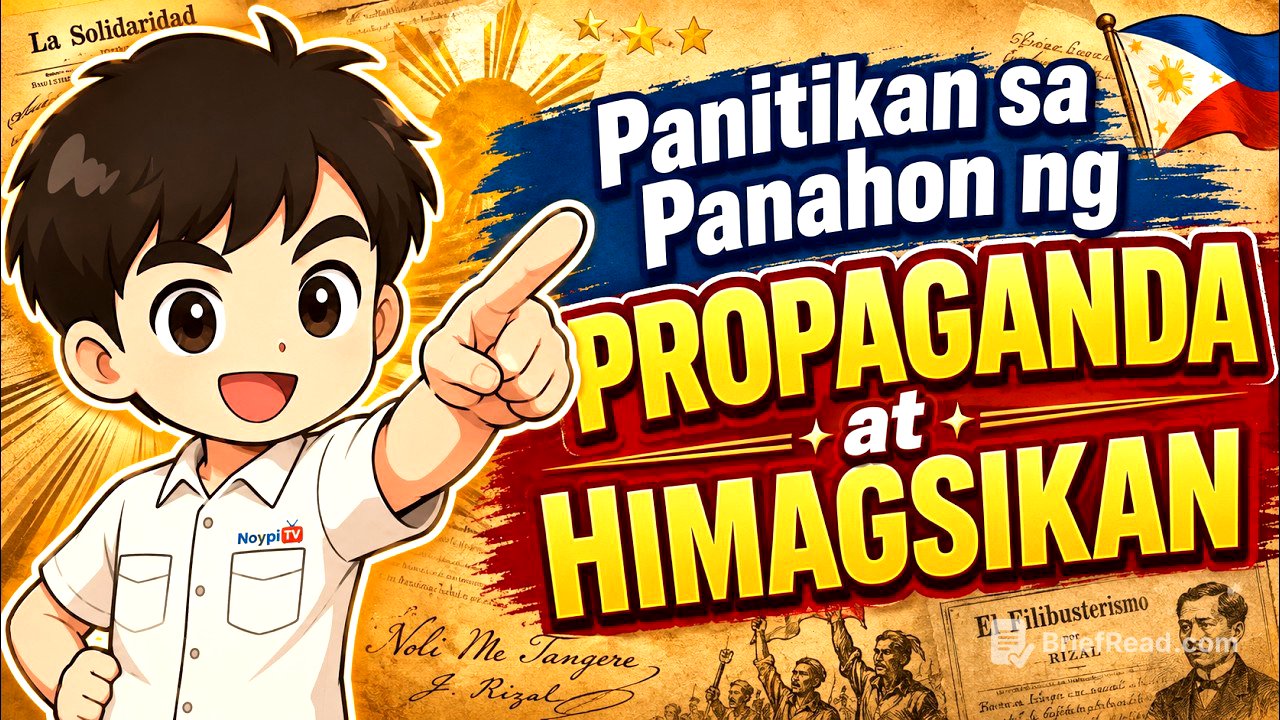
This video discusses Philippine literature during the Propaganda and Revolutionary periods (1872-1896), highlighting its role in the rise of nationalism and the fight for independence. It covers the objectives and works of propagandists like Jose Rizal, Marcelo H. del Pilar, and Graciano Lopez Jaena, as well as revolutionary figures like Andres Bonifacio, Emilio Jacinto, and Apolinario Mabini. The video explains how literature served as a tool to express patriotic sentiments, critique Spanish rule, and inspire Filipinos to seek freedom.
- The Propaganda Movement aimed for reforms through peaceful means, while the Revolutionary Period sought independence through armed struggle.
- Key figures used pseudonyms to protect themselves while writing influential works that exposed injustices and promoted national identity.
- The Katipunan, a secret society, played a crucial role in organizing the revolution against Spanish colonizers.
The Rise of Nationalism in the Philippines [0:33]
The period from 1872 to 1896 marked the emergence of nationalism in the Philippines, with literature becoming a vital tool for expressing this sentiment. Filipinos became aware of their oppressed state and used literature to voice their desire for change and freedom. The Spanish government's failure to address the propagandists' demands intensified patriotic feelings, leading to the revolution led by Andres Bonifacio. This era is divided into the Propaganda Movement, which advocated for reforms, and the Revolutionary Period, which sought independence through armed struggle.
The Propaganda Movement [1:35]
The Propaganda Movement was a period where Filipinos used their writing and intellect as weapons instead of violence. This movement consisted of educated Filipinos who aimed to achieve reforms from the Spanish government. Their objectives included equal rights between Filipinos and Spaniards to end racial discrimination, making the Philippines a province of Spain to grant Filipinos equal rights as citizens, having Philippine representation in the Spanish court to voice the grievances of Filipinos to the government, Filipinizing the parish priests in churches in the country, and granting freedom of the press, speech, assembly, and expression of grievances or petitions. Literature became an important medium for patriotic ideas and calls for reform during this time.
The Revolutionary Period [2:53]
When Spain didn't respond to the demands of the Propaganda Movement, the Philippines entered the Revolutionary Period. This stage was dominated by the belief that revolution was the only way to achieve freedom. The Katipunan, also known as KKK (Kataas-taasang Kagalang-galang Katipunan ng mga Anak ng Bayan), was founded during the Revolutionary Period. It was a secret society with the aim of liberating the country from Spanish colonization. The goals of the Katipunan were to form a strong alliance of Filipinos ready to unite for freedom, to fight through revolution against the colonizers, to liberate the country from Spanish colonization, and to establish an independent republic after the revolution. During this period, literature became bolder, more direct, and full of revolutionary spirit.
Propagandists and Their Works [4:09]
During the Propaganda Movement, illustrados used literature as a weapon to express the country's problems and criticize the Spanish government's mismanagement. Key propagandists included Dr. Jose Rizal, Marcelo Del Pilar, and Graciano Lopez Jaena.
Jose Rizal used the pen names Laong Laan and Dimasalang. His most famous work, Noli Me Tangere, was a novel dedicated to the country that described the state of Philippine society under Spanish rule. This was followed by El Filibusterismo, a novel dedicated to Gomburza, who were three Filipino priests—Mariano Gómez, José Burgos, and Jacinto Zamora—executed in 1872 in Cavite. Rizal also wrote Mi Ultimo Adios, a poem written while imprisoned in Fort Santiago before his execution, and Sobre la Indolencia de los Filipinos, an essay that examines whether Filipinos are truly lazy. Additionally, A la Juventud Filipina is a poem dedicated to Filipino students, who are considered the hope of the nation.
Marcelo H. Del Pilar used the pen names Plaridel, Dolores Manapat, Siling Labuyo, and Piping Dilat. One of his works is Diaryong Tagalog, a newspaper where criticisms of the Spanish government's good governance could be read. Caiingat Cayo is an essay that jokingly and sarcastically criticizes Padre Jose Rodriguez's response to Rizal's Noli Me Tangere. He also wrote Dasalan at Tocsohan, a work based on the catechism but full of opposition to the friars. His works also include Dupluhan, Dalit, and riddles that show his sharpness of writing and social criticism.
Graciano Lopez Jaena used the pen names Bolivar and Diego Laura. Fray Botod is a satirical tale that criticizes friars who are gluttonous, ambitious, and demoralized. A Los Filipinos is a speech aimed at improving the condition of Filipinos. He also wrote Las Dificultades de Filipinas, which refers to the mismanagement and flawed education system in the country, and El Bandolerismo, which discusses his defense that there are no bandits in the Philippines.
Other propagandists include Antonio Luna, who wrote Noche Buena, which describes the real life of Filipinos, and Mariano Ponce, who wrote Alamat ng Bulacan, which contains folk tales.
The Revolutionary Period: Key Figures and Writings [7:35]
Due to the failure of peaceful reforms, the struggle shifted to the Revolutionary Period. During this time, literature became more overt, bolder, and more revolutionary. Important personalities in this period included Andres Bonifacio, Emilio Jacinto, and Apolinario Mabini.
Andres Bonifacio used the pen names Agapito Bagumbayan, May Pag-asa, and Magdiwang. He is recognized as the father of the Katipunan and the father of Philippine democracy. His works include Katapusang Hibik ng Pilipinas, a poem describing the suffering of Filipinos, and Pag-ibig sa Tinubuang Lupa, a poem urging Filipinos to be patriotic.
Emilio Jacinto used the pen names Dimasilaw and Pingkian. He is recognized as the brain of the Katipunan due to his important contributions to the ideology of the organization. His main work is Kartilya ng Katipunan, a work containing the laws and principles of the Katipunan. He also wrote Liwanag at Dilim, which describes the condition of Filipinos in the hands of the colonizers.
Apolinario Mabini used the pen name Bini. He was called the great paralytic because even with polio, he joined the revolution. One of his works is El Verdadero Decalogo or the true commandments, which emphasizes the qualities that Filipinos should possess in order to achieve true freedom and independence. He also wrote El Desarollo y Caida de la Republica Filipina, a work that refers to the Philippine nation.
Conclusion [9:40]
Overall, the literature of the Propaganda and Revolutionary periods demonstrated how Filipinos used writing as a weapon in the struggle for freedom. From peaceful calls for reform to revolutionary literature, the works that awakened the patriotic spirit of the nation became an important part of history.