TLDR;
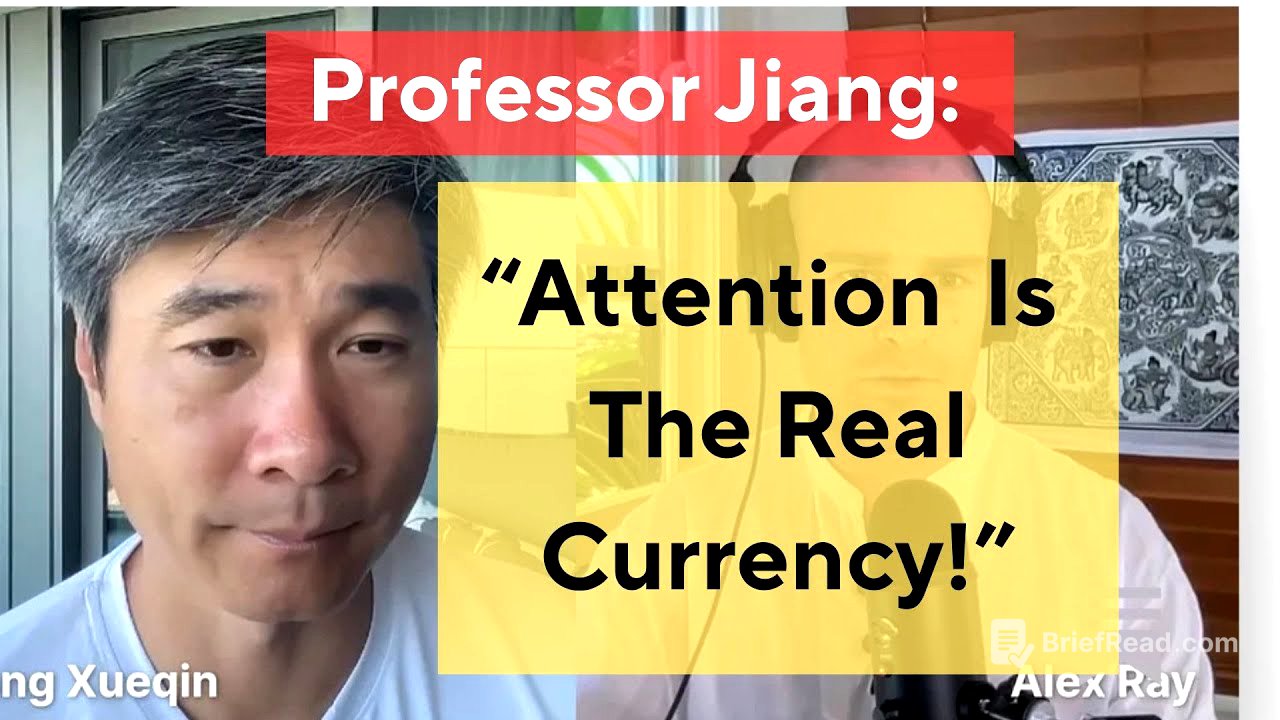
Professor Xang Shu Ching discusses his journey to developing a nuanced approach to history, incorporating psychology and spirituality, which he terms "psycho history." He reflects on his childhood, his experiences at Yale, and his subsequent disillusionment with the world, leading him to develop a game theory-based analysis of geopolitics. He also touches on the nature of reality, the role of consciousness, and the manipulation of society by elites, as well as the potential future of AI and its implications for humanity.
- Psycho history combines psychological and spiritual elements to understand human societies and motivations.
- The elite manipulate society by controlling consciousness and extracting energy from people.
- Individuality and rejecting materialism are key to rebelling against the system.
- The current Western consumer society is in decline and faces a bleak future.
- AI is a tool for enslavement and control, not for freedom and spiritual growth.
Introduction [0:00]
Alex Ray introduces Professor Xang Shu Ching, highlighting his popularity and unique approach to understanding history through psychological and spiritual elements, briefly termed "psycho history." He asks Professor Jang to elaborate on this approach compared to traditional historical perspectives and the importance of incorporating psychology and spirituality.
The Genesis of Psycho History [1:39]
Professor Jang recounts his childhood as an immigrant in Toronto, where bullying led him to retreat into books, particularly science fiction like Isaac Asimov's "Foundation" series. He explains how Asimov's concept of psycho history, using micro data to identify patterns and predict future events, deeply influenced him. Despite finding the writing style of the "Foundation" series poor as an adult, the underlying idea of predictable patterns in human history stayed with him. His life took a turn when he attended Yale, where he observed the social dynamics and values of the elite, initially believing in the triumph of the best ideas and individuals.
Disillusionment and a New Understanding [5:24]
After graduating from Yale, Professor Jang experienced a series of failures and disillusionment, working various jobs and struggling with depression. He realized that the world didn't operate according to the meritocratic principles he had believed in. Playing poker helped him recognize the diversity of human strategies and the importance of psychology in game theory. A pivotal moment occurred through email exchanges with his former Yale professor, David Brahmich, where they discussed geopolitics and he realized his analytical framework could predict events. This led him to teach a class on geopolitics and share his predictions on YouTube, gaining popularity as his predictions proved accurate.
Game Theory and Geopolitics [10:52]
Professor Jang explains that his framework involves understanding human society as a game with different players, emphasizing the psychology of major figures like Putin and Trump. He argues that individuals play to maximize their interests, and understanding this is key to understanding world events. He uses the example of the American war in Venezuela to illustrate his game theory analysis, suggesting that Maduro's actions and subsequent kidnapping were part of a larger plan involving Trump and the overturning of the 2020 election.
Politics as a Show and the Deep State [17:42]
Professor Jang asserts that politics has always been a show, citing George H.W. Bush's involvement in the Epstein files and his relationship with Bill Clinton as examples. He suggests that Bush, a deep state operative, orchestrated events like Iran-Contra and 9/11, and that subsequent presidents like Clinton and Obama were part of a continuous regime implementing similar policies. He views Trump as a disruption to this system, aiming to attack the deep state and install a new one.
The Allegory of the Cave and Control of Consciousness [26:20]
Professor Jang uses Plato's allegory of the cave to explain how the elite control and direct people's consciousness to manifest a reality that benefits them. He argues that institutions like schools, media, and the internet serve to shape consciousness and extract energy from people. He identifies money as a primary tool for directing attention, but also warns of artificial intelligence as a future mechanism for controlling perception and maintaining power.
Science, Secret Societies, and the Nature of Reality [31:20]
Professor Jang contends that science itself was a creation of Freemasons, designed to replace previous history with a purposeless interpretation of the world. He discusses the theory of evolution as a problematic concept that quickly dominated global education. He also touches on the idea that secret societies have attained powers over the mind and use them immorally, understanding that the nature of reality is not true and that what happens in this realm is not as important as what happens in the monad, giving them license to behave as they want in this world.
Individuality and Rebellion [38:09]
Professor Jang explains that the idea of individuality and individual creativity is the greatest threat to the system. He argues that the only way out is for individuals to embrace their consciousness, reject materialism and status, and focus on their own creativity and impact on others. He emphasizes that this act of rebellion requires courage, as it involves abandoning societal norms and expectations.
The Elite and the Lack of Meaning in the West [43:30]
Professor Jang asserts that the Epstein files reveal that the elite are not special or morally superior, but rather born into positions of power. He explains that the elite engage in disturbing activities like those revealed by the Epstein files because they are bored and seeking excitement. He also touches on the cultural malaise and lack of meaning in the West, attributing it to the provincial nature of the Anglosphere and the superficiality of the English language.
The Decline of Western Society and the Future [51:43]
Professor Jang expresses pessimism about the future of Western society, predicting a long period of decline. He argues that consumer liberal democracy has conquered the world but lacks meaning and is unsustainable. He warns of a coming magnetic pole excursion that will reset the game and destroy much of humanity. He suggests that previous civilizations were more advanced and based on spiritual enlightenment rather than material greed.
Resilience and the Power of Will [1:01:52]
Professor Jang dismisses the idea that AI will lead to more leisure time, arguing that it will instead result in the enslavement of mankind and the capture of conscious energy. He emphasizes the importance of resilience and the power of will in navigating the coming crisis. He concludes by stating that those who prioritize learning, wisdom, and helping others will thrive in the coming age of darkness.