TLDR;
In this video, Armando Hasudungan discusses the role of the innate immune system and its response to pathogen invasion in tissue. The chapter outlines the recruitment of leukocytes, the process of inflammation, and the importance of complement proteins in fighting off infections. It also explains how dendritic cells activate and communicate with adaptive immune cells, bridging the innate and adaptive immune responses.
- The innate immune system acts quickly to halt pathogen invasion.
- Neutrophils are essential for initial defense and recruitment of other immune cells.
The Lymphoid Precursor and T-Cell Development [0:18]
The video begins by explaining how the lymphoid precursor cell, destined to become a T-cell, enters the thymus. Initially, this precursor does not express CD8 or CD4 co-receptors. As the T-cell develops in the thymus, it differentiates into a naive T-cell that expresses both co-receptors. These naive T-cells then mature into either CD8 or CD4 T-cells, eventually migrating to peripheral lymphoid organs like lymph nodes, where they participate in immune responses.
Introduction to the Innate Immune Response [1:32]
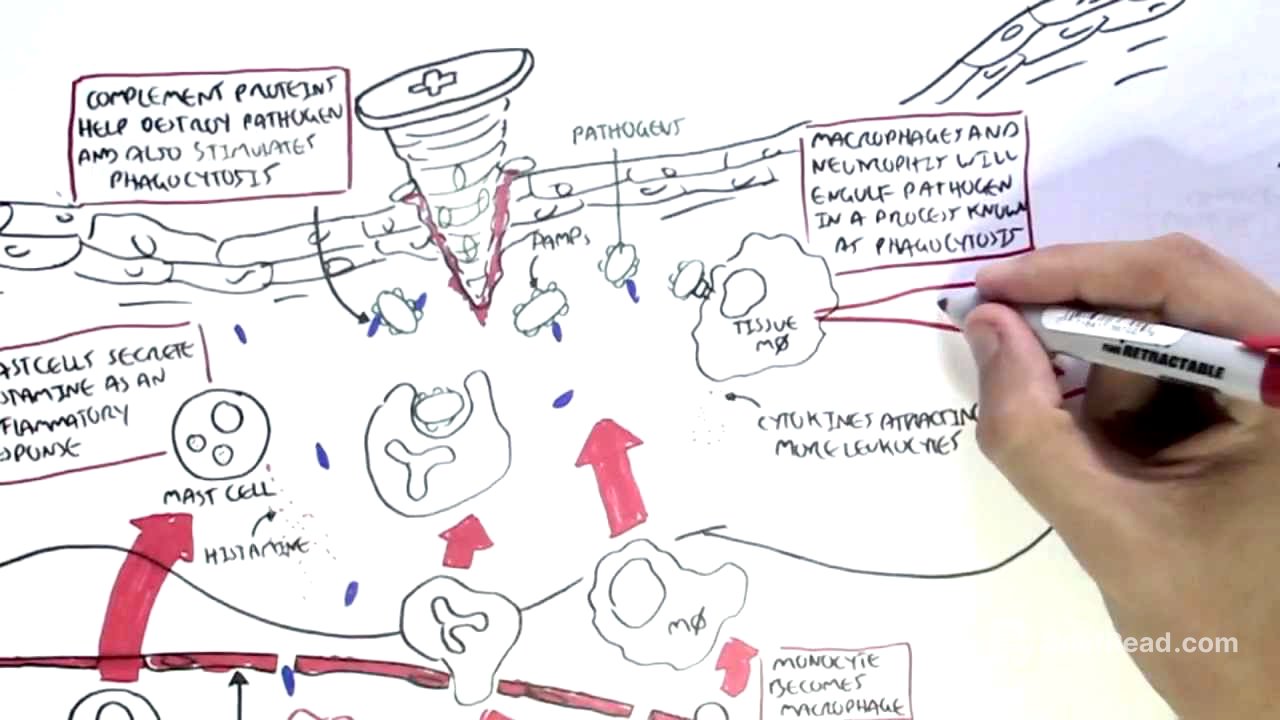
The video transitions into describing the innate immune system's role when a pathogen invades tissue, such as through a puncture in the skin. It highlights that upon invasion, tissues may become inflamed and that chemical signals will recruit leukocytes to the affected site. Complement proteins significantly aid the innate immune response by enhancing leukocyte function and pathogen destruction.
Mechanisms of Pathogen Recognition and Inflammation [1:58]
In response to pathogen intrusion, the innate immune system's primary action is to contain and halt pathogen spread. This is crucial during the first exposure to a pathogen when the innate immune system needs to wait for adaptive immune cells to respond. Dendritic cells play a vital role by activating after they engulf the pathogen, transporting antigens to lymph nodes to present them to T and B cells, thus activating the adaptive response.
The Phagocytic Response and Complement Activation [3:20]
The discussion includes what happens to healthy tissue upon pathogen entry. The innate immune cells, such as macrophages and neutrophils, recognize pathogen-associated molecular patterns (PAMPs) and initiate an inflammatory response. Macrophages secrete cytokines to draw in more leukocytes, while histamine increases blood vessel permeability. As neutrophils are fast-acting, they arrive quickly to engulf pathogens via phagocytosis, aided by complement proteins that stimulate and enhance this process.
Conclusion and Overview of the Immune Response [6:54]
The video concludes with a summary of the involvement of macrophages and neutrophils in the innate immune response. It emphasizes the significance of these cells in phagocytosis and cytokine secretion, which further recruits other immune cells to combat the infection effectively. The interconnectedness between the innate and adaptive immune systems is reiterated, highlighting how they work together to recognize and eliminate pathogens.