TLDR;
This video provides an introduction to the Open Systems Interconnection (OSI) model, explaining its purpose, layers, and how it facilitates network communication. The OSI model is a reference tool for understanding how applications communicate over a network, ensuring hardware and software interoperability. The video uses a story to illustrate the functions of each of the seven layers: Application, Presentation, Session, Transport, Network, Data Link, and Physical.
- The OSI model is a reference for application communication over a network.
- It consists of seven layers, each with specific functions.
- The video uses a story to explain each layer's role in data transmission.
Introduction to the OSI Model [0:00]
The video introduces the OSI model as a crucial concept for understanding network communication. It explains that the OSI model is a reference tool that helps to understand how data is transferred between computers on a network, even if they are running different operating systems. The OSI model was introduced in 1976 by the International Organisation for Standardisation (ISO) to guide technology vendors and developers in creating interoperable hardware and software.
OSI Model Layers [1:43]
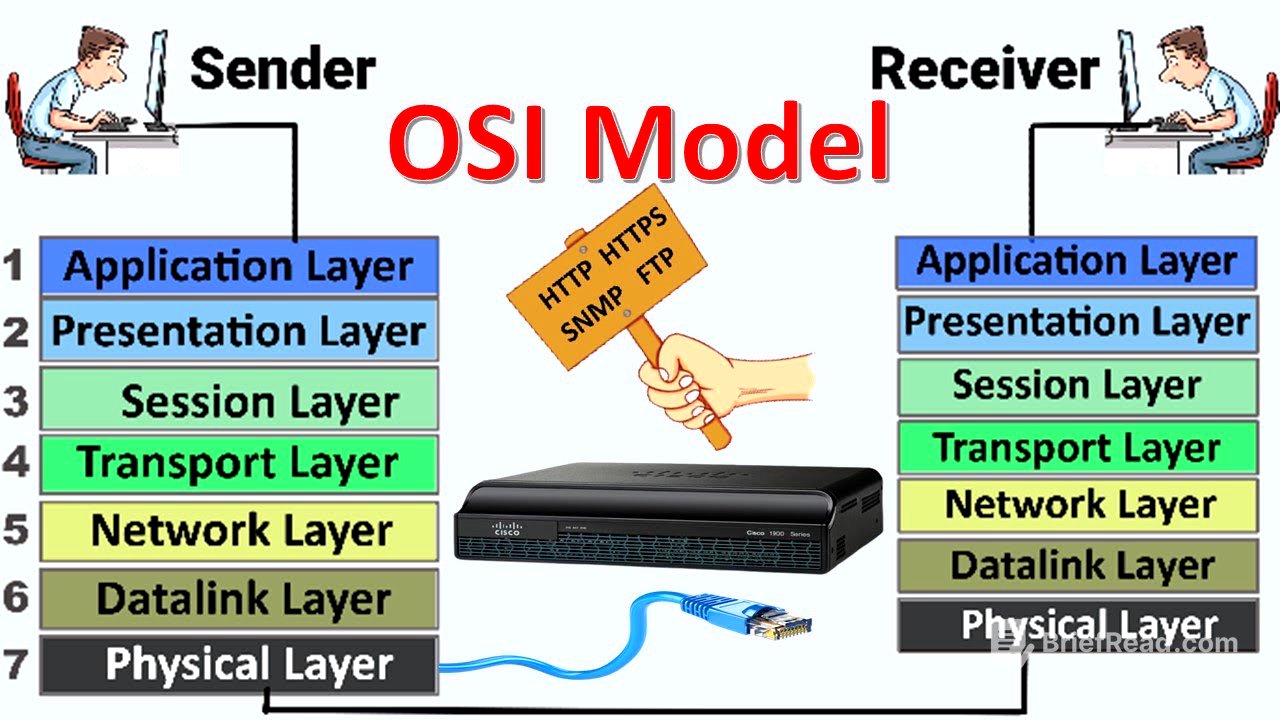
The OSI model consists of seven layers: Application, Presentation, Session, Transport, Network, Data Link, and Physical. A mnemonic phrase, "All People Seem To Need Data Processing," is provided to help remember the order of the layers. The video highlights that each layer has a specific function and that the top three layers (Application, Presentation, and Session) are considered software layers, while the bottom three (Network, Data Link, and Physical) are hardware layers. The Transport layer is described as the backbone or heart of the OSI model, connecting the software and hardware layers.
Sender vs. Receiver Perspective [2:50]
The video addresses a common question about which layer is the first layer of the OSI model. It clarifies that the answer depends on whether you are on the sender or receiver side. For the sender, the Application layer is the first layer because the sender interacts with it first. For the receiver, the Physical layer is the first layer because it is the first to interact with the incoming data. All seven layers work together to transfer data from one computer to another.
Story Explanation of OSI Model [5:18]
To explain how the OSI model works, the video presents a story about a company in Qatar with seven employees, each representing a layer of the OSI model. The CEO (Abdul, representing the Application layer) wants to send 400 pages of documents to another company. Each employee then performs a specific task: translating the documents (Presentation layer), establishing a connection with the receiver (Session layer), dividing the data into segments (Transport layer), adding addresses (Network layer), sealing the envelopes (Data Link layer), and physically delivering the envelopes (Physical layer).
Unwrapping the Story: Application Layer [11:35]
The video begins to unwrap the story, starting with Abdul, who represents the Application layer. The Application layer provides the interface for the user and includes protocols like HTTP, HTTPS, SNMP, and FTP, which are used by applications like web browsers, email clients, and file-sharing applications. The Application layer's task is to provide an interface to the user.
Unwrapping the Story: Presentation Layer [12:57]
Pintu, who translates the documents from Arabic to English, represents the Presentation layer. The Presentation layer converts data into a machine-understandable binary format and performs data translation, encryption, and decryption. It ensures that the data is presented in a format that the receiving application can understand, such as .mp3, .docx, or .pdf.
Unwrapping the Story: Session Layer [14:58]
Sakip, who contacts the receiver and establishes a connection, represents the Session layer. The Session layer establishes and maintains an end-to-end connection between the sender and receiver, ensuring that all data is received without loss. It manages the session until all data is successfully transmitted and acknowledged.
Unwrapping the Story: Transport Layer [15:58]
Tuba, who divides the 400 pages into smaller units, represents the Transport layer. The Transport layer divides data into smaller segments, controls data flow, and manages error control. It uses protocols like TCP (Transmission Control Protocol) for reliable, connection-oriented transmission and UDP (User Datagram Protocol) for fast, connectionless transmission.
Unwrapping the Story: Network Layer [18:10]
Noor, who puts the "to" and "from" addresses on each segment, represents the Network layer. The Network layer is responsible for logical addressing, routing, and path determination. It adds IP addresses to the packets and determines the best path for the data to travel. Routers operate at this layer.
Unwrapping the Story: Data Link Layer [18:51]
Danish, who seals the envelopes, represents the Data Link layer. The Data Link layer adds the sender and receiver MAC addresses to each packet, creating a frame. This layer allows the upper layers to access the physical media and ensures reliable transmission over a single link.
Unwrapping the Story: Physical Layer [19:48]
Peter, who physically delivers the envelopes, represents the Physical layer. The Physical layer converts the binary data into signals and transmits them over the physical medium, such as electrical signals over Ethernet cables or light signals over optical fibre cables.
Receiver Side and Conclusion [20:26]
The video concludes by explaining that the receiver side mirrors the sender side but in reverse. The Physical layer receives the signals and converts them back into binary data, which is then passed up through the layers, with each layer performing its corresponding function in reverse order. The video summarises the basic functionality and importance of the OSI model in networking.