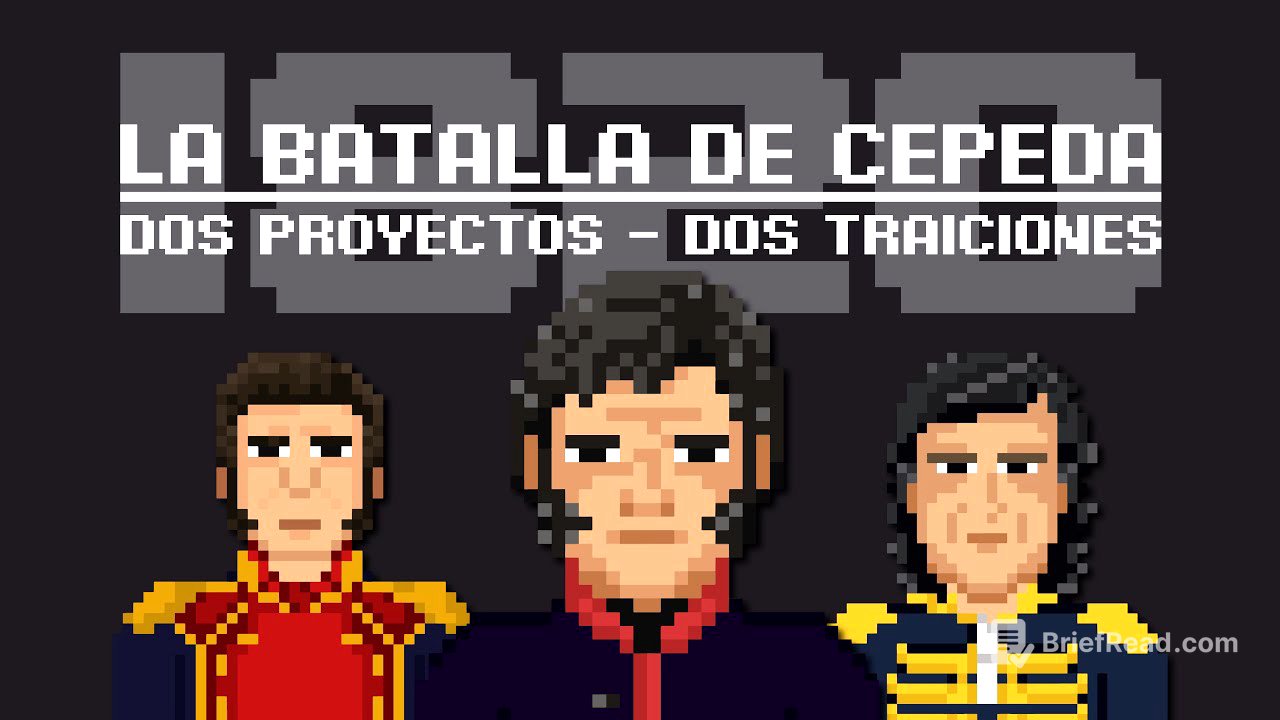
TLDR;
The video discusses the conflicts and power struggles in the Río de la Plata region around 1819, focusing on two main projects: the United Provinces, which sought a centralized, Buenos Aires-led government, and the League of Free Peoples, advocating for a federal system under the leadership of José Artigas. It covers key events such as the Battle of Cepeda, the treaties of Pilar and Benegas, and the deaths of prominent figures like Carrera and Ramírez, ultimately leading to a fragmented political landscape.
- Two Criollo projects: United Provinces vs. League of Free Peoples.
- Key figures: Artigas, López, Ramírez, and Dorrego.
- Treaties: Pilar and Benegas.
- Battles: Cepeda.
- Outcomes: Federalism, provincial autonomy, and political fragmentation.
Capítulo 1: Dos proyectos [0:23]
In 1819, two conflicting projects emerged in the Río de la Plata: the United Provinces and the League of Free Peoples. The United Provinces, based in Buenos Aires, aimed to establish a centralist government akin to the old viceroyalty, with Buenos Aires at its head. This project favored an international division of labor, exporting raw materials to England in exchange for manufactured goods, benefiting the landowning class. Despite facing numerous challenges, the United Provinces, which declared independence in Tucumán, managed to persist through various forms of government.
Liga de los Pueblos Libres [3:40]
The League of Free Peoples, led by José Artigas, sought a more radical revolution, advocating for a federal system where sovereignty resided in each province. This league emphasized autonomy and equality among provinces, contrasting with Buenos Aires' centralist ambitions. Artigas's vision extended to empowering indigenous populations, as seen in the Guaraní people regaining sovereignty in the Misiones region. The league also opposed unrestrained economic liberalism, promoting local industry through trade regulations.
Reglamento de Tierras [5:22]
Artigas's Reglamento de Tierras of 1815 proposed distributing land among the most disadvantaged, including free blacks, zambos, indigenous people, widows, and poor Creoles. Beneficiaries were required to build a dwelling and corrals within two months, with the land reverting to the state if they failed to comply. This agrarian reform aimed to prevent land accumulation by large landowners, a stark contrast to developments in Buenos Aires.
Guerra a tres frentes [6:31]
The League of Free Peoples faced a war on three fronts, which undermined its consolidation. Besides fighting the Buenos Aires directorate, Andresito Artigas battled Paraguayans and Portuguese forces. The Portuguese, allied with the English, received support from the Buenos Aires directorate, which agreed to cede the Banda Oriental to remove Artigas. Manuel García negotiated this agreement, representing the interests of the Buenos Aires merchant class.
Mientras tanto el Directorio... [7:49]
While the Eastern Crisis was happening, the Congress of Tucumán declared independence on July 9. Córdoba was brought into their sphere of influence. Puerredón became the director, supporting San Martín's campaign in Chile and Admiral Brown. However, he also invaded the littoral provinces, sent García to negotiate the surrender of the Banda Oriental, moved the congress to Buenos Aires, and sought a European king.
Los caudillos del Litoral [8:55]
As the Banda Oriental remained occupied by the Portuguese, Artigas delegated authority to the caudillos of the littoral: Francisco "Pancho" Ramírez and Estanislao López. These leaders from Santa Fe and Entre Ríos rose to prominence during the independence war and opposed the directorate.
Se cierran las fronteras [9:35]
In October 1819, López closed communications between Buenos Aires and the interior, initiating a series of attacks in southern Santa Fe. In response, Rondó summoned national forces, including the Army of the North and the Army of the Andes, to fight in the civil war. However, widespread rejection of the new constitution led to disobedience, marking the beginning of the "anarchy of the year 20."
Fuerzas Unitarias [10:48]
Rondó was left to defend Buenos Aires with city garrisons, including the Batallón Número Tres de los Tercios Cívicos, the Batallón de Aguerridos, artillery, dragoons, and militias.
Fuerzas Federales [10:59]
The federal army consisted of 2,300 troops: 700 from Entre Ríos under Ramírez, 600 from Santa Fe contributed by López, 600 indigenous Avipones from the Chaco, 400 Correntinos led by Campbell, and a foreign escort commanded by José Miguel Carrera. Estanislao López ceded command to Ramírez for the battle due to Ramírez's experience in open-field engagements.
Los federales le duermen los caballos a Rondeau [11:34]
In early January, the two armies converged on the Arroyo del Medio. On January 31, the federales launched a surprise night attack, stealing most of the directorate's horses, leaving Rondó in a difficult position.
Estrategia Unitaria [12:09]
Rondó used the Cañada de Cepeda for protection on one flank and a wall of carts to guard the rear. He formed his troops with infantry in the center and cavalry on the flanks, but his cavalry was weak.
Empieza la Batalla [12:30]
The federal army, primarily cavalry, arrived at the field around 9 AM and began to encircle Rondó's forces. Ramírez's troops crossed the cañada, outflanking Rondó, who had to reverse his formation. Around midday, the federales launched a fierce charge, overwhelming Rondó's column. Simultaneously, Ramírez routed Castellanos, leaving Balcarce to defend the center with only 900 men.
El destina será Federal [13:45]
Balcarce formed a square around the artillery and resisted for over three hours before retreating to San Nicolás and then to the capital. This retreat marked the directorate's defeat. Ramírez reported 340 casualties, with only 40 federales among them. López and Ramírez entered the Plaza de la Victoria in Buenos Aires, tying their horses to the central pyramid as a sign of dominance. They demanded autonomy and federalism, giving Buenos Aires ten days to become a province.
¿Artigas? ¿qué haces? [14:45]
Rondó resigned, the Congress of Tucumán was dissolved, and the Constitution of 1819 was rejected. A junta of representatives was formed, electing Manuel de Sarratea as governor. Buenos Aires transformed into a province, ending centralism and embracing provincial autonomy.
Capítulo 2: Dos traiciones [14:59]
The federalist cause prevailed in the Río de la Plata, but Artigas still needed to defeat the Portuguese to establish a greater nation.
El Ocaso del Protector [15:30]
Artigas sought support from his ally, Rivera, who betrayed him by signing a pact with the Portuguese. Isolated, Artigas retreated westward and learned of the Treaty of Pilar.
Tratado del Pilar [16:00]
The Treaty of Pilar, signed by López, Ramírez, and Sarratea, proclaimed national unity and a federal system, aligning with Artigas's goals. It also opened river navigation and convened a congress in San Lorenzo. However, Artigas was only addressed as "capitán general," and the treaty vaguely acknowledged Buenos Aires's assistance against Portugal, ignoring Artigas's ongoing war and the foreign occupation.
Artigas vs Ramírez [17:55]
Ramírez accused Artigas of betrayal and declared war. Artigas marched towards Concepción del Uruguay, winning initial battles but later facing defeat as Sarratea sent Lucio Norberto Mancilla with a squadron to aid Ramírez. Artigas retreated to Corrientes, where he received support from locals, but the province was in chaos due to the Portuguese invasion and the defection of Cacique City.
La aurora de panchito [19:11]
Artigas was pursued to Misiones, where he was defeated by Ramírez and exiled to Paraguay. This marked the end of the League and the rise of Ramírez, who established the Republic of Entre Ríos, including Entre Ríos, Corrientes, and Misiones.
Retornan los directoriales [20:32]
While Ramírez and Delfina were occupied east of the Paraná, the directorials, led by Balcarce and Soler, returned to Buenos Aires. They overthrew Sarratea for failing to deliver promised armaments. López intervened with the help of Carrera and Alvear, winning in Cañada de la Cruz and forcing Soler's resignation.
López vs Dorrego [21:22]
Manuel Dorrego, a federalist, counterattacked and expelled them from the province, defeating López in Pavón. López used "mio mio," a toxic plant, to poison Dorrego's horses, leading to victory in El Gamonal.
Tratado de Benegas [23:34]
López sought reparations for the Treaty of Pilar, but Governor Martín Rodríguez refused. Juan Manuel de Rosas agreed to pay the debt secretly with cattle. Juan Bautista Bustos, the governor of Córdoba, guaranteed the treaty.
Lo durmieron a Ramírez [24:07]
Ramírez was excluded from the Treaty of Benegas. He abandoned his plans in the east and prepared to attack Buenos Aires, but López refused passage through Santa Fe, leading to conflict between the caudillos.
La campaña de Ramírez [24:50]
In April 1821, Ramírez launched an offensive, defeating La Madrid in Coronda but was betrayed by Mancilla and López. He fled westward, meeting Carrera in Córdoba, but they disagreed on their next steps.
Mueren Carrera y Ramírez [25:30]
Carrera was captured and executed in Mendoza, his body parts displayed in various cities. Ramírez attempted to return to Entre Ríos but was killed in Río Seco. His head was sent to López, who displayed it in a cage.
Panorama Final [26:41]
Estanislao López and Martín Rodríguez emerged as key figures. Rodríguez focused on the southern frontier, while Rivadavia dominated Buenos Aires, undermining the Congress of Córdoba. Misiones and the Banda Oriental remained under Portuguese control. José Ricardo López Jordán briefly succeeded Ramírez but was ousted by Mancilla. Other provinces experienced instability and fragmentation.



![Digimon: The Movies | Teaser trailer (Movie Collection 1) [Discotek Media]](https://wm-img.halpindev.com/p-briefread_c-10_b-10/urlb/aHR0cDovL2ltZy55b3V0dWJlLmNvbS92aS9ReGV2NUhEX1pRRS9ocWRlZmF1bHQuanBn.jpg)