TLDR;
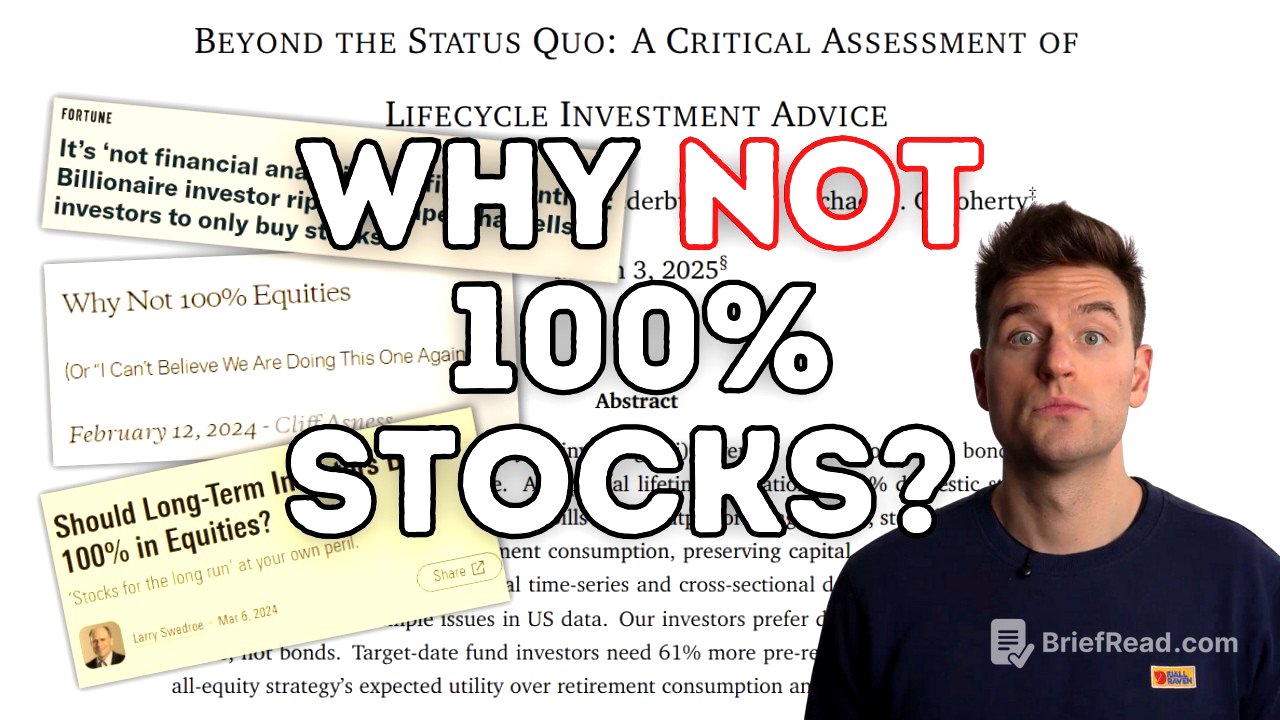
This video summarizes the 2025 paper "Beyond the Status Quo," which challenges conventional life cycle investment advice. The paper suggests that investors should maintain globally diversified, 100% stock portfolios throughout their lives, even in retirement. The analysis uses a block bootstrap method to simulate returns based on historical data from 39 developed countries.
Key points:
- The paper advocates for a 100% equity portfolio, challenging the traditional shift to bonds as investors age.
- It uses historical data and simulations to support its findings, addressing common criticisms and alternative scenarios.
- The analysis considers factors like home country bias, leverage, and the impact of stock market valuations.
Introduction [0:00]
The video introduces a controversial academic paper, "Beyond the Status Quo," which suggests that investors should hold globally diversified 100% stock portfolios throughout their lives, including retirement. The presenter, Ben Felix, acknowledges his familiarity with the paper and its co-authors, emphasizing that the paper's findings, while controversial, are worth careful consideration. The video aims to explain the paper's methodology, findings, and practical implications, addressing criticisms and exploring various scenarios.
Status Quo vs. Block Bootstrap [2:09]
The video contrasts the paper's approach with the status quo life cycle investment advice, which typically involves shifting from stocks to bonds as investors age. The paper uses a block bootstrap method to simulate return scenarios for stocks, bonds, and bills based on historical data from 39 developed countries, dating back to 1890. This method maintains important characteristics of stock and bond returns, such as serial correlation, volatility clustering, and skewness, which are often overlooked in traditional models. The authors assume that the historical experiences of developed countries are interchangeable for the purpose of estimating the expected distribution of returns for any given country.
Optimal Asset Allocation and Utility Measurement [6:15]
The paper measures the optimal asset allocation based on utility over real retirement consumption and bequest, considering factors like labor income risk, social security income, and longevity risk. In the base case, the optimal allocation is found to be 33% domestic stocks and 67% international stocks. The paper compares this optimal allocation against other strategies, such as 100% bills, 100% domestic stocks, a 60/40 portfolio, and a target date fund, by measuring the portion of income that would need to be saved to match the utility of the base case. The analysis finds that the optimal all-equity portfolio performs well even in adverse scenarios, with a lower chance of running out of money compared to other allocations.
Dynamic Asset Allocation and Data Constraints [9:38]
The paper explores whether allowing households to dynamically adjust their asset allocation each year changes the optimal portfolio. The results indicate that the optimal portfolio remains primarily all equity, except for a brief period at retirement where a small allocation to bills may be beneficial. However, this cash allocation disappears when a flexible spending strategy is used. The video highlights that the 100% equity result is contingent on using the large global sample for international and domestic stocks. When the analysis is constrained to domestic data only or uses independent and identically distributed returns, bonds play a more significant role in optimal allocations.
Conditioning on Price-Dividend Ratio [10:55]
The authors examine the impact of conditioning asset allocation on the price-dividend ratio of the domestic stock market. They divide months into quintiles based on the lagged price-to-dividend ratio and allow households to choose a different asset allocation in each quintile. The optimal portfolio remains similar to the base case across the middle quintiles. In the highest valuation quintile, the domestic stock allocation is decreased, with a greater allocation to international stocks and a small allocation to bonds. The primary benefit comes from reducing the allocation to domestic stocks when valuations are high, rather than allocating to bonds.
Alternative Scenarios and Robustness Checks [12:45]
The paper addresses critiques by examining various alternative scenarios and robustness checks. These include restricting the sample to the post-World War II period, countries with large populations, and countries with developed financial markets. The authors also exclude the US market entirely to assess its impact on the optimal portfolio. The optimal portfolio remains almost completely unchanged across a range of specifications for bootstrap block length, household risk aversion, bequest motives, withdrawal strategies, retirement age, savings rates, and household composition.
US Exceptionalism and Labor Income Correlation [15:57]
The paper considers the possibility of US exceptionalism and assigns probabilities to the US continuing to have outlier returns. If an American investor is highly confident that future US market returns will resemble the past, they will hold a larger allocation to US stocks. The authors also analyze the relationship between labor income, the domestic stock market, and optimal home country bias. A high correlation between labor income and the domestic stock market reduces the optimal home country allocation.
Leverage Analysis [17:18]
The paper examines the impact of leverage on the optimal portfolio. At a medium borrowing cost, the household borrows 55% of their wealth and invests in the base case optimal all-equity portfolio, which materially decreases the utility-matched savings rate. Using the same amount of leverage to invest in a portfolio of 60% domestic stocks and 40% bonds would require a significantly higher savings rate to match the utility of the base case unlevered 100% equity portfolio. In the lowest cost of leverage case, the household borrows 100% of their wealth and invests in a portfolio of 28% domestic stocks, 57% international stocks, and 15% bonds.
Conclusion [20:01]
The video concludes by summarizing the key findings of the paper and cautioning against taking the precise results as strict instructions. The presenter emphasizes that the paper's insights are directionally useful, highlighting the long-term attractiveness of stocks, the importance of international diversification, and the limited impact of timing asset class exposures based on valuations. The analysis is based on simulations derived from historical data, and the future could differ from the past. Investor behavior and downside volatility aversion also need to be considered.