TLDR;
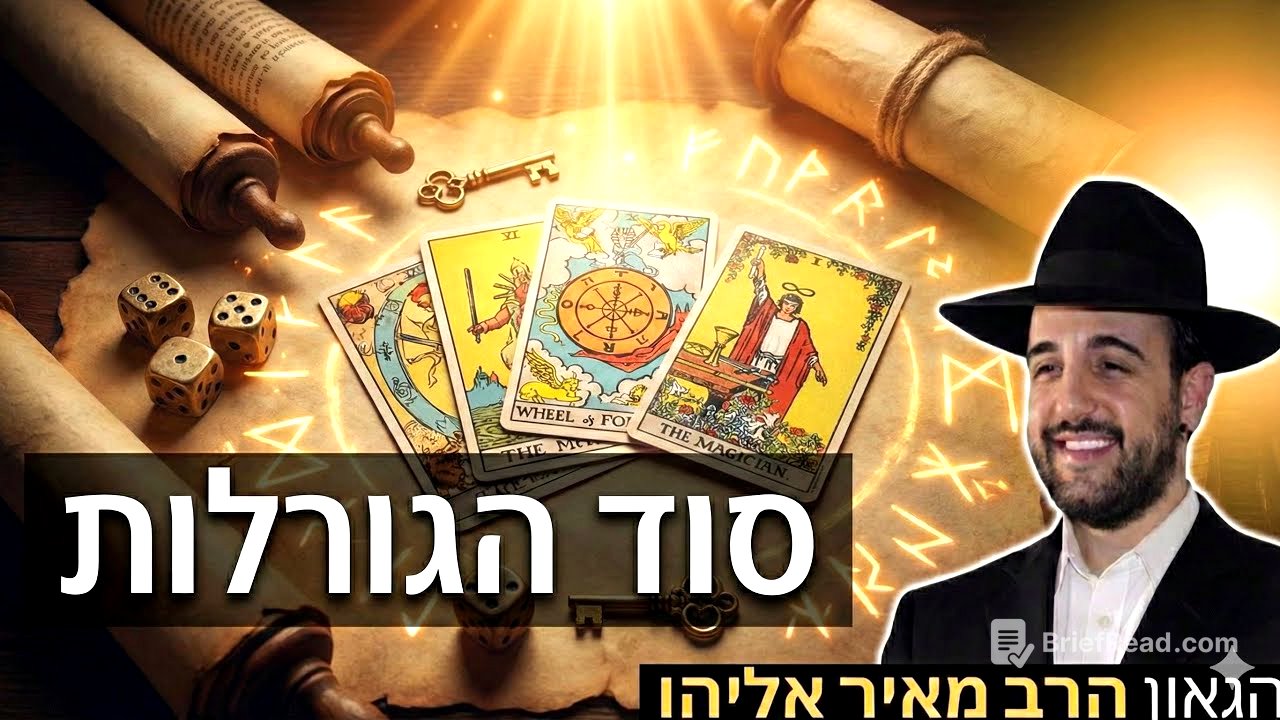
This lecture explores the permissibility of using lots (Goral) for various purposes in Jewish law, including dividing property, identifying criminals, and making future decisions. It examines biblical, Talmudic, and Kabbalistic sources, revealing that while lots were used in the past, their validity today is limited. The lecture distinguishes between using lots for:
- Predicting the future (forbidden).
- Dividing assets or assigning mitzvot (generally permitted).
- Uncovering hidden truths (permitted only under specific, extraordinary circumstances).
Introduction to the Topic of Lots [0:00]
The lecture introduces the topic of using lots (Goral) to resolve doubts and make decisions, a practice found throughout Jewish tradition. It outlines several scenarios where lots might be considered, such as dividing inherited property fairly among equal heirs, identifying a thief when conventional methods fail, or seeking guidance on future actions like marriage or business ventures. The lecture also mentions the use of a pendulum, a related but distinct topic to be discussed in a future session. The central question is whether a lot is a random tool or a means through which divine will is expressed. The lecture aims to explore the concept of "Goral HaHol" (casting lots with sand), a Kabbalistic method of divination.
Lots in the Torah [5:10]
The lecture examines the use of lots in the Torah, noting its presence in various contexts, including the division of the land of Israel, the selection of the scapegoat on Yom Kippur, and the appointment of elders. However, it emphasizes that each instance had unique circumstances, such as the involvement of the Urim and Thummim or divine prophecy, making it difficult to apply these examples to ordinary situations.
Dividing the Land of Israel by Lots [6:12]
The Torah describes dividing the land among the tribes using lots to avoid disputes. Each tribe would draw a lot indicating their portion. However, the Gemara clarifies that this process involved the Urim and Thummim and prophecy, with the High Priest announcing the results through divine inspiration. The lots served to confirm the divinely revealed allocation, not as a standalone decision-making tool.
The Scapegoat on Yom Kippur [10:03]
On Yom Kippur, two goats were chosen, one "for God" and one "for Azazel," through a lottery. The Zohar states that the lots would leap from the High Priest's hands and attach to the designated goat's horns, indicating divine intervention. This supernatural element distinguishes it from ordinary lotteries.
Selecting the 70 Elders [11:28]
Moses chose 70 elders to assist him by using lots. He wrote "elder" on 70 tickets and left two blank. Candidates who drew a ticket marked "elder" were chosen, while those who drew a blank were not. This method ensured fairness and prevented conflict. However, the lecture questions whether this example justifies using lots for public appointments today, especially given the potential for corruption.
Lots in the Prophets [16:58]
The lecture explores instances of lots in the books of the Prophets, including the story of Achan, King Saul, and Jonah.
Achan's Transgression [17:10]
After a defeat, Joshua used lots to identify Achan, who had violated the ban by taking spoils from Jericho. While this seems like a valid use of lots to uncover wrongdoing, some scholars argue that Achan's subsequent confession was the basis for his punishment, not the lot itself. Additionally, God instructed Joshua to use lots, suggesting divine involvement.
King Saul and Jonathan [21:47]
King Saul used lots to determine why he was losing a battle, which revealed that his son Jonathan had unknowingly violated a vow. However, this example is also problematic because Saul possessed Ruach HaKodesh (divine inspiration).
Jonah and the Storm [22:20]
The story of Jonah is examined, where sailors cast lots to identify the cause of a storm, which fell upon Jonah. The lecture questions whether this justifies using lots in life-threatening situations, considering the sailors were non-Jews and Jonah ultimately confessed. The lecture notes that the sailors cast lots multiple times, using different methods, and observed other signs pointing to Jonah's guilt. The lecturer cites differing opinions on whether it's permissible to learn from this story, especially since the sailors were gentiles.
Practical Halachic Implications [39:39]
The lecture transitions to the practical halachic implications of using lots today. It cites the Magen Avraham, who permits using lots to resolve disputes over who should lead prayers or perform mitzvot. The Shulchan Aruch prohibits consulting astrologers or using lots for divination. The lecture reconciles these conflicting views by distinguishing between using lots for:
- Determining the future, which is forbidden.
- Resolving current issues, such as dividing property or assigning honors, which is permitted.
Dividing Assets and Assigning Mitzvot [41:33]
The lecture discusses the permissibility of using lots to divide assets or assign mitzvot, citing the Gemara in Bava Batra. It notes that lots can be used to divide physical assets or sentimental items, like a deceased relative's tallit or tefillin. The Chavat Yair rules that if a lottery is conducted improperly, the results are invalid and must be redone.
Seeking Future Guidance
The Shulchan Aruch forbids using lots to predict the future, comparing it to astrology. This prohibition stems from the Torah's commandment to be "wholehearted with the Lord your God," which implies avoiding divination.
Three Distinctions Regarding Lots [52:36]
The lecture summarizes three distinctions regarding the use of lots:
- Using lots to predict the future is strictly forbidden.
- Using lots to divide assets or assign mitzvot is permissible.
- Using lots to uncover hidden truths is permissible only under extraordinary circumstances, such as when there is divine guidance or strong circumstantial evidence.
Goral HaHol (Casting Lots with Sand) [55:23]
The lecture explores the Kabbalistic practice of "Goral HaHol," which involves drawing random dots on sand or paper and interpreting the resulting patterns to answer questions about the future. The lecturer describes the process, noting that it involves focusing on the question while making the marks and then consulting a book to interpret the patterns.
Conflicting Opinions on Goral HaHol [1:01:13]
The lecture presents conflicting opinions on the permissibility of Goral HaHol. Some authorities, like Rabbeinu Yerucham, forbid it, while others, like some Moroccan Kabbalists, permit it. The lecturer notes that the Ben Ish Chai attributes the practice to Abraham, Daniel, or Joseph.
The Sefer HaGoralot of the AriZal [1:02:16]
The lecture discusses the "Sefer HaGoralot" (Book of Lots) attributed to the AriZal, which provides instructions for using lots to answer a wide range of questions, including those about the future. The lecturer notes that the book contains specific instructions, such as avoiding the practice when certain planets are dominant and reciting specific prayers and incantations.
Real-Life Scenario and Conclusion [1:08:19]
The lecture concludes with a real-life scenario involving a raffle held by a yeshiva. A man won a ring advertised as being worth a significant sum, but its actual value was much lower. The lecturer analyzes who is responsible for the discrepancy, concluding that the yeshiva should refund the man's ticket purchase. The lecturer cautions against trusting advertisements that promise high-value prizes, as they are often misleading.