TLDR;
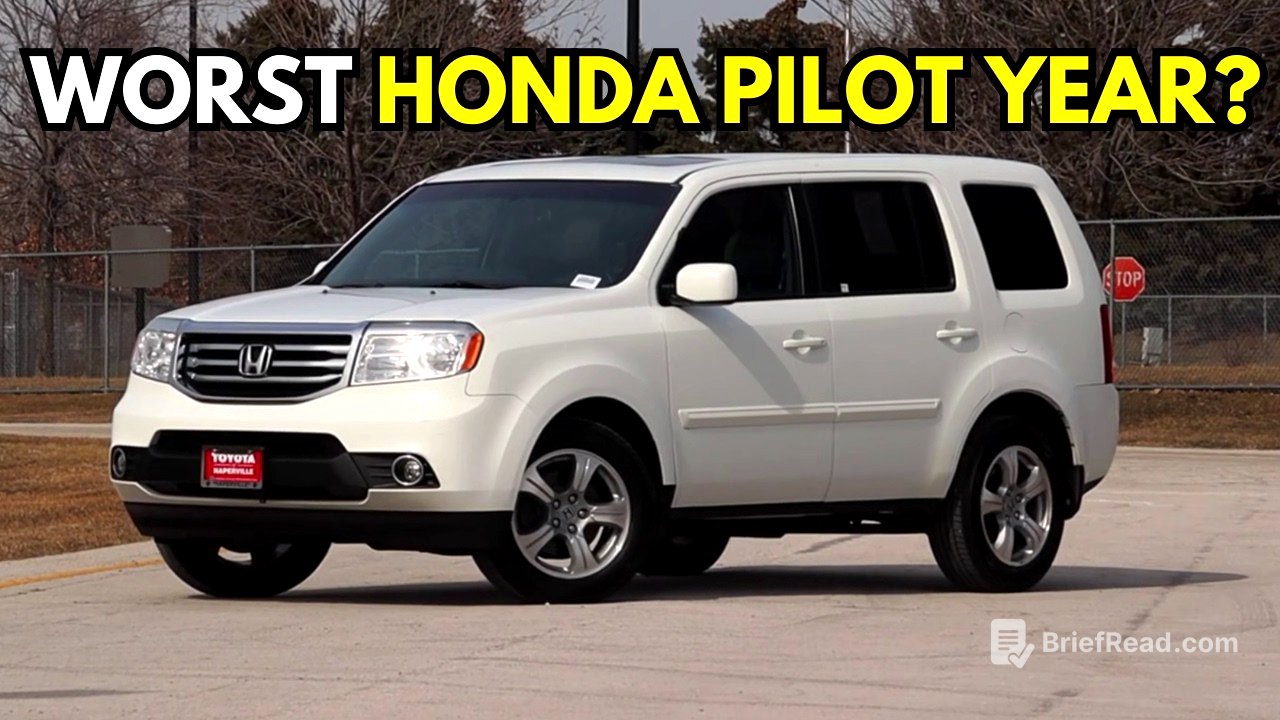
The video provides an overview of the Honda Pilot's reliability and issues across its various model years, emphasizing that while it has a strong reputation, certain years are marked by significant problems.
- Early models (2003-2005) suffer from transmission failures.
- Mid-generation models (2009-2011) face excessive oil consumption.
- Models from 2013 to 2015 are highlighted as the most reliable.
- Recent models (2016-2022) had issues with the automatic transmission, but overall reliability improved.
Overview of the Honda Pilot [0:00]
The Honda Pilot has been a popular family SUV since its launch in 2003, known for its three rows of seating and reliability. However, not all model years are created equal, with some experiencing significant reliability issues, which necessitates careful selection when considering a used Pilot.
First Generation (2003-2008) Issues [0:30]
The first generation of Honda Pilots, which includes models from 2003 to 2005, has a poor reputation due to notorious automatic transmission failures. Many owners report issues like slipping or complete breakdowns before reaching 150,000 miles, with repair costs often exceeding the vehicle's value. Additionally, air conditioning failures add another potential $1,000 to $1,500 in repair bills. By 2006, improvements occurred, but the design felt outdated, leading to expensive mechanical issues overshadowing the initial low purchase price.
Second Generation Concerns (2009-2015) [1:39]
The second generation, introduced in 2009, initially presented as a major upgrade with more space but quickly became associated with excessive oil consumption due to Honda's variable cylinder management system. Many owners reported using a quart of oil every 1,000 miles, leading to costly repairs ranging from $2,000 to $5,000 for serious engine fixes. However, the models from 2013 to 2015 were noted for their reliability and performance, providing dependable power and comfort while maintaining predictable maintenance costs.
Third Generation Upgrades and Issues (2016-2022) [3:21]
The third generation, starting in 2016, featured a complete redesign, but introduced problems with the new N-speed automatic transmission. Models from 2016 and 2017 faced jerky shifts and hesitation, leading to potentially high repair bills if transmission replacements were needed. Conversely, lower trims with a six-speed automatic had better reliability. By 2019, Honda rectified many of these issues, making the 2019 to 2022 models reliable family vehicles, though they command higher resale prices and maintain lower risks of transmission or engine problems.
Current Generation (2023) and Final Recommendations [5:01]
The fourth generation, introduced in 2023, has positive initial reviews but is still too new for long-term reliability assessment. These models offer enhanced designs and technology but come with new vehicle price tags between $40,000 to $50,000. Buyers should steer clear of the problematic years (2003-2005, 2009-2011, 2016-2017) and focus on the reliable 2013-2015 models, as well as the dependable 2019-2022 versions for modern features and long-term durability.