TLDR;
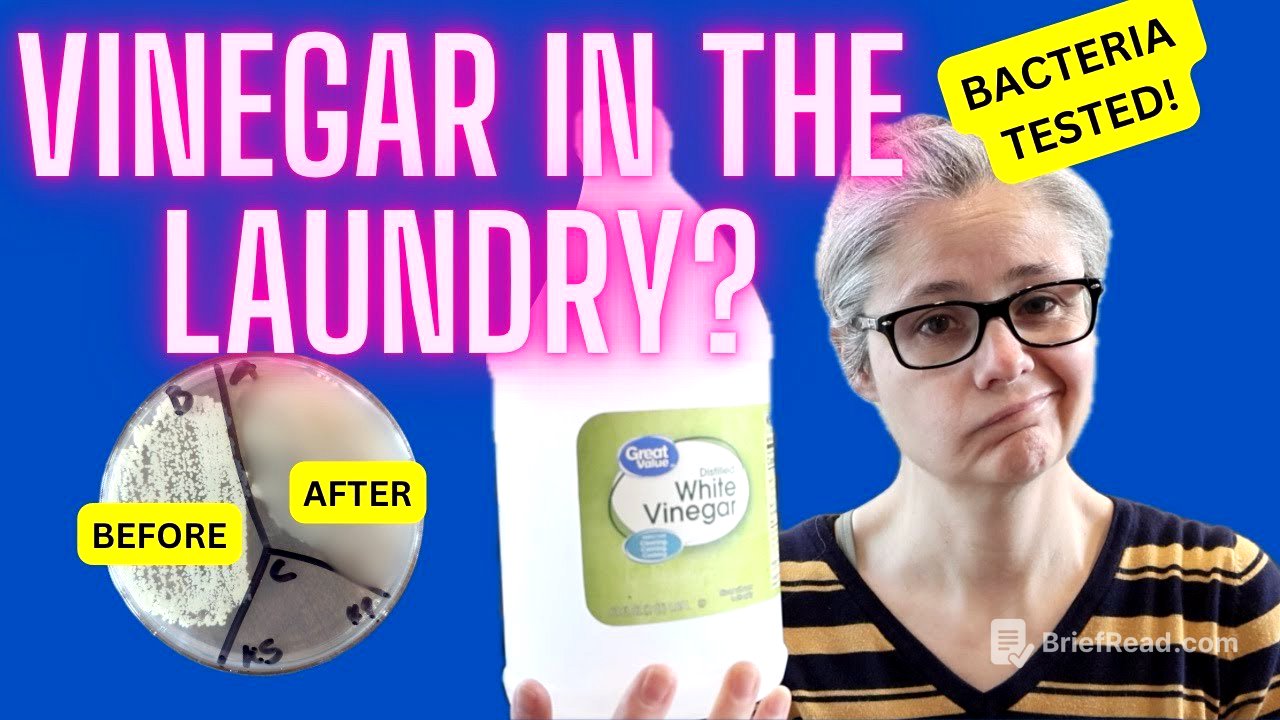
This video tests the effectiveness of vinegar as a laundry rinsing agent for removing bacteria from cleaning cloths. The experiment involves swabbing cloths before and after washing with vinegar, and after drying, to compare bacteria levels. The results indicate that vinegar alone is not very effective at removing bacteria, but the dryer significantly reduces bacteria levels.
- Vinegar is tested as a laundry rinsing agent to remove bacteria.
- Cleaning cloths are swabbed before washing, after washing with vinegar, and after drying.
- Results show vinegar alone is not effective, but the dryer helps reduce bacteria.
Introduction [0:00]
The video begins with an introduction to the experiment, which aims to determine if vinegar can effectively remove bacteria from cleaning cloths when used as a rinsing agent in a washing machine. The idea for this test came from viewer requests. The presenter mentions specific viewers who suggested the test.
Experiment Setup [0:51]
To conduct the experiment, four cleaning cloths are used to wipe various surfaces known to harbor bacteria: a kitchen sink, a kitchen sink drain, a bathroom sink, and a toilet rim. Sterile swabs are then used to collect samples from these cloths, which are placed on petri dishes to establish a baseline of bacteria present before washing. The cloths are then placed in a washing machine without any detergent, using only 4 oz of regular Walmart Great Value vinegar (5% acidity) in the fabric softener compartment for the rinse cycle. The washing machine is set to the towel setting. After washing, the cloths are swabbed again, and the samples are placed on new petri dishes. Finally, the cloths are put in the dryer, and a third swabbing is performed after the drying cycle.
Results: Kitchen Sink and Drain [5:37]
The results from the kitchen sink cloth showed a tremendous amount of bacteria before washing. After the vinegar rinse, there was a slight decrease in bacteria, but a significant amount remained. The kitchen sink drain cloth also showed a decrease in bacteria after the vinegar rinse, but it was not a significant decrease compared to other laundry sanitizers tested. After drying, both the kitchen sink and kitchen sink drain cloths showed that the bacteria was mostly removed. The presenter concludes that vinegar only slightly decreased the bacteria, while the dryer was responsible for removing the majority of it.
Results: Bathroom Sink and Toilet Rim [7:27]
The bathroom sink cloth had a significant amount of bacteria before washing. After the vinegar rinse, there was a visible decrease, but a substantial amount of bacteria remained. The toilet rim cloth also showed a significant amount of bacteria before washing, with only a slight decrease after the vinegar rinse. After drying, the bathroom sink cloth still had some bacteria, while the toilet rim cloth had only one or two tiny colonies remaining.
Conclusion [8:42]
The presenter concludes that vinegar is not impressive in its ability to remove bacteria in laundry and is not recommended as a laundry sanitizer. Other laundry sanitizers are more effective. While some people use vinegar as a fabric softener, the presenter did not test this aspect. The presenter expresses a preference for using proven laundry sanitizers to remove bacteria. Viewers are encouraged to suggest products for future testing via the comment section or by mailing products to the address provided in the description, with an accompanying email.