TLDR;
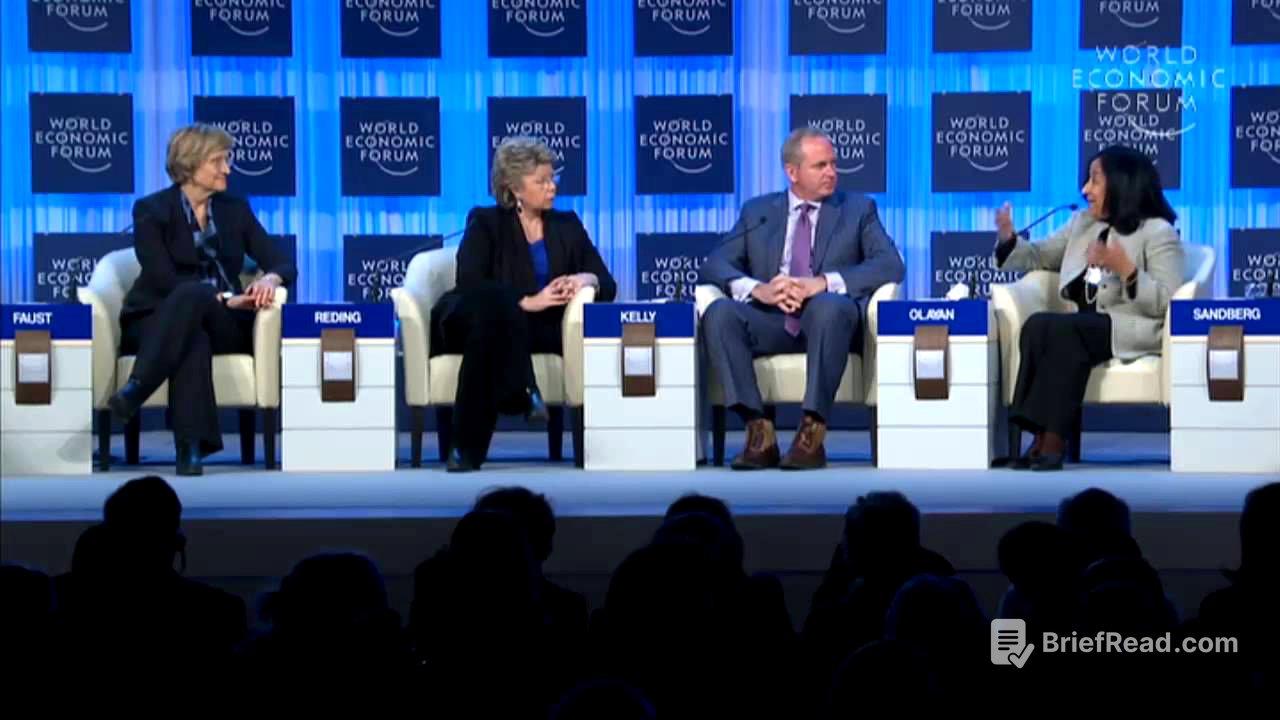
This panel discussion at the World Economic Forum addresses the persistent gender gap in economic decision-making. Despite women's increasing education and entry into various occupations, their representation at senior levels remains low. The discussion covers the business case for gender diversity, the impact of women in leadership, the role of regulation and quotas, and the mid-career barriers women face.
- The underrepresentation of women in top economic positions is a global issue with slow progress.
- Gender diversity improves economic growth, governance, decision-making, and inspires women.
- Cultural stereotypes and biases significantly hinder women's advancement.
- Both organizational changes and individual empowerment are crucial for progress.
Introduction: The Gender Gap in Economic Decision-Making [0:00]
Herminia Ibarra introduces the panel on women and economic decision-making, highlighting the urgency of closing gender gaps at the highest levels of economic participation. Statistics reveal that women are significantly underrepresented in leadership positions such as board members, CEOs, and executive committee members. Progress has been slow, despite women making up a large percentage of graduates and entering occupations in equal proportions to men. A "cliff" appears at the mid-career level, hindering women's advancement. The business case for gender diversity is clear, with research showing benefits in economic growth, governance, decision-making, and inspiration for women. The panel aims to address implementation gaps and shape agendas to increase women's representation in senior roles.
The Impact of Women in Leadership [3:59]
Christine Lagarde discusses the importance of gender diversity and inclusiveness for both humanity and economics. She emphasizes the economic sense of improving women's access to education, health, jobs, and financing. Lagarde shares her personal experiences with discrimination and how it has made her more attentive to minorities and inclusive leadership. She argues that women often listen more and are more attentive to those who may be overlooked. Lagarde also addresses the relationship between advocating for women in top positions and addressing basic human rights for women, asserting that both are crucial across all levels of development and cultures.
Being a "First": Perspectives from Harvard's President [8:52]
President Faust reflects on her experience as the first woman president of Harvard University. Initially, she resisted being labeled solely as the "woman president," but she later recognized the significance of her position for women worldwide. She emphasizes the importance of highlighting women's achievements to inspire young women and advance education. Faust underscores the role of conversation and highlighting the issues to promote change and commitment. Drawing from her experience growing up in a male-dominated environment, she notes how it made her aware of difference and the opportunity to interact in ways that could positively change dynamics.
The Role of Regulation and Quotas in Europe [12:32]
Commissioner Reding discusses her advocacy for quotas to increase women's representation on corporate boards in Europe. She highlights the aging population and the underutilization of highly educated female graduates. Studies show that companies with more women in top management achieve better economic results. Despite initial resistance, Reding implemented a law mandating 40% women on corporate boards, emphasizing that the goal is to ensure talent and competence are prioritized. The law includes a provision that at equal talent, women should be chosen to fill board positions until the 40% target is met. Reding believes quotas are a tool to break through the glass ceiling and will eventually expire once natural selection takes over.
The Search Business Perspective on Gender Diversity [18:46]
Kevin Kelly shares his perspective from the executive search business, noting that companies often "hire people because they're different and then fire them because they're not the same." He emphasizes that gender diversity is about increasing the overall quality of a board. A survey reveals that women are more likely to support quotas due to frustration with the slow progress. Kelly recounts an incident where a qualified female executive was rejected for a board position because she lacked prior experience on a major board. He suggests adhering to term limits for board members to promote turnover and accountability for gender diversity.
Progress and Challenges in the Arab World [23:01]
Lubna Olayan discusses the progress and challenges for women in the Arab world, particularly in Saudi Arabia. While women's education has improved, economic participation remains low. Olayan highlights the importance of leadership support for change and notes the recent appointment of women to Saudi Arabia's consultative council. She emphasizes the need for the private sector to follow the government's lead in promoting women and the importance of CEOs being committed to hiring, promoting, and mentoring women.
Addressing Mid-Career Hurdles and Gender Stereotypes [29:34]
Sheryl Sandberg discusses the mid-career hurdles women face and the impact of gender stereotypes. She emphasizes the importance of open dialogue about gender in the workplace and addressing institutional barriers. Sandberg points out that success and likability are positively correlated for men but negatively correlated for women, leading to a penalty for successful women. She also highlights the different pressures men and women face at home, with women often having two jobs. Sandberg advocates for companies to address these issues openly and honestly.
Daring the Difference and Role Models [38:39]
Panelists discuss the importance of role models and the need for both women and men to support gender diversity. They emphasize that women in leadership positions should focus on their actions and how they bring up other women. It is crucial for men in top management to champion women's advancement. Panelists share personal anecdotes about daring to be different and challenging stereotypes. They stress the need to adjust measurements and stereotypes to create a more equitable environment.
Audience Questions and Concluding Remarks [45:59]
The panel addresses questions from the audience, including the challenge of aligning perceptions between men and women regarding gender advancement. Panelists share initiatives to engage young women and promote education. The discussion concludes with a recognition of the progress made and a call to continue daring the difference and opening up conversations to create more opportunities for women.