TLDR;
This video provides a comprehensive overview of how computers work, starting from basic logic gates to complex systems involving microprocessors, memory, and AI. It explains the evolution from manual switches to transistors, the use of binary code, and the development of integrated circuits. The video also covers practical applications in HVAC systems, including demand-controlled ventilation, sensor technology, and building management systems, highlighting the importance of data-driven analysis and machine learning.
- Basic logic gates (AND, OR, XOR) are the foundation of computer operations.
- Transistors replaced vacuum tubes due to their smaller size, lower power consumption, and higher speed.
- Binary code is used to represent numbers and perform calculations in computers.
- Microprocessors execute instructions written in programming languages, which are translated into machine code.
- Building management systems use sensors, protocols, and data analysis to optimize energy efficiency and comfort in HVAC systems.
Part 1 - A Logical Buildup [1:31]
The video starts by illustrating basic logic using a light bulb circuit with switches. When switches are connected in series, both switches must be closed for the light to turn on, representing an AND gate. When connected in parallel, closing either switch A or B will complete the circuit, representing an OR gate. These scenarios are mapped out using truth tables, which outline the outcome for each set of inputs.
What is Logic? [1:35]
Logic is defined as the process of outlining what the outcome should be given a particular set of inputs. The video transitions from manual switches to relays, where electric signals drive the switches. These signals are either 5 volts (on) or 0 volts (off), representing a bit of data. Logic gates, such as AND and OR gates, are the building blocks for modern computers.
Vacuum Tubes [4:53]
Vacuum tubes work similarly to relays, using one circuit to control another. A heated electrode emits electrons that flow to a positively charged electrode, creating a diode. Adding a grid allows control of the electron flow by adjusting its charge. A negatively charged grid stops current flow, while a positively charged grid allows it. Vacuum tubes respond quickly but are inconvenient due to their size and high power consumption.
Transistors [7:53]
The invention of transistors enabled the miniaturization of computer components, leading to increased computing power. Transistors are made from silicon, which has four valence electrons. Doping silicon with phosphorus (five valence electrons) creates n-type silicon, which has free electrons. Doping silicon with boron (three valence electrons) creates p-type silicon, which has electron holes.
Solid State Theory and Operation [8:18]
When n-type and p-type silicon are joined, free electrons fill electron holes, creating an insulating barrier. Applying voltage in one direction allows current flow, while reversing the voltage stops it, functioning as a diode. Adding another n-type material creates a transistor, where a control circuit regulates the primary circuit's flow. The middle of the transistor is called the base, with the emitter and collector on either side.
Building Logic Gates [12:48]
An AND gate can be made using transistors, where both transistor bases (inputs) must receive voltage for the output to be on. Similarly, an OR gate can be constructed with transistors. Transistors were a breakthrough due to their smaller size, lower power consumption, and high speed compared to vacuum tubes.
Binary Basics [14:21]
Computers use the binary system (base 2) for efficiency. Binary uses powers of two (1, 2, 4, 8, etc.) to represent numbers. Any number can be represented by combining these powers of two. A "1" indicates the power is used, and a "0" indicates it is not. Each position is a bit, carrying one bit of information.
Binary Addition [17:25]
Binary addition involves adding bits together, similar to decimal addition. 0+0=0, 1+0=1, 0+1=1, and 1+1=10 (carry the 1). An exclusive OR (XOR) gate is used to add two bits, outputting 1 only when the inputs are different. An AND gate is added to indicate a carry bit.
Building a 4-bit Adder [20:00]
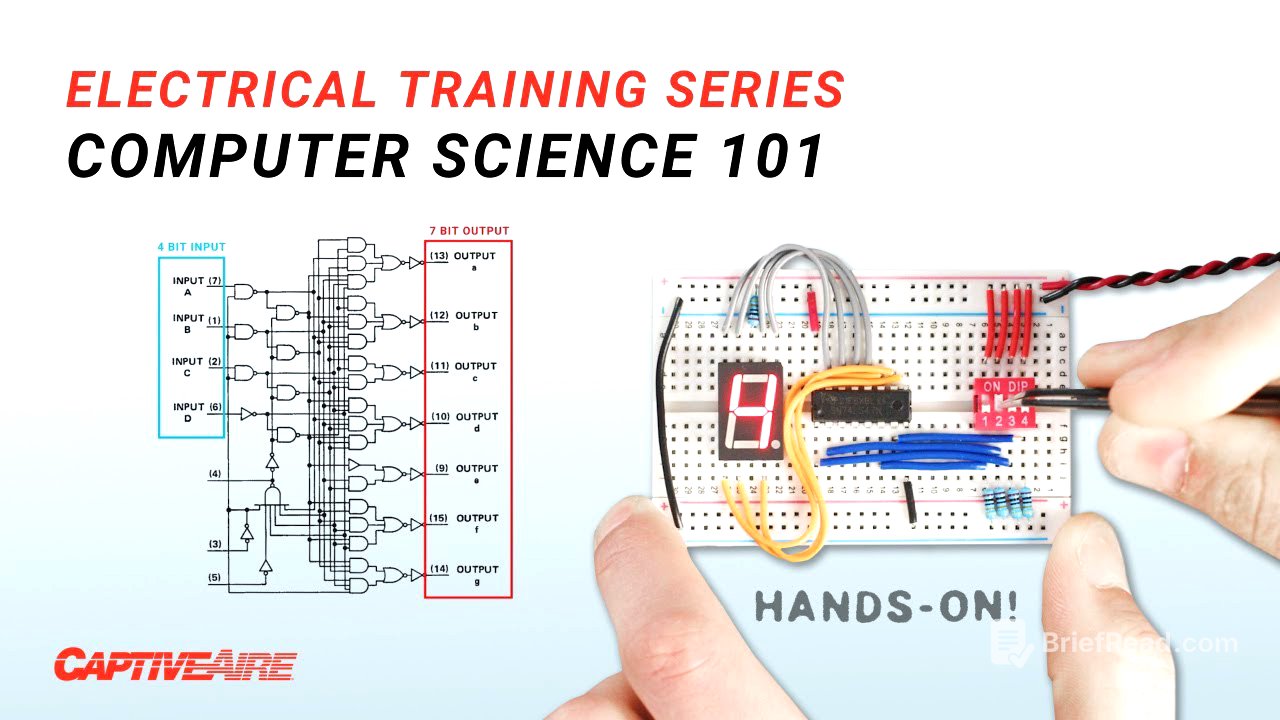
A 4-bit adder requires multiple logic gates. Integrated circuits (ICs) house multiple logic gates in a smaller package. These ICs minimize the number of components and wiring. The video demonstrates a 4-bit adder circuit using ICs, showing how it can add two 4-bit numbers together.
Integrated Circuits [20:25]
Integrated circuits (ICs) are used to house multiple logic gates in a smaller platform. For example, one IC might contain four different AND gates, while another contains four different OR gates. This minimizes the number of components and wiring needed for circuits.
Part 2- Beyond Logic [22:04]
The video transitions to how computers communicate useful information beyond basic logic.
Nixie Tubes [22:23]
Nixie tubes are numerical displays that use neon gas to glow around digit-shaped filaments. Applying voltage from a mesh to one of the digit filaments lights up that digit. However, Nixie tubes require high voltage and consume a lot of energy.
Segmented Displays [23:38]
Segmented displays, like LED displays, are a lower-power alternative to Nixie tubes. Each segment lights up when power is connected through its pin. An integrated circuit translates a 4-bit signal to light up the individual segments, forming the correct digit.
Displaying the Right Data [24:39]
More complex displays, like LCDs, use lookup tables to translate input signals into characters. For example, a 4-bit signal corresponds to a specific character. These displays use memory to store the data for each character.
Memory [26:11]
Memory comes in two types: long-term and short-term. Long-term memory is embedded at the factory and translates input signals into the correct output. Short-term memory is used for temporary storage during calculations.
Long-Term Memory [26:31]
Long-term memory uses floating gate MOSFETs to store data permanently. By controlling the presence of electrons in a floating gate, the transistor can be set to flow or block current, representing a 1 or 0. Flash memory, like that in SD cards, uses these floating gates to store data.
Short-Term Memory [28:31]
Short-term memory is faster than long-term memory. It uses logic gates in a feedback loop to store data temporarily. A data latch captures a bit of information in its current state. Data registers store multiple bits (e.g., 8 bits in a byte). Memory is often packaged in a grid configuration, using addresses to pinpoint data locations.
Microprocessors [31:17]
A microprocessor is the brain of a computer, containing memory components and processing units like adders. It executes instructions written by programmers. These instructions are derived from simple components to perform arithmetic operations.
Programming [32:36]
Programmers write code in languages like C, which is then translated into assembly language. Assembly language provides step-by-step instructions for the processor. Finally, the assembly language is translated into binary code (1s and 0s) that the processor can execute.
Code Translations [34:00]
The C code is compiled into Assembly Language, which is a set of step-by-step instructions specific to the processor. This is then translated into binary code. Hexadecimal (hex) is used as a more readable translation from binary, breaking down binary strings into 4-bit chunks represented by a single character.
Clocks [36:57]
A clock drives many computer operations, signaling components to perform actions. Clock speed is measured in hertz (cycles per second). Miniaturization has allowed for more transistors on microchips, increasing processing speed. Moore's Law predicts the number of transistors on a microchip will double every two years.
Part 3 - Harness The Power [38:41]
The video shifts to practical applications of computing power, particularly in HVAC systems.
Design Philosophies [38:48]
CaptiveAire designs its own circuit boards to customize and improve existing technologies. The ECP 103 board is used for hood ventilation control, allowing individual fan control based on temperature needs.
Demand-Controlled Ventilation Example [39:47]
Demand-controlled ventilation adjusts fan speeds based on temperature, optimizing energy efficiency. The ECP 103 board allows individual control of fans based on temperature needs in different sections of a kitchen hood.
Sensors [41:50]
Sensors interact with the physical world, providing data to controllers. Simple sensors like float switches have binary outputs (on or off). More complex sensors, like temperature sensors, use thermistors to measure resistance, which changes with temperature.
Analog to Digital Conversion [43:32]
Analog signals from sensors must be converted to digital signals for computers to read. An analog-to-digital converter (ADC) uses comparators to compare input voltages and output a binary string. The ADC in the ECP 103 board is a 10-bit ADC, measuring voltages in 1024 slices.
Building Management Systems [48:27]
Controllers can be connected to a building management system (BMS) to monitor and control equipment. A gateway collects data through protocols like MODBUS and sends it to a server for analysis.
Understanding Protocols [49:05]
Protocols dictate how information is packaged and communicated. The Universal Serial Bus (USB) protocol is used in keyboards to send keystrokes as packets of information. Protocols are useful in HVAC for network connections, allowing more complex communication.
MODBUS [50:48]
The MODBUS protocol works on a master-auxiliary system. The master device requests information, and the auxiliary devices respond. It is relatively slow but allows long cable links.
Gateways [51:32]
Gateways convert signals from one protocol to another, allowing MODBUS devices to interact with other building management systems using different protocols like BACnet.
Data-Driven Analysis [52:34]
Data from equipment is harvested and put on a server for analysis. This allows engineers and end-users to monitor the operation of the system and make decisions. Building management systems provide visibility of equipment operation, ensuring efficiency and proper functioning.
Machine Learning and AI [53:58]
Machine learning algorithms can be implemented to detect faults or optimize equipment operation. The availability of data and computing power allows for automating actions and improving efficiency. The goal is to free humans from repetitive tasks and allow them to focus on creative and conceptual work.