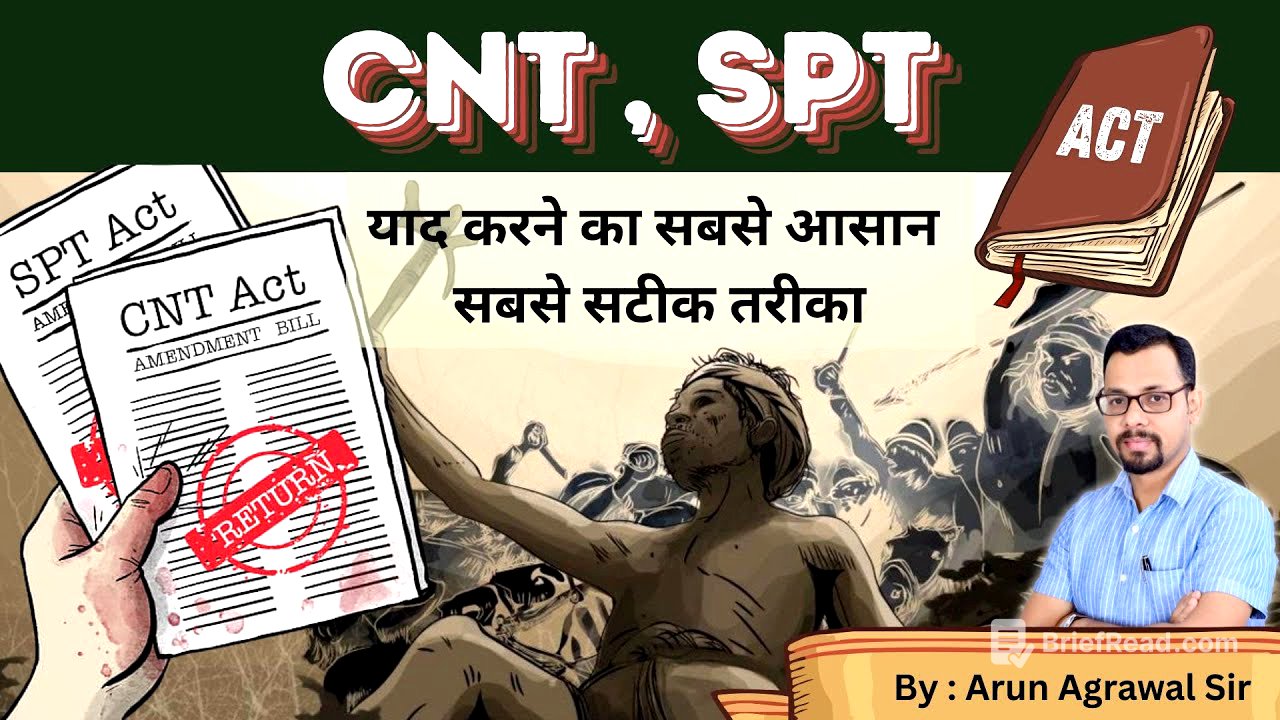
TLDR;
This YouTube video provides an overview of the Chota Nagpur Tenancy Act (CNTA) and the Santhal Pargana Tenancy Act (SPTA), two important land-related laws in Jharkhand, India. It explains the historical context, objectives, and key provisions of these acts, along with relevant terminology. The video aims to simplify these complex legal concepts for aspirants preparing for Jharkhand state civil service exams and also to provide general awareness about land laws in Jharkhand.
- The video emphasizes the importance of understanding these laws for those working in administrative positions in Jharkhand, as land disputes are common.
- It highlights the historical context of the acts, including the tribal revolts and the need to protect the interests of the indigenous people.
- The video also touches upon the challenges in implementing these laws and the need for a balanced approach to development and land rights.
Introduction to CNT and SPT Acts [0:00]
The speaker introduces the importance of the Chota Nagpur Tenancy Act (CNTA) and the Santhal Pargana Tenancy Act (SPTA) for various Jharkhand state exams. These acts are crucial for understanding land-related issues in Jharkhand, which are often complex and can be confusing due to the legal language involved. The speaker emphasizes that a deep understanding of these laws is essential for anyone aspiring to work in administrative positions in Jharkhand, as they will frequently encounter land-related challenges.
Recent Land-Related Issues in Jharkhand [0:11]
The speaker discusses recent land-related issues in Jharkhand, such as illegal encroachments and disputes over land ownership. He cites the example of the RIMS land encroachment case, where the High Court ordered the demolition of illegal constructions on RIMS land. The speaker also points out the complexities involved in such cases, where individuals who purchased flats on encroached land suffer the consequences, while the officials who approved the illegal constructions often go unpunished. He highlights that the law operates based on facts and evidence, not emotions. The court has directed the Jharkhand government to compensate those displaced by encroachments, recovering the money from the involved officials.
Objectives and Importance of Land Laws [4:06]
The speaker explains that the primary objective of the CNTA and SPTA is to protect the interests of the original inhabitants, tribal and indigenous communities of Jharkhand. However, despite these laws, many individuals have acquired land illegally, leading to disputes and construction of unauthorized structures. Understanding the provisions of the CNTA and SPTA is crucial to comprehend these issues and connect them with current events. The speaker also mentions various terminologies like Khutkatti, Bhuhari, and Kodkar, which are important to understand the nuances of land laws in Jharkhand.
Course Overview: Key Aspects of CNT and SPT Acts [5:11]
The speaker outlines the key aspects that will be covered in the course on CNTA and SPTA. The aim is not to become legal experts but to gain sufficient knowledge for exams and practical application in the field. This includes understanding land-related laws, which are essential for administrative officers who deal with land-related applications and issues. The speaker mentions that DCs often hold "Janata Darbar" to address land disputes, highlighting the importance of this knowledge for resolving such issues.
Key Land Laws: CNT and SPT Acts [6:13]
The speaker introduces the two main land-related acts: the Chota Nagpur Tenancy Act (CNTA) of 1908 and the Santhal Pargana Tenancy Act (SPTA). The CNTA was enacted during British rule to protect the land rights of the people in the Chota Nagpur region. The SPTA applies to the Santhal Pargana region, which, along with Chota Nagpur, formed the original Jharkhand area before the separation from Bihar. The speaker explains that the SPTA is applicable in the six districts of the Santhal Pargana division, while the CNTA is applicable in the remaining 18 districts, including the Palamu and Kolhan divisions.
Other Land-Related Acts and Provisions [8:49]
The speaker mentions that there are other land-related acts and provisions in Jharkhand, such as the Wilkinson Rule in the Kolhan region and the Yule Rule in the Santhal Pargana region. He explains that land-related rights are primarily under the jurisdiction of the state governments, as per the Ninth Schedule of the Indian Constitution. However, the central government also has the power to acquire land for development purposes, leading to potential conflicts between state and central laws. The speaker also mentions the proposed amendments to the CNTA, which were not passed but may be considered in the future.
Land Acquisition Act and Jharkhand's Development [11:34]
The speaker touches upon the Land Acquisition Act of 2013 and its relevance to Jharkhand. Despite being rich in mineral resources, Jharkhand lags in development rankings due to various factors, including land-related disputes. The speaker emphasizes that economic development requires land for infrastructure, factories, and other projects, but land disputes hinder this process. He also mentions that those selected for administrative positions in Jharkhand will be trained on CNTA and SPTA at the Sri Krishna Institute of Public Administration (SKIPA).
Understanding "Kastkari" (Tenancy) [14:27]
The speaker explains the meaning of "Kastkari" (tenancy) in the context of the CNTA and SPTA. The term is related to "kiraya" (rent) and involves two parties: the landlord and the tenant. In the past, landlords were either the government or zamindars (landlords), while tenants were the cultivators. After the Zamindari Abolition Act of 1950, the government became the primary landlord, collecting revenue from the tenants. The speaker also introduces terms like "Raiyat" (cultivator) and "Dar-Raiyat" (sub-tenant), which will be discussed in detail later.
Landlord-Tenant Relationship and Land Revenue Systems [15:58]
The speaker explains the historical context of land revenue systems in India, particularly during British rule. He mentions the three main systems: Zamindari, Ryotwari, and Mahalwari. The Zamindari system was prevalent in the Bengal region, where landlords collected rent from the cultivators and paid a portion to the British government. The speaker notes that many land-related documents use Urdu and Persian terms, which originated during the Mughal period. He also mentions the use of Kaithi script in land documents in Bihar, which is now being translated due to the script's declining usage.
Landlord and Tenant in Modern Context [18:50]
The speaker explains that in the modern context, the government is the actual landlord of the land. Before India's independence, the Zamindari system was in place. The British implemented three types of systems for collecting land revenue: the Permanent Settlement (also known as the Zamindari system), the Ryotwari system, and the Mahalwari system. The Zamindari system was mainly implemented in North India, particularly in the Bengal Presidency. The Ryotwari system was implemented in the Bombay and Madras regions, while the Mahalwari system was implemented in the northeastern part of India.
Zamindari System and Land Ownership [20:14]
The speaker explains how the Zamindari system worked. The British designated certain individuals as Zamindars, transferring the land ownership to them. The Zamindars then collected rent from the cultivators, kept a portion for themselves, and paid the rest to the government. The speaker also mentions the "Sunset Law," which was related to this system. After independence, the Zamindari system was abolished, and the land was vested in the government.
Tenant Classifications: Raiyat and Dar Raiyat [21:31]
The speaker explains the classification of tenants, including Raiyat and Dar Raiyat. A Raiyat is a farmer who cultivates the land and pays rent to the government. The government is the actual owner of the land and can evict the Raiyat if needed for development projects. A Dar Raiyat is a sub-tenant who cultivates the land under a Raiyat. The speaker also mentions other terms like Sikmi and Kaymi, which will be discussed later.
Course Structure: Key Topics to be Covered [23:59]
The speaker outlines the key topics to be covered in the course, including the CNTA, SPTA, and other related acts. The course will cover the background, objectives, provisions, impact, and comparison of the CNTA and SPTA. It will also focus on understanding the terminology used in these laws. The speaker emphasizes the importance of understanding the historical background of these laws, including the tribal revolts and the motivations behind their enactment.
Background and Objectives of CNT and SPT Acts [24:22]
The speaker explains that the CNTA and SPTA were not created in a vacuum but have a historical background. The CNTA was a result of the Birsa movement, which fought for the rights of the tribal people. The speaker emphasizes that any law or provision is made with a specific objective in mind. He uses the example of traffic police checking vehicles to illustrate that laws are made to ensure order and safety. Similarly, the CNTA and SPTA were created with specific objectives to protect the interests of the tribal communities.
Provisions and Impact of CNT and SPT Acts [26:53]
The speaker explains that the course will cover the provisions of the CNTA and SPTA, including the sections and chapters. He notes that the provisions in the constitution are called articles, while the provisions in the laws are called sections. The course will also analyze the impact of these laws on Jharkhand, comparing the situation before and after their enactment. Additionally, the course will compare the CNTA and SPTA and focus on understanding the terminology used in these laws.
Importance of Terminology in Land Laws [28:46]
The speaker emphasizes the importance of understanding the terminology used in land laws, as it is often different from common language and requires special effort to comprehend. He mentions that the course will begin with terminology to make it easier to understand the laws. The speaker also shares his own experience of struggling with the legal language and assures that he will use simple examples to explain the concepts.
Real-Life Examples and Land Records [30:23]
The speaker relates the topic to real-life situations, mentioning that many people have experience with land transactions and ownership. He mentions terms like "Khatian," "Khatauni," "Khewat," and "Dakhil Kharij," which are commonly found in land records. The speaker assures that the course will explain these terms and their significance.
Introduction to "Gair Majarua" Land [31:59]
The speaker introduces the term "Gair Majarua" land, asking the audience how many have heard of it and how many actually know what it means. He explains that "Majarua" means cultivable land, while "Gair" means non-cultivable. Therefore, "Gair Majarua" land is land that is not suitable for cultivation, such as rocky or swampy land.
Defining "Majarua" and "Gair Majarua" Land [32:53]
The speaker elaborates on the definitions of "Majarua" and "Gair Majarua" land. "Majarua" land is cultivable land that is under the ownership of an individual, such as a Raiyat, Zamindar, or landowner. "Gair Majarua" land is land that is not cultivable, such as barren land, rocky land, or forests. The speaker emphasizes that the term "Majarua" refers to land that is both cultivable and under private ownership.
Classification of "Majarua" Land: Zirat and Majarua Khas [35:07]
The speaker explains that "Majarua" land is further classified into two types: "Zirat" and "Majarua Khas." "Zirat" land is "Majarua" land that is actually being cultivated. "Majarua Khas" land is "Majarua" land that is not being cultivated but is being used for other purposes, such as residential or commercial use. The speaker clarifies that both "Zirat" and "Majarua Khas" are types of "Majarua" land, but they differ in their usage.
Classification of "Gair Majarua" Land: Aam and Khas [37:06]
The speaker explains that "Gair Majarua" land is classified into two types: "Gair Majarua Aam" and "Gair Majarua Khas." "Gair Majarua Aam" is land that is used for public purposes, such as playgrounds or cremation grounds. "Gair Majarua Khas" is land that is under the possession of an individual, either legally or illegally. The speaker emphasizes that possession does not always imply illegality.
"Gair Majarua Aam" Land and "Bandobasti" (Settlement) [39:39]
The speaker explains that "Gair Majarua Aam" land cannot be "Bandobasti" (settled), meaning it cannot be assigned to an individual for revenue collection. He explains that "Bandobasti" is the process of bringing land under revenue collection. Since "Gair Majarua Aam" land is for public use, it cannot be assigned to an individual for private benefit.
"Gair Majarua Khas" Land and its Historical Context [41:32]
The speaker explains that "Gair Majarua Khas" land is "Gair Majarua" land that is under the possession of an individual. This possession can be legal, such as through a lease from the government, or illegal. The speaker notes that during the Zamindari system, much "Gair Majarua" land was given to Zamindars. The speaker also mentions "Hukum Nama," which was a document used by Zamindars to settle land with individuals.
"Hukum Nama" and Land Leases [44:39]
The speaker explains that "Hukum Nama" was a document used by Zamindars to settle land with individuals, allowing them to use the land for various purposes. He mentions that there were different types of "Hukum Nama," such as registered and unregistered ones. The speaker also mentions that Zamindars could lease land to individuals for a certain duration.
Post-Zamindari Abolition and Land Ownership [46:15]
The speaker explains that after the abolition of the Zamindari system, all land was vested in the government. However, the government allowed individuals who were residing on "Gair Majarua Khas" land to continue living there. The speaker summarizes the different types of land discussed so far, including "Majarua," "Gair Majarua," "Zirat," "Majarua Khas," "Gair Majarua Aam," and "Gair Majarua Khas."
Land for Schools: Public vs. Private [46:53]
The speaker answers a question about the type of land on which schools are built. He explains that private schools are built on land that is either owned by the school or leased from the government. Government schools are typically built on "Gair Majarua Aam" land. The speaker also mentions that individuals can donate land for the construction of schools or other public facilities.
Conversion of "Gair Majarua Aam" to "Gair Majarua Khas" [48:51]
The speaker answers a question about whether "Gair Majarua Aam" land can be converted to "Gair Majarua Khas" land. He explains that it is possible if the public use of the land is discontinued. For example, if a market that was held on "Gair Majarua Aam" land is no longer held, the government can settle the land with individuals. However, the speaker notes that some types of land, such as "Bhuihari" land, cannot be converted.
Land Surveys and Land Records [50:09]
The speaker explains that land is classified based on surveys conducted in the past. He mentions the "Bhuhari Survey" conducted by Rakhal Das Banerjee and the "Cadastral Survey," which is considered the most important and scientific survey. The speaker notes that land records contain various numbers, such as "Khata Sankhya," "Plot Sankhya," "Khasra Sankhya," and "Jamabandi Sankhya," which can be confusing. He also mentions that land surveys typically begin from the northwest direction.
Land for Industries and Government Policies [55:19]
The speaker answers a question about whether the government can lease "Gair Majarua" land to industries. He explains that the government can lease "Gair Majarua Khas" land to industries to promote economic development and generate employment. The speaker notes that companies often prefer to lease land rather than purchase it. He also mentions that the government provides subsidies and other incentives to industries to encourage them to set up factories in the state.
Land for Personal Use and Government Schemes [58:03]
The speaker explains that the government can also settle "Gair Majarua Khas" land with individuals for personal use, such as under the Pradhan Mantri Awas Yojana (PMAY) scheme. He notes that the government has also provided land to Maoists who have surrendered under the rehabilitation policy. The speaker emphasizes that the government has criteria for settling "Gair Majarua Khas" land, such as poverty and lack of housing.
Community Buildings and Land Classification [59:40]
The speaker clarifies that community buildings are built on "Gair Majarua Aam" land, not "Gair Majarua Khas" land. He explains that "Gair Majarua Aam" land is for public use, while "Gair Majarua Khas" land is for private use. The speaker also notes that the government can take back "Gair Majarua Khas" land if needed for public purposes.
Illegal Land Conversions and Government Action [1:00:46]
The speaker addresses the issue of illegal land conversions, where individuals have converted "Gair Majarua" land to other types of land. He notes that such conversions are illegal and that the government can take action against those involved. The speaker emphasizes that government officials who facilitate such illegal conversions can also be held accountable.
Riverbank Land and its Classification [50:35]
The speaker clarifies that the land near the river is "Gair Majarua Aam" because the river can expand and claim that land.
Khutkatti and Bhuihari Land: Tribal Land Systems [1:02:05]
The speaker introduces another classification of land based on tribal communities: Khutkatti and Bhuihari land. Khutkatti land is land that was cleared and cultivated by the ancestors of the Munda tribe. Bhuihari land is land that was cleared and cultivated by the ancestors of the Oraon tribe. The speaker notes that Khutkatti land is typically found in the Ranchi and Khunti regions, where the Munda population is concentrated.
Transfer of Khutkatti and Bhuihari Land [1:04:20]
The speaker explains that Bhuihari land can only be transferred within the same lineage and cannot be sold to others, even within the Oraon tribe. He mentions that a survey was conducted by Rakhal Das Banerjee to identify Bhuihari land. The speaker notes that Khutkatti land is typically owned collectively by the Munda community and cannot be sold individually.
Rakhal Das Banerjee and Land Surveys [1:05:26]
The speaker corrects his earlier statement, clarifying that the land survey of 2482 villages was conducted by Babu Rakhal Das Halder, not Banerjee. He reiterates that the purpose of the survey was to identify and document Bhuihari land.
Classification Based on Taxation: Majhihas and Rajhans Land [1:06:07]
The speaker introduces a third classification of land based on taxation: Majhihas and Rajhans land. This classification is based on the land survey conducted during the enactment of the CNTA and SPTA. Majhihas land is land that is exempt from taxation, while Rajhans land is land that is subject to taxation.
Majhihas Land: Tax-Free Land [1:06:51]
The speaker explains that Majhihas land is the land of the Paha Raja (chief) and is tax-free. Since the Paha Raja is the owner of the land, he does not pay tax to anyone. The speaker notes that agriculture is practiced on this land.
Rajhans Land: Taxable Land [1:07:16]
The speaker explains that Rajhans land is land that is given as a gift by the Raja to someone else. This land is cultivable, but the recipient is required to pay tax on it. The speaker notes that this land is also known as Parjali or Parjai in the Tamad region.
Summary of Land Types [1:07:40]
The speaker summarizes the different types of land discussed so far, including Majarua, Gair Majarua, Zirat, Majarua Khas, Gair Majarua Aam, Gair Majarua Khas, Khutkatti, Bhuihari, Majhihas, and Rajhans land.
Land Ownership and Zamindari System [1:09:06]
The speaker clarifies that the Paha Raja is like a Zamindar, who is the owner of the land. He explains that the term Zamindar refers to anyone who has ownership rights over the land and can collect taxes. The speaker notes that the Zamindari system was formalized by the British, but the concept of Zamindars existed even before that.
Rajhas Land: Taxation and Land Fertility [1:10:04]
The speaker explains that the Rajhas land, which is taxable, is further classified based on its fertility. The tax imposed on the land depends on its quality and productivity.
Doon and Taan Land Classification [1:11:20]
The speaker explains that in Jharkhand, land is broadly classified into two categories: Doon and Taan. Doon refers to low-lying land where water accumulates, making it fertile. Taan refers to elevated land where water does not accumulate, making it less fertile.
Chhattis Land: Fertile Land with Mandatory Tax [1:12:00]
The speaker explains that Chhattis land is fertile Doon land where tax payment is mandatory. The tax amount is fixed, regardless of whether the land is cultivated or not.
Murli Chhattis Land: Fertile Land without Tax Contract [1:12:51]
The speaker explains that Murli Chhattis land is also fertile Doon land, but there is no contract for tax payment. This means that the land is tax-free.
Uthkar Land: Less Fertile Land with Conditional Tax [1:13:13]
The speaker explains that Uthkar land is land that is slightly elevated and less fertile than Doon land. Tax is only imposed on this land if a crop is harvested. The tax amount is 50% of the tax imposed on Chhattis land. The tax can be paid in cash or in the form of crops.
Kodkar Land: Reclaimed Land with Tax Exemption [1:14:19]
The speaker explains that Kodkar land is Taan or jungle land that has been reclaimed by farmers for cultivation. This land is initially tax-exempt for 3-5 years to allow the land to become fertile. After the tax exemption period, the tax amount is 50% of the tax imposed on Chhattis land. The speaker notes that Kodkar land is also known by other names, such as Jal Shasan and Ariyat.
Two, Three, One, and Other Land Classifications [1:18:54]
The speaker mentions that there are other classifications of land, such as Doon One, Doon Two, Taan One, Taan Two, and Taan Three. He notes that these classifications will be discussed in detail later.
Importance of Special Topics for Competitive Exams [1:19:39]
The speaker emphasizes the importance of studying special topics like land laws to gain an edge in competitive exams. He notes that general topics like history, geography, and economics are common knowledge, but special topics are not. The speaker shares his experience of researching and finding information about Taan and Doon land classifications in a foreign university's research paper.
Asfak Ulla Khan and Palamu Connection [1:21:21]
The speaker mentions that there is a new connection between Asfak Ulla Khan, a famous freedom fighter, and Palamu. He notes that this connection may be asked in future exams.
Paha Raja and Zamindari System [1:23:04]
The speaker clarifies that the Paha Raja is like a Zamindar, who is the owner of the land. He explains that the term Zamindar refers to anyone who has ownership rights over the land and can collect taxes.
Bhent Kheta Land: Land for Begari Workers [1:25:39]
The speaker introduces another classification of land based on social customs: Bhent Kheta land. This land is given to those who perform Begari (forced labor) on the Majhihas land of the Paha Raja. The speaker notes that the person who performs Begari is entitled to the produce from this land.
Customary Laws and Land Allocation [1:27:20]
The speaker explains that in Jharkhand, land allocation is based on customary laws and the local governance system.
Mahatai Land: Land for Village Headman [1:32:42]
The speaker explains that Mahatai land is allocated to the village headman (Mahto). The person holding the position of village headman is entitled to the produce from this land.
Pahan Land: Land for Religious Head [1:33:05]
The speaker explains that Pahan land is allocated to the religious head (Pahan) of the village. The person holding the position of religious head is entitled to the produce from this land.
Panbhara Land: Land for Service Provider [1:33:20]
The speaker explains that Panbhara land is allocated to the person who provides services during village meetings and gatherings. The person providing the services is entitled to the produce from this land.
Daali Kataari Land: Land for Deities [1:33:44]
The speaker explains that Daali Kataari land is dedicated to deities. The produce from this land is used for religious purposes and is not owned by any individual.
Bhoot Kheta Land: Land for Ancestral Spirits [1:34:04]
The speaker explains that Bhoot Kheta land is dedicated to ancestral spirits. The produce from this land is offered to the spirits.
Rayati Land: Land Registered in Tenant's Name [1:34:24]
The speaker explains that Rayati land is land that is registered in the name of the tenant (Raiyat). The Raiyat is the owner of the land and has the right to cultivate it.
Conclusion and Next Steps [1:35:08]
The speaker concludes the session, noting that the important types of land have been covered. He mentions that the next session will focus on terminology related to land laws.





![[목돈연구소] 인생 선배, 퇴직한 직장인들이 후회하는 일은 무엇일까? 후회 없는 인생을 위한 길라잡이 I 지식편의점 230702(일)](https://wm-img.halpindev.com/p-briefread_c-10_b-10/urlb/aHR0cDovL2ltZy55b3V0dWJlLmNvbS92aS83YXAtUHdPZlZoYy9ocWRlZmF1bHQuanBn.jpg)