TLDR;
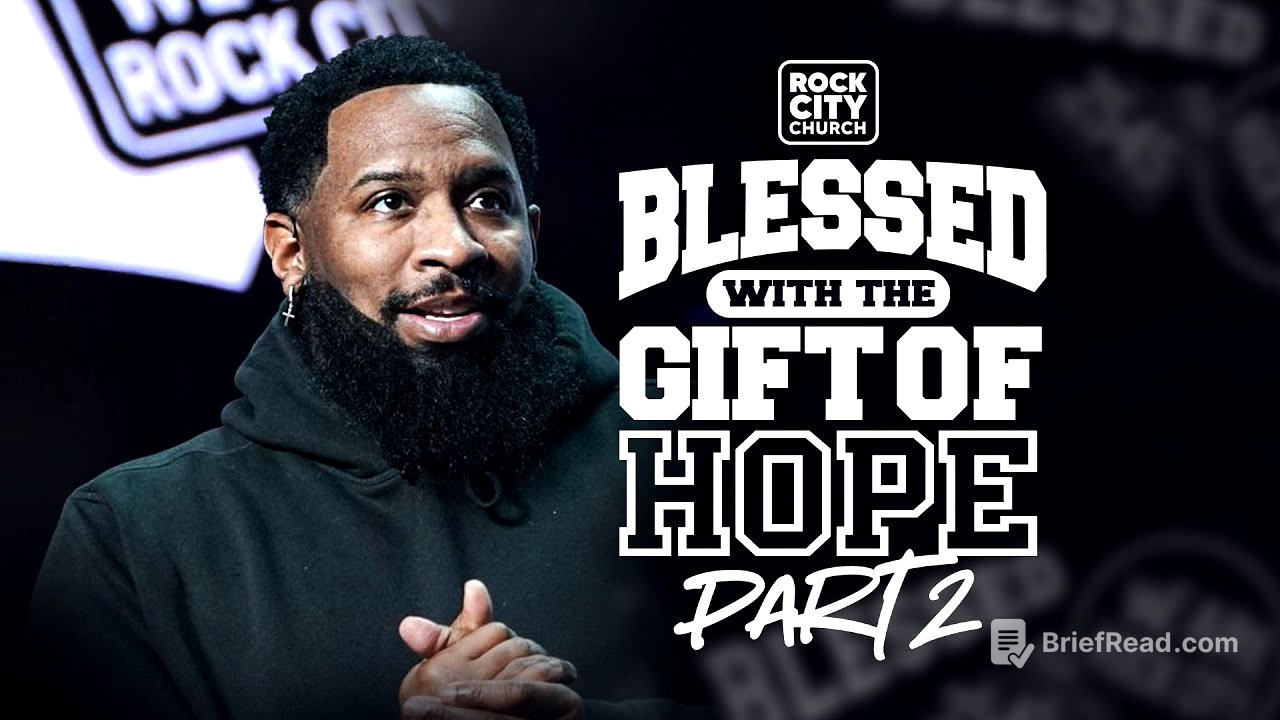
This sermon emphasizes gratitude and sacrificial giving as the greatest gift to God, shifting away from fear-based motivations. It explores living a life that is not wasted or wrecked, but winning through sacrifice and alignment with God's will. The message encourages listeners to have hope and expectation, understanding that God's blessings can manifest exponentially and expeditiously. It also highlights the importance of guarding one's words and waiting on God's timing, illustrated through the story of Zachariah and Elizabeth.
- Gratitude and sacrificial giving are the greatest gift to God.
- Living a winning life means living sacrificially and in alignment with God's will.
- Hope and expectation are crucial for receiving God's blessings.
- Guarding one's words and waiting on God are essential for fulfilling one's destiny.
Introduction [0:00]
The sermon begins with a note that it will be more prophetic than note-heavy, focusing on speaking and declaring things over the listeners' lives to help them become who God has called them to be. It's described as necessary for the soul and future, even if not deeply intellectual. The message is set against the backdrop of Luke 1:5, introducing the story of Zachariah and Elizabeth.
The Greatest Gift [0:39]
The greatest gift is defined as a sacrificial offering given to God out of gratitude and faith for the future. The speaker emphasizes giving out of gratitude rather than fear, contrasting it with the idea of God as a punishing figure. He shares how he encouraged his teenagers to give sacrificially, allowing them to decide what to give based on their own relationship with God. Gifts are important in established relationships because they are emotional and symbolic, showing appreciation and shifting the relationship from good to great, but great gifts require great sacrifice.
Sacrifice and Inflection Points [3:44]
The speaker connects personal sacrifice to the ultimate sacrifice of Jesus, who bridged the gap between humanity and divinity. He describes being at an inflection point, a moment where one can either move forward or repeat the same season. He learned that life can be lived in three ways: wasted (selfishly), wrecked (sinfully), or winning (sacrificially). A wasted life revolves around comfort and personal gain, while a wrecked life involves sin that fractures alignment with God's design, direction, and desire.
Wasted, Wrecked, or Winning [8:15]
The speaker elaborates on the three ways to live: wasted, wrecked, and winning. A wasted life is selfish, consuming what was meant to be contributed, and drains one quietly. A wrecked life is sinful, fracturing alignment with God's design, direction, and desire. Alignment is when who you are, how you live, and what you pursue match what God intended. Many chase things that are not God's design for their lives, and a wrecked life is when God is present but not in control. People drift into sin, and what you tolerate will eventually dominate. A winning life, however, is living sacrificially.
Winning with God [11:52]
Winning with God differs from worldly winning; it involves sewing instead of stacking, humility instead of checking people, fasting instead of feasting, and being hidden instead of being seen. Sacrifice is an investment, giving up what you want now for what God wants to release later. The speaker prophesies that because of faithfulness, God will move exponentially (a whole lot) and expeditiously (real quick) in the listeners' lives in 2026.
The Gift of Hope [14:32]
The reason some may not believe in this prophecy is because they lack hope. The gift of hope is the divine ability to stay convinced on the inside when nothing makes sense on the outside. Faith is when we believe God, while hope is when we expect God. Expectation influences behavior, so if you truly expect something, you should act like it.
Luke 1:5-7 - Zachariah and Elizabeth [19:40]
The sermon shifts to Luke 1, introducing Zachariah and Elizabeth, a righteous couple who are childless and very old. Despite living righteously, they face the cultural stigma of being childless, which was often interpreted as a curse. The speaker emphasizes that being blessed doesn't always equate to producing or having material possessions. Elizabeth is blessed but barren, and it's important not to judge one's blessedness by their current production.
Human Limitations and Divine Intervention [25:24]
The speaker explains that everyone hits a wall called human limitations, which are God-given boundaries reminding us that we are created, not creators. God allows us to hit these limits to remind us that we need Him. Human limitations are an invitation for divine intervention, which is biblically known as a miracle. God steps into situations that are too much for us, helping us lift burdens higher than we ever expected.
Chosen by Lot [30:38]
Zachariah, a priest, finally gets the opportunity to burn incense in the temple, a significant moment in his career. He was chosen by lot, highlighting that favor comes from faithfulness and obedience to God's commands. The angel of the Lord appears to him, and Zachariah is gripped with fear. The angel tells him not to be afraid, as what God has for him has his name on it.
Your Prayer is Heard [35:10]
The angel tells Zachariah that his prayer has been heard and that his wife Elizabeth will bear a son. The speaker emphasizes the importance of having intercessors in one's life who pray on their behalf without invitation or information. Before Zachariah could even light the incense, he received the blessing of a son, illustrating that God can provide blessing upon blessing.
Fumbling Blessings [42:20]
Zachariah questions how this can be, given his and Elizabeth's old age. The angel identifies himself as Gabriel, who stands in the presence of God, and declares that because of Zachariah's disbelief, he will be silent until the child is born. The speaker warns against "fumbling" blessings by canceling them with negative words or a lack of belief. Heaven cannot be bribed with offerings if one's mouth contradicts their prayers.
How to Wait, What to Watch, Guard Your Words [46:58]
To be what God has called you to be, there are three things to capture this year: how to wait, what to watch, and guard your words. Waiting on God means not going outside of God to get what you want. Watching what you look at means not looking at what broke you longer than you look at who can fix you. Guarding your words means speaking in alignment with your prayers and not speaking excuses. Prayers birth possibilities, but words shape destiny.
Prayers and Words [50:40]
The speaker emphasizes the importance of guarding one's words, as they shape destiny. He notes that while the church often focuses on prayer meetings, there is a need for "word meetings" where negative conversations are avoided. The ear is described as the birth canal to the spirit, highlighting the impact of words on one's spiritual well-being.
Call to Action and Prayer [53:33]
The speaker asks everyone to fill out a card with their prayers and bring it to the altar, along with their offering. He leads a prayer of repentance and gratitude, thanking God for 2025 and expressing excitement for 2026. He prays for a revival, restoration, and an acceleration anointing, asking God to do for the church what He did for him in 2019.
Kronos vs. Chyros [59:37]
The speaker contrasts Kronos (chronological time) with Chyros (God's appointed time). God operates outside of time and can bring your 2031 blessing to your 2026. This is illustrated by Zachariah, who received everything he had been believing God for at the same time, which the speaker calls a "Kyros collision." He prophesies that everything the listeners have been praying for will start happening all at the same time.
Final Prophecy and Worship [1:01:14]
The speaker gives a final prophecy of joy, peace, and laughter in 2026. He invites everyone to come forward, bring their cards and offerings to the altar, and worship. The service concludes with a time of worship, with the congregation singing and praising God.