TLDR;
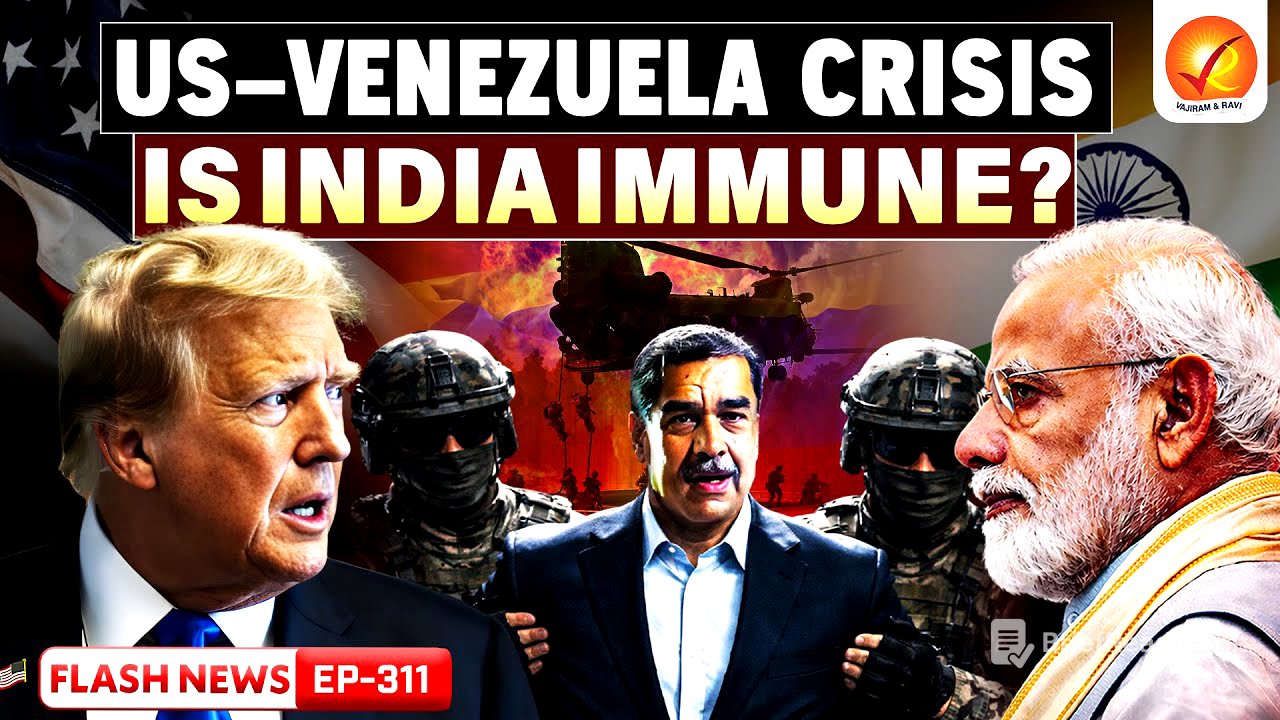
This video discusses the US-Venezuela crisis, exploring the reasons behind US intervention, the impact on the global oil market and India. It highlights that while the US cites democracy and counter-terrorism as reasons, energy security is the primary driver. The crisis has limited immediate impact on India due to diversified oil sources and strategic reserves, but long-term implications include potential inflation and balance of payment issues.
- US intervention in Venezuela is driven by energy security, not just democracy.
- Global oil market impact is currently limited, but financial markets are seeing volatility.
- India is relatively insulated in the short term, but faces potential long-term economic challenges.
US–Venezuela crisis [0:00]
The US-Venezuela conflict is more than just a regional issue; it involves international law, geopolitics, energy security, and India's economic security. The video aims to explain why the US decided to "attack" Venezuela in the name of democracy, the real reasons behind it, the global impacts, and whether India is protected from these impacts.
What happened [1:02]
The United States has taken direct action by capturing Venezuela's President, Nicholas Maduro, marking a shift from relying solely on sanctions and diplomacy to using hard power. This direct regime decapitation, unseen in Latin America for decades, signals a change in US strategy. This action by a major economy on its neighbor is expected to have global impacts, especially since Venezuela holds the world's largest oil reserves during a fragile global recovery, affecting the global oil market.
Oil & energy angle [2:32]
Venezuela has the world's largest proven oil reserves, exceeding those of Saudi Arabia and the UAE. Despite this, its oil production hasn't matched its reserve potential. The country's economy heavily relies on oil, with 90% of export earnings coming from it. However, underinvestment and sanctions, primarily from the US, have restricted financial and technological advancements. The collapse of the state-owned oil and gas company, PDVSA, has further weakened operational capacity. Venezuela is an energy superpower in terms of geology but appears as a failed state economically, making it vulnerable to external powers.
Real reason (energy security) [6:11]
The US cites addressing drug trafficking, migration, and restoring democracy as official reasons for intervention, but the real driver is energy security. Venezuela has the potential to supply 2 million barrels of oil per day. The US aims to secure heavy crude for its Gulf Coast refineries, reducing dependence on the Middle East and OPEC. US refineries are designed for heavy crude, which Venezuela predominantly has. This move aligns with President Trump's sentiment that US oil firms will invest billions in sourcing and supplying Venezuelan oil, giving the US strategic advantages. Energy security is being pursued through security projection and geopolitics.
Global impact [8:23]
The global oil demand is around 100 million barrels per day, with Venezuela contributing only 1%. Before the attack, prices were $58-$60 per barrel, rising to $60-$65 afterward, indicating no major price shock. Venezuelan supplies were already discounted due to sanctions, and global inventories are stable. Markets react more to marginal supply loss than theoretical reserves. Other global financial markets are also affected, with a jump in safe-haven metals like gold and volatility in energy stocks. The dollar is strengthening in a risk-off environment, impacting other currencies. Geopolitics will affect oil prices, increasing inflation expectations and interest rates, leading to capital outflow from developing countries. Developing countries and high-value oil importers with weak current account balances will suffer the most.
Impact on India [13:48]
India has reduced its dependence on Venezuelan oil over the last two decades. Imports from Venezuela were 3-4% between 2010-14 but are now almost negligible. India has diversified its crude oil sources to include the Middle East, Russia, Africa, and America. The refinery system in India is flexible and can process diverse crude grades. There is no immediate supply shock impact. However, if the crisis escalates, it could impact oil prices, worsen India's current account deficit, and increase inflation at the consumer level by 0.3-0.4% for every $10 increase per barrel. While the immediate impact is muted due to discounted Russian oil and government pricing buffers, India may need to prepare for better insulation in the medium and long term.
Conclusion [16:35]
Resource abundance does not guarantee economic strength, as seen in Venezuela. Energy security is strategic, not just commercial, and India's diversification strategy has become a strategic asset. The video concludes by asking for viewers' thoughts on the US attack.