TLDR;
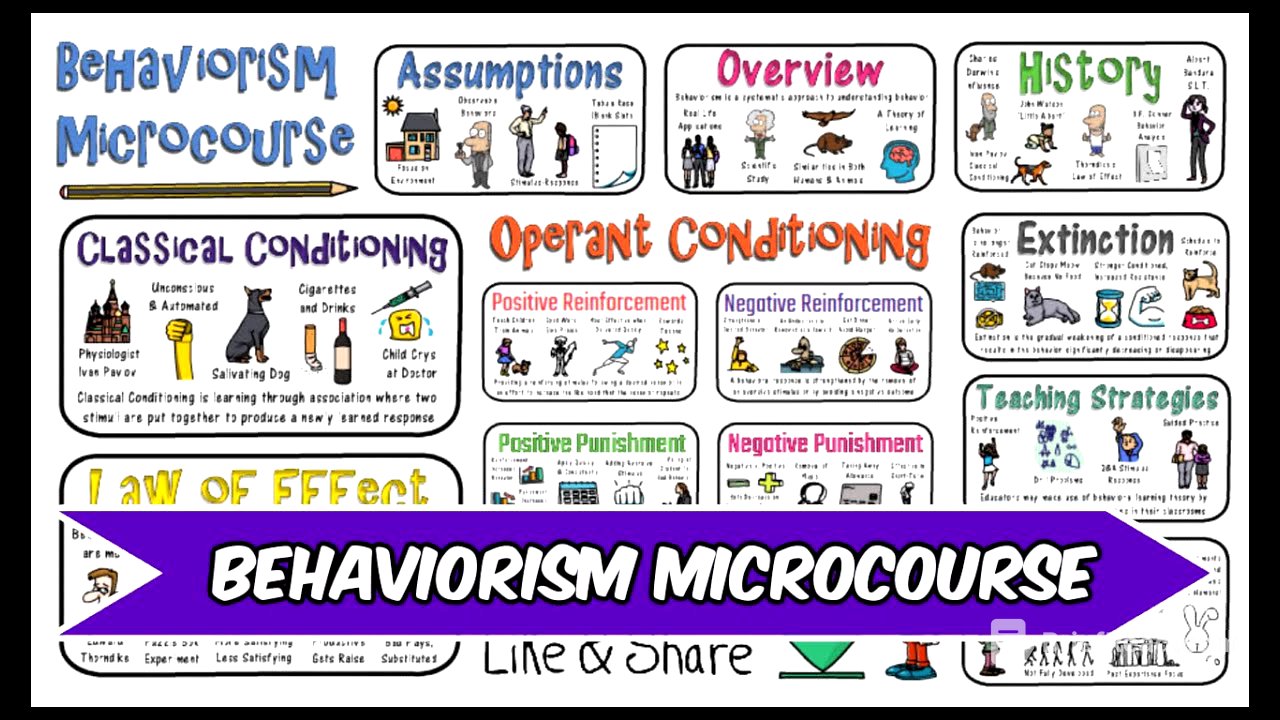
This video provides a comprehensive overview of behaviorism, a systematic approach to understanding behavior through scientific study and data analysis. It covers key concepts such as classical and operant conditioning, the law of effect, and the historical contributions of influential figures like Ivan Pavlov, John Watson, Edward Thorndike, B.F. Skinner, and Albert Bandura. The presentation also explores the assumptions of behaviorism, its applications in education, and common criticisms.
- Behaviorism is a scientific approach to understanding behavior through environmental interactions.
- Key figures like Pavlov, Watson, Thorndike, and Skinner have significantly contributed to the development of behaviorist theories.
- Behaviorist principles are applied in education through positive reinforcement, repetition, and guided practice.
Introduction to Behaviorism [0:00]
Behaviorism is a systematic and scientific approach to understanding behavior, utilizing controlled investigations and data analysis. It has practical applications in education and parenting, often employing animal testing to understand principles applicable to human behavior due to genetic similarities. The core idea is that behaviors are learned through interactions with the environment, contrasting with cognitive and social constructivist theories.
Assumptions of Behaviorism [1:36]
Behaviorism assumes that all behavior is learned from the environment, emphasizing environmental factors over genetic influences. The concept of "tabula rasa" suggests that individuals are born with a blank slate, with knowledge acquired through experience and perception. This approach is empirical, focusing on observable behaviors and the stimulus-response theory, which posits that behavior arises from interactions between stimuli and responses.
Historical Contributions to Behaviorism [2:39]
Charles Darwin, though not a modern behaviorist, studied behavior, organism movement, and emotional reactions to environmental stimuli. Ivan Pavlov is known for classical conditioning, or learning through association, demonstrated by his salivating dog experiments, earning him a Nobel Prize in Physiology in 1904. John Watson popularized behaviorism and conducted the "Little Albert" experiment, conditioning a baby to fear rats. Edward Thorndike developed the law of effect, stating that behaviors followed by pleasant responses are more likely to be repeated, influencing operant conditioning. B.F. Skinner, known for behavioral analysis and operant conditioning, termed his philosophy radical behaviorism. Albert Bandura's social learning theory bridged behaviorism and cognitive psychology, emphasizing social cognitive aspects of behavior.
Classical Conditioning [4:21]
Classical conditioning, or learning through association, involves pairing two stimuli to create a learned response. Ivan Pavlov is credited with discovering classical conditioning, which has applications in treating phobias. His conditioned reflex concept was demonstrated in experiments where dogs were conditioned to salivate at the sound of a bell, associating it with food. Other examples include associating smoking with alcohol at social gatherings and a child's fear of the doctor's office due to previous painful experiences.
Law of Effect [5:55]
The law of effect, developed by Edward Thorndike, states that behavior responses followed by satisfying results are more likely to be repeated. Thorndike's puzzle box experiment showed that cats learned to press a lever to escape and get food, demonstrating that positive responses encourage repeated behavior. Conversely, behaviors followed by unpleasant responses are less likely to occur. Examples include increased work productivity leading to raises and a sports player being substituted out of a game for making a bad play.
Operant Conditioning: Positive Reinforcement [7:39]
Positive reinforcement involves providing a reinforcing stimulus after a desired behavior to increase the likelihood of that behavior repeating. It is used in education to teach children and modify behavior, such as through positive behavior intervention systems and in training animals like canine rescue dogs. An example is a teacher praising a student for good work, with the reinforcement being most effective when delivered quickly after the desired behavior. Token rewards are also a common method of positive reinforcement in schools and therapy.
Operant Conditioning: Negative Reinforcement [9:06]
Negative reinforcement strengthens a behavioral response by removing an aversive stimulus or avoiding a negative outcome. Unlike positive reinforcement, which adds something to increase a desired behavior, negative reinforcement takes something away. An example is eating a meal to avoid hunger pains, where the undesirable stimulus of hunger is removed. In education, students may arrive on time to avoid detention, thus avoiding a negative experience.
Operant Conditioning: Punishment [10:23]
Punishment, unlike reinforcement, aims to decrease the occurrence of a behavior. It involves changes after a behavior to reduce the likelihood of it happening again and should be delivered quickly and consistently. Positive punishment adds an aversive stimulus to remove an undesirable behavior, such as a teacher yelling at a student. Negative punishment removes something desirable to decrease a specific behavior, like taking away a child's music for making a mess. While punishment can be effective in the short term, its long-term effectiveness is questionable.
Extinction [13:11]
Extinction is the gradual weakening of a conditioned response, leading to a significant decrease or complete disappearance of the behavior when it is no longer reinforced. For example, a rat trained to run a maze for cheese will stop running if the reward is removed. Similarly, a cat will stop meowing for food if it consistently receives no food. The stronger the initial conditioning, the greater the resistance to extinction. Schedules of reinforcement are often used to maintain desired behaviors and avoid extinction.
Behavioral Teaching Strategies [14:49]
Educators use behavioral learning theory by implementing behaviorism learning strategies in the classroom. These include positive reinforcements like student of the month certificates, repetition to drill concepts, question-and-answer sessions as stimulus-response interactions, and guided practice with reinforcement at different steps. These strategies aim to reinforce desired behaviors and skills in students.
Criticisms of Behaviorism [15:58]
Behaviorism faces criticisms for focusing too much on the environment and ignoring emotions and the mind. Critics argue that behaviorist theories are not fully developed, studying only certain aspects of human behavior and overlooking the future outlook of life. Additional criticisms include irrelevance to human language acquisition, immoral uses of punishment, and an overemphasis on animal studies, which do not account for human cognitive differences and social norms.






![[위대한수업] 나와 세상을 연결해주는 진화의 메커니즘! 위대한 수업 폴 너스 4강 요약해드려요. 진화의 메커니즘, 자연선택. great minds](https://wm-img.halpindev.com/p-briefread_c-10_b-10/urlb/aHR0cDovL2ltZy55b3V0dWJlLmNvbS92aS9EWlBWR3E3bUhtcy9ocWRlZmF1bHQuanBn.jpg)