TLDR;
This video provides a detailed overview of the shoulder joint anatomy, covering the bones, ligaments, and rotator cuff muscles involved. It explains the structure and function of each component, including the movements they facilitate and common injuries. The video also includes diagrams and reviews to help viewers understand and remember the information.
- Bones and Ligaments: The shoulder joint is composed of the sternum, clavicle, scapula, and humerus, connected by various ligaments such as the acromioclavicular, sternoclavicular, coracoacromial, coracoclavicular, and glenohumeral ligaments.
- Rotator Cuff Muscles: The rotator cuff consists of four muscles—infraspinatus, teres minor, supraspinatus, and subscapularis—that stabilize the joint, facilitate movement, and provide concavity compression.
- Biceps Brachii: The biceps brachii, while not a primary shoulder muscle, has origins on the scapula and is anatomically relevant to the shoulder joint.
Introduction [0:00]
The video introduces a detailed exploration of the shoulder joint's anatomy. It promises to cover every bone and ligament involved, the four muscles of the rotator cuff and their functions, and the joint's movement. The approach will be step-by-step, using diagrams and practice opportunities to ensure viewers understand the shoulder joint's intricacies.
Shoulder Joint Bones and Ligaments [0:25]
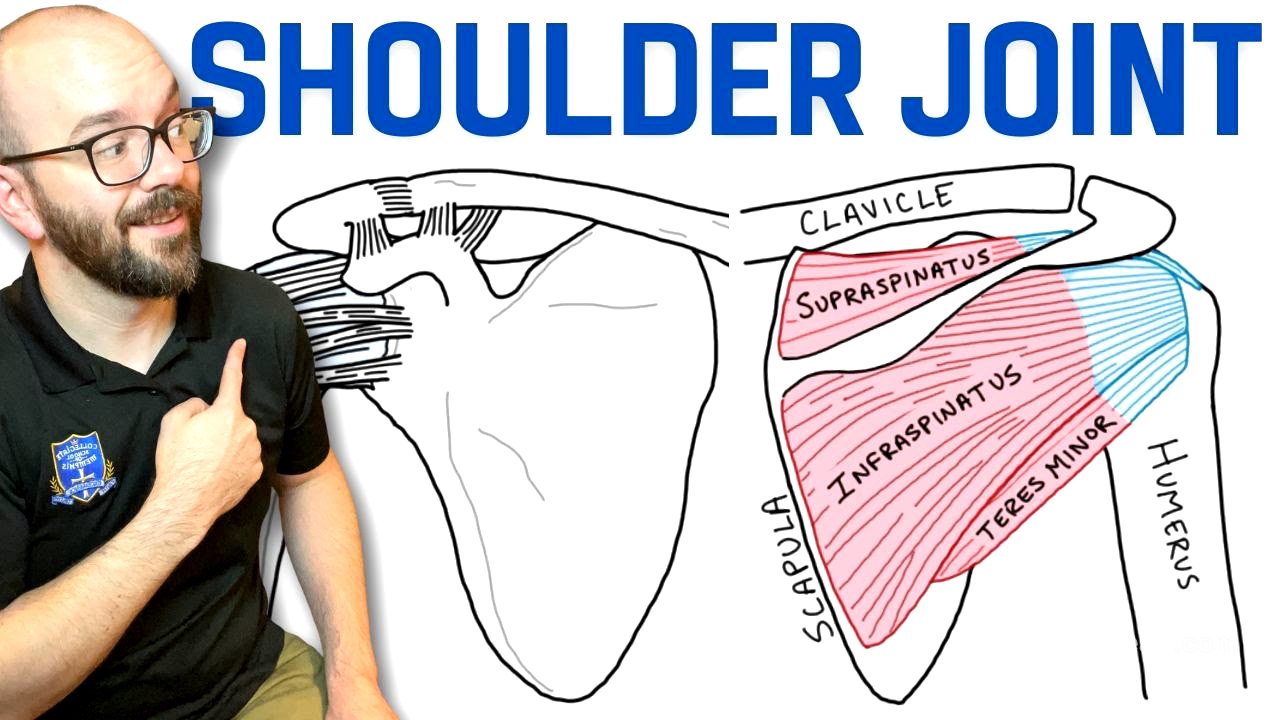
The shoulder joint anatomy is presented, starting with the anterior view. The bones include the sternum, clavicle (collarbone), and scapula (shoulder blade). Key parts of the scapula are the coracoid process, acromion, and glenoid fossa (or glenoid cavity). The humerus, the main bone of the arm, has a head that articulates with the glenoid cavity, forming a ball-and-socket joint, which allows for a wide range of motion. This joint is a synovial joint with articular cartilage on the head of the humerus and glenoid fossa to reduce friction, along with synovial fluid for lubrication. The joint capsule stabilizes the joint and contains the synovial fluid. Ligaments, including the acromioclavicular and sternoclavicular ligaments, connect the bones. The acromioclavicular ligament connects the acromion and clavicle, while the sternoclavicular ligament connects the sternum and clavicle. The coracoacromial ligament connects the coracoid and acromion, and the coracoclavicular ligament connects the coracoid and clavicle. The glenohumeral joint, specifically the ball-and-socket joint, is supported by the joint capsule and glenohumeral ligaments (superior, middle, and inferior), which are thickenings of the joint capsule.
Quick Recap of the Bones and Ligaments [6:14]
A quick review of the bones and ligaments of the shoulder joint is provided. The three bones involved are the clavicle, scapula, and humerus. Important parts of the scapula include the acromion, coracoid, and glenoid fossa. The ligaments discussed are the acromioclavicular, sternoclavicular, coracoacromial, coracoclavicular, coracohumeral, and the three glenohumeral ligaments (superior, middle, and inferior). The joint capsule surrounds the head of the humerus and the glenoid cavity, containing synovial fluid and articular cartilage.
Rotator Cuff [6:59]
The rotator cuff muscles are examined, requiring both anterior and posterior views. The bones include the clavicle, scapula (with the coracoid and acromion on the anterior side, and the spine of the scapula on the posterior side), and the humerus. The rotator cuff consists of four muscles that provide movement and structural support to the shoulder joint. The infraspinatus muscle, located below the spine of the scapula on the posterior side, rotates the shoulder back. The teres minor muscle, inferior to the infraspinatus, synergistically rotates the humerus laterally. The supraspinatus muscle, located above the spine of the scapula, abducts the humerus and works with the deltoid muscle to lift the arm. A common injury is a torn rotator cuff, most often affecting the supraspinatus. The subscapularis muscle, located on the anterior side of the scapula, rotates the humerus medially and works with the pectoralis major. The primary functions of the rotator cuff muscles are stabilization, concavity compression (pulling the head of the humerus medially for efficient rotation), and movement (abduction and rotation). The biceps brachii, while not a primary shoulder muscle, has two heads originating on the scapula: one connecting to the coracoid process and the other with a tendon that threads under the subscapularis tendons. The transverse ligament, often shown in diagrams, is essentially an extension of the subscapularis tendon.
Quick Recap of Rotator Cuff [13:43]
A quick recap of the rotator cuff muscles and their functions is presented. The infraspinatus and teres minor rotate the shoulder back. The supraspinatus, along with the deltoid muscle, abducts the arm. The subscapularis, along with the pectoralis major, rotates the shoulder forward. A common injury is a torn rotator cuff, often in the supraspinatus tendon. The rotator cuff muscles provide stabilization, concavity compression, and movement.
Review! [14:20]
Viewers are prompted to pause the video and label a blank diagram of the ligaments, bones, and parts of the bone in the shoulder joint. The answers are then provided, identifying the humerus, scapula (including the acromion and coracoid), clavicle, sternum, and ligaments (acromioclavicular, sternoclavicular, coracoacromial, coracoclavicular, joint capsule, coracohumeral, and glenohumeral ligaments). A blank diagram of the rotator cuff muscles is presented, and viewers are asked to name the muscles and their functions. The answers include the supraspinatus, infraspinatus, teres minor, subscapularis, and biceps brachii. The functions of the rotator cuff are stabilization, concavity compression, and movement (abduction and rotation).
Endscreen [16:01]
The video concludes by encouraging viewers to subscribe for more anatomy content.





![[ENG] 석삼이 형이 왜이리 무리해... (with. 러블리즈 예인)ㅣ지편한세상 타이어모어 편](https://wm-img.halpindev.com/p-briefread_c-10_b-10/urlb/aHR0cDovL2ltZy55b3V0dWJlLmNvbS92aS81NDZwOXJqU2hQMC9ocWRlZmF1bHQuanBn.jpg)