TLDR;
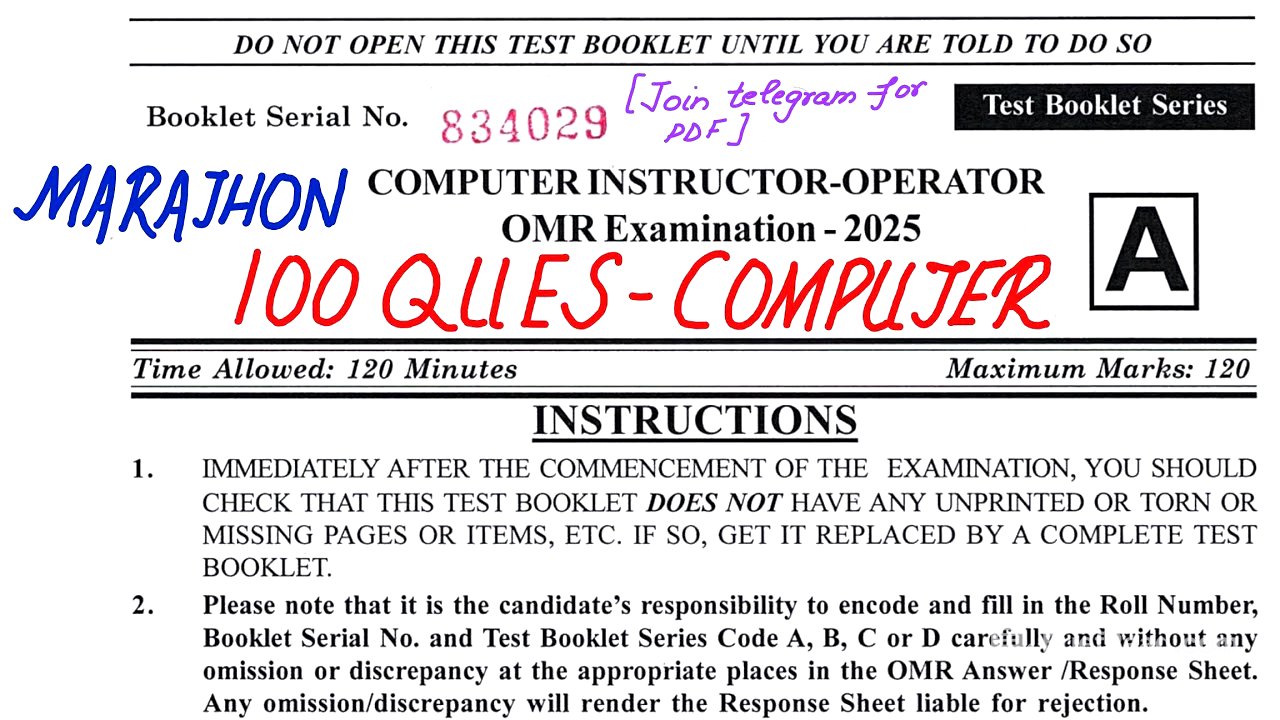
This video by JK Maths provides a detailed walkthrough of a computer-based question paper, focusing on questions relevant to junior assistant exams. The instructor explains key concepts, provides additional information, and offers test-taking strategies.
- ASCII codes, binary-decimal conversions, and computer classifications are explained.
- MS Word, Excel, and networking concepts are covered with practical examples.
- Test-taking strategies such as elimination and understanding question nuances are emphasized.
Introduction [0:00]
The instructor welcomes viewers and expresses satisfaction that his computer, math, and reasoning lessons are helping students improve. He introduces a computer instructor/operator paper from 2025 with 120 questions, over 100 of which are computer-related. He aims to solve relevant questions for junior assistant exams, potentially combining another paper if time permits.
ASCII Codes and Decimal Representation [1:04]
The instructor discusses ASCII codes, starting with the question of finding the decimal representation for the dollar sign. He explains that while the question is advanced, it introduces the important concept of ASCII. ASCII stands for American Standard Code for Information Interchange. It assigns unique codes to characters, acting as a bridge between human-readable characters and the binary data computers use. The decimal code for the dollar sign is 36. He also provides the codes for percentage (37), ampersand (38), and hash (35). He encourages viewers to share additional ASCII codes in the comments.
Binary to Decimal Conversion [4:00]
The instructor explains binary to decimal conversion. He suggests writing down powers of 2 (1, 2, 4, 8, 16, 32, 64, 128) and matching them to the binary digits. Add the values where the binary digit is 1. For example, the binary number 11010101 is converted to decimal by adding 128 + 64 + 16 + 4 + 1, resulting in 213. For decimal to binary conversion, divide the decimal number by 2 repeatedly, noting the remainders. The binary number is then read from the bottom-up of reminders.
Decimal to Binary Conversion [7:12]
The instructor demonstrates converting the decimal number 278 to binary by repeatedly dividing by 2 and noting the remainders. He emphasizes that the binary equivalent is read from the bottom up. He also advises using the process of elimination by checking the last digits to narrow down the options.
Mainframe vs. Supercomputers [9:11]
The instructor discusses the characteristics of mainframe and supercomputers. Mainframe computers handle a large volume of computations concurrently, while supercomputers execute fewer programs but at a very high speed. He then classifies computers based on size (micro, mini, mainframe, super), work (analog, digital, hybrid), and purpose (general, special). He provides examples for each category, such as PCs and laptops for microcomputers, PDP 8 for minicomputers, IBM 370 for mainframes, and Cray-1 and Param for supercomputers.
MS Word: Windows Split Feature [14:01]
The instructor explains the Windows split feature in MS Word, which allows users to view different parts of a document simultaneously. The shortcut to remove the split is Alt + Shift + C. Alternatively, Ctrl + Alt + S can toggle the split, and the View tab also provides a split option.
MS Word: Mail Merge [16:34]
The instructor defines mail merge as a process in Microsoft Word that combines names and addresses with a standard document. This feature is located under the Mailing tab in MS Word.
MS Word: Opening Existing Documents [17:15]
The instructor explains the steps to open an existing document in MS Word: go to File, select Open, and then select the document. To select text, drag the mouse over the desired text.
MS Word: Compatibility Checker [17:57]
The instructor explains that the compatibility checker in MS Word identifies features in a document that may not be supported in earlier versions of Word. It ensures that the document appears the same in different versions.
MS Word: Auto Correct Options [19:30]
The instructor explains how to customize the auto-correct options in MS Word by going to File > Options > Proofing > AutoCorrect Options.
MS Excel: Consolidate Feature [20:16]
The instructor identifies the consolidate feature in MS Excel, which gathers data from different worksheets into a master worksheet.
MS Excel: Keyboard Shortcuts [20:38]
The instructor reviews Excel keyboard shortcuts: Ctrl + Shift + $ applies currency format, Ctrl + Arrow Key navigates to the last used cell in the current column, and Ctrl + G opens the Go To dialog box.
MS Excel: NOW Function [22:13]
The instructor explains that the NOW function in MS Excel returns the current date and time. It is used by typing =NOW() in a cell.
Databases: Data Sheets [23:22]
The instructor explains that a data sheet in a database is similar to a worksheet in Excel, allowing users to view data in rows and columns.
MS Excel: Navigation Shortcuts [24:06]
The instructor reviews MS Excel navigation shortcuts: Home moves to the first column of the current row, Ctrl + Home moves to the beginning of the worksheet, and Page Down moves the active cell down by one screen.
MS Excel: Correct Statements [26:08]
The instructor identifies the correct statement about MS Excel: it allows users to automate tasks using built-in functions and macros. He clarifies that Excel supports multiple file formats, and pivot tables are used for more than just creating charts.
MS Excel: Donut Charts [28:30]
The instructor explains that a donut chart in MS Excel is similar to a pie chart but with a hollow center.
MS Excel: Sparklines [29:41]
The instructor defines sparklines as tiny charts within a cell used for visual representation of data.
MS Excel: SUM Formula [31:08]
The instructor explains how to use the SUM formula in MS Excel to calculate the sum of numeric values in a column. For example, to sum values from D11 to D16, the formula is =SUM(D11:D16).
SQL Databases: Key Concepts [31:57]
The instructor defines SQL (Structured Query Language) and explains that it is used to retrieve data from databases. He mentions that a view is a virtual table based on the result set of an SQL query.
Relational Databases: Foreign Keys [32:44]
The instructor explains that a foreign key in a relational database creates a relationship between two tables.
SQL: Full Form [33:31]
The instructor reiterates that SQL stands for Structured Query Language.
File Extensions: Paint Brush Files [33:56]
The instructor explains that the default file extension for Paint Brush files in Windows is .bmp (BitMap Image File). He reviews various file extensions for text files (DOC, PAGES, TXT, WPS, LOG), image files (BMP, GIF, JPEG, JPG, PNG), video files (AVI, MP4, MOV, WMV), and audio files (WMA, MP3, WAV).
Mobile Communication: IMEI [37:15]
The instructor explains that IMEI stands for International Mobile Equipment Identifier. It is a 15-digit code that acts as a fingerprint for a mobile device, used for tracking stolen phones.
Networking Devices: Gateways [39:00]
The instructor explains that a gateway is a networking device used for interconnecting networks on different protocols. He differentiates it from a bridge, which connects networks using the same protocol.
Internet Protocols: DHCP, DNS, HTTP [40:53]
The instructor discusses various internet protocols, including HTTP (Hypertext Transfer Protocol), DNS (Domain Name System), and DHCP (Dynamic Host Configuration Protocol). DHCP provides unique IP addresses to devices, and DNS converts domain names to IP addresses.
Internet Key Exchange Protocol [42:29]
The instructor explains that the main function of the Internet Key Exchange Protocol is to establish a secure and authenticated communication channel.
Internet Access Methods: ISDN [42:55]
The instructor discusses internet access methods, including dial-up connections, ISDN (Integrated Services Digital Network), and DSL (Digital Subscriber Line). ISDN uses out-of-band signaling and provides a physical layer service from layer 2 to layer 7.
Networking: VPN, ISP, Encryption [45:05]
The instructor matches networking terms: VPN (Virtual Private Network) ensures security by scrambling data and masking IP addresses, ISP (Internet Service Provider) provides access to the internet, and encryption converts information to protect it from unauthorized access.
Modems: Modulation and Demodulation [46:08]
The instructor explains that a modem converts digital signals to analog and vice versa, involving modulation and demodulation.
Peer-to-Peer File Sharing: BitTorrent [48:37]
The instructor identifies BitTorrent as a protocol primarily used in peer-to-peer file sharing.
Networking Protocols: FTP, SMTP, Telnet, DNS [49:19]
The instructor reviews networking protocols: FTP (File Transfer Protocol), SMTP (Simple Mail Transfer Protocol), Telnet (Telecommunication Network), and DNS (Domain Name System). He notes that Telnet can also stand for Teletype Network or Terminal Network.
Email Communication: Stages [51:34]
The instructor outlines the stages of sending and receiving an email: the sender composes the email, the message is sent to the sender's ISP mail server, the ISP routes the message to the recipient's ISP mail server, the message is held in the recipient's electronic mailbox, and the message is retrieved and sent to the recipient's computer. He also shares information about the first internet service providers in India, including BSNL and Satyam Infotech.
Search Engines: Identifying [54:44]
The instructor identifies search engines, noting that Opera is a web browser, while Bing, Google, and Yahoo are search engines.
Telnet Protocol: TCP Port [55:16]
The instructor mentions that the Telnet protocol uses TCP port 23 by default for communication.
Email Communication: Encryption [56:54]
The instructor explains that encryption is used to keep sensitive information in email communication secure from unauthorized access.
Email Clients: Desktop-Based [57:24]
The instructor identifies desktop-based email clients, correcting an earlier mistake. He clarifies that Gmail is a browser-based client, while Outlook, Netscape Mail, and Thunderbird are desktop-based.
Email Clients: Primary Purpose [59:49]
The instructor states that the primary purpose of an email client is to receive, send, and organize email messages on the user's device.
SMTP: Port Number [1:00:07]
The instructor notes that SMTP uses port number 25 for sending emails.
Web Pages: Format [1:00:52]
The instructor explains that web pages are typically saved in HTML (HyperText Markup Language) format.
Meta Search Engines: Dogpile [1:01:33]
The instructor identifies Dogpile as a meta-search engine that aggregates results from multiple search engines.
Mailboxes: Accessing [1:02:10]
The instructor explains that mailboxes can be accessed through email clients and web pages, but not pagers. He defines a pager (or beeper) as a wireless communication device used to display messages.
Web Development: DHTML and XML [1:03:31]
The instructor matches web development terms: DHTML (Dynamic HyperText Markup Language) allows for dynamic and interactive web pages, and XML (Extensible Markup Language) is used for storing and exchanging data.
Viruses: Parasitic [1:04:30]
The instructor identifies a parasitic virus as one that attaches to EXE files and infects other EXE files.
Network Security: Firewalls [1:05:09]
The instructor explains that the primary purpose of a firewall is to monitor and control incoming and outgoing network traffic based on security rules.
World Wide Web: Creator [1:05:35]
The instructor identifies Tim Berners-Lee as the creator of the World Wide Web in 1989. He also notes that HTTP is the backbone of the WWW, and TCP/IP is the backbone of the internet. He mentions Vint Cerf and Robert E. Kahn as the developers of TCP/IP and Larry Page as the co-founder of Google.
Cyber Crime: Phishing [1:07:20]
The instructor defines phishing as a cybercrime where criminals use fraudulent emails or websites to steal sensitive personal information.
IP Addressing: IPv6 [1:08:29]
The instructor explains that IPv6 supports a significantly larger address space than IPv4.
Domain Management: ORG [1:09:27]
The instructor notes that the Public Interest Registry manages the .ORG domain.
MS PowerPoint: New Blank Presentation [1:09:44]
The instructor explains that the shortcut key in MS PowerPoint to create a new blank presentation is Ctrl + N. Ctrl + M adds a new slide.
MS PowerPoint: Presentation Shortcuts [1:10:36]
The instructor reviews MS PowerPoint shortcuts: F5 starts the presentation from the first slide, Shift + F5 starts the presentation from the current slide, Alt + F5 starts the presentation in presenter view, and Ctrl + H hides the pointer and navigation buttons.
MS PowerPoint: Dynamic Effects [1:11:56]
The instructor explains that animations in MS PowerPoint allow users to add dynamic effects to the text.
MS PowerPoint: Adding Images [1:12:32]
The instructor explains that JPG files can be added to slides in MS PowerPoint by going to Insert > Images.
Printers: Non-Impact [1:12:51]
The instructor explains that non-impact printers are also known as page printers. He also discusses printer speed, measured in pages per minute (PPM), lines per minute (LPM), or characters per second (CPS). Dot matrix printers are measured in CPS.
Memory: Access Time [1:14:17]
The instructor explains that registers have the fastest access time, followed by cache memory.
Input Devices: Visual Data [1:15:04]
The instructor identifies a webcam as a device used to input visual data.
File Extensions: Matching [1:15:29]
The instructor matches file extensions: JPG is for images, MP4 is for video, and MP3 is for audio.
Software: Open Source [1:16:12]
The instructor identifies Microsoft Office as not being open source software. He provides details about Libra Office, including its components like Writer, Calc, Impress, and Base.
Software: Hardware and Application [1:17:58]
The instructor explains that system software directly interacts with hardware, while application software interacts with system software to perform user-specific tasks.
Operating Systems: Linux [1:18:23]
The instructor explains that Linux is an open-source operating system that can be modified and distributed freely. He notes that it was developed by Linus Torvalds and its mascot is a penguin.
Operating Systems: UNIX [1:19:47]
The instructor defines UNIX ( यूनिकोड इंफॉर्मेशन Computing System Code) and explains that its source code is not available. It is used as a server system in mainframe computers and is a CUI-based operating system. It was developed by Ken Thompson and Dennis Ritchie and written in C language.
Windows: First Version with Store [1:20:50]
The instructor notes that Windows 8 was the first version to support the Windows Store for downloading apps. He also shares that Windows is a GUI-based OS introduced by Microsoft, founded by Bill Gates and Paul Allen.
Text Editors: Wordpad vs. Notepad [1:22:04]
The instructor explains that Wordpad offers more advanced features than Notepad, supporting formatting, font styles, and multimedia, while Notepad only supports plain text.