TLDR;
Alright, so this video is all about the provincial dynasties of North and Deccan during the medieval period. We're talking about important dynasties like the Sharqi dynasty of Jaunpur, the Bahmani Sultanate, and the dynasties of Kashmir. The video covers who founded these dynasties, their capitals, and some key rulers. Plus, there's a mention of a combo offer on courses with a sweet discount code.
- Key dynasties: Sharqi, Bahmani, Kashmir
- Important rulers and founders discussed
- Combo offer with discount code "1 MILLION 40"
Jaunpur City and the Sharqi Dynasty [1:19]
The city of Jaunpur was founded by Firoz Shah Tughlaq in memory of Muhammad bin Tughlaq, also known as Juna Khan. Firoz Shah Tughlaq appointed Malik Sarwar as the governor of the region. Malik Sarwar and his adopted son, Mubarak Shah, declared independence and established the Sharqi dynasty, also known as the Dynasty of the East. Jaunpur remained independent for about 85 years until Bahlol Lodi of the Lodi dynasty defeated the last ruler, Hussain Shah, in 1479 and conquered Jaunpur.
Siraj of the East: Jaunpur [4:23]
Jaunpur was known as the "Siraj of the East" or "Shiraz-e-Hind" during the rule of the Sharqi dynasty. Firoz Shah Tughlaq established the city in memory of Muhammad bin Tughlaq, whose original name was Juna Khan. Malik Sarwar was later appointed as the governor.
Last Ruler of Jaunpur [5:17]
The last ruler of the Jaunpur state was Hussain Shah. Bahlol Lodi defeated him in 1479 to conquer Jaunpur. The city was founded by Firoz Shah Tughlaq in memory of his cousin, Muhammad bin Tughlaq (Juna Khan), and was later known as the "Shiraz-e-East."
Akbar of Kashmir: Zain-ul-Abidin [6:04]
Zain-ul-Abidin, also known as Shahi Khan, was the ruler of Kashmir and was known as the "Akbar of Kashmir" because his policies resembled those of Akbar. He was known for his religious tolerance, abolished the Jizya tax, and banned cow slaughter. During his reign, the Mahabharata, Dasavatara, and Rajatarangini were translated into Persian.
Abolition of Jizya and Cow Slaughter in Kashmir [7:22]
Zain-ul-Abidin, the "Akbar of Kashmir," abolished the Jizya tax and banned cow slaughter in Kashmir.
Establishment of the Bahmani State [7:51]
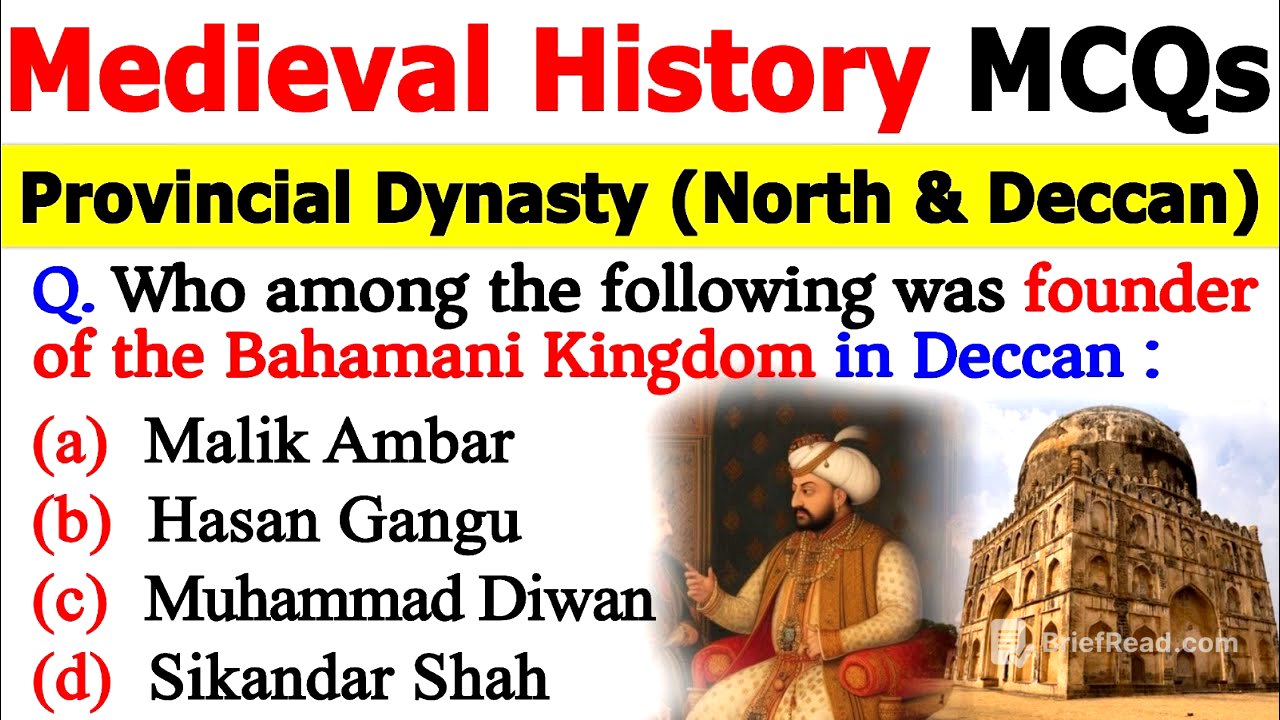
The Bahmani State was established by Alauddin Hasan, also known as Hasan Gangu. He founded the Bahmani Empire in 1347. He declared Gulbarga as the capital of his empire, renaming it Ahsanabad. He divided his empire into four regions: Gulbarga, Daulatabad, Berar, and Bidar. He also abolished Jizya.
First Capital of the Bahmani Kingdom [9:08]
The first capital of the Bahmani Kingdom was Gulbarga before it was shifted to Bidar.
Founder of the Bahmani Kingdom in Deccan [9:31]
Hasan Gangu, also known as Alauddin Hasan Bahman Shah, founded the Bahmani Kingdom in Deccan in 1347.
Matching Dynasties with Their Locations [10:13]
- Adil Shahi dynasty: Bijapur (founder Yusuf Adil Shah)
- Qutb Shahi dynasty: Golconda (founder Quli Qutb Shah)
- Nizam Shahi dynasty: Ahmednagar (founder Malik Ahmed)
- Sharqi dynasty: Jaunpur (founder Malik Sarwar)
Jagatguru: Ibrahim Adil Shah [11:41]
Ibrahim Adil Shah was known as "Jagatguru" by his Muslim subjects because of his belief in secularism. He was a ruler of the Sultanate of Bijapur and was known for his tolerance of other religions. He wrote the book "Kitab-e-Navras."
Author of Kitab-e-Navras [13:11]
Ibrahim Adil Shah II wrote the book "Kitab-e-Navras."
End of the Nizam Shahi Dynasty [13:24]
The Nizam Shahi dynasty of Ahmednagar came to an end when the Mughal Empire annexed Ahmednagar and Hussain Shah was sentenced to life imprisonment. The city of Ahmednagar was founded by Ahmed Nizam Shah, and it was conquered and annexed by Shah Jahan in 1632.
Location of Golconda [14:23]
Golconda is located in Hyderabad. It was the capital of the Qutb Shahi dynasty.
Surrender to the Portuguese [14:55]
Bahadur Shah, a ruler of medieval Gujarat, surrendered Diu to the Portuguese. In 1535, he entered into a treaty with the Portuguese governor, Nuno da Cunha, to assist against Mughal dangers.
Capital of the Hoysalas [15:33]
Dwarasamudram was the capital of the Hoysala dynasty. In the early 14th century, Malik Kafur of the Delhi Sultanate besieged Dwarasamudram.
Dynasty of Rudrama Devi [16:14]
The Kakatiya dynasty is associated with the female king Rudrama Devi.
Modern Name of Dwarasamudram [16:43]
The modern name of Dwarasamudram, the ancient capital of the Hoysalas, is Halebidu, located in the Hassan district of Karnataka.
Monument with the Largest Dome [17:04]
The Gol Gumbaz in Bijapur has one of the largest domes in the world. It is the mausoleum of Muhammad Adil Shah of Bijapur.
Matching Dome Structures [17:27]
- Gol Gumbaz: Muhammad Adil Shah
- Double Dome: Sikandar Lodi's tomb
- Octagonal Tomb: Sher Shah's tomb
Builder of Gurjar Mahal [18:11]
Raja Mansingh Tomar built the Gurjar Mahal between 1486 and 1516 AD. He constructed it for his wife, Mrigyani, who was a Gurjar princess.
Incorrectly Matched Pair [18:48]
The incorrectly matched pair is Adina Masjid, which is located in Pandua, West Bengal, not in Mandu. The Adina Masjid was built by Sikandar Shah.
Polygars of South India [19:57]
Polygars of South India were territorial administrative and military governors appointed by the Nayaka rulers of South India during the 16th to 18th centuries.
Location of Hoysala Monuments [20:25]
Hoysala monuments are found in Halebidu and Belur.
Matching Ruling Dynasties with Capitals [20:39]
- Pallavas: Kanchi
- Pandyas: Madurai
- Yadavas: Devagiri
- Kakatiyas: Warangal


![Baray Bhaiya Episode 74 - [Eng Sub] - Aijaz Aslam - Maya Khan - Rabya Kulsoom - 28th August 2025](https://wm-img.halpindev.com/p-briefread_c-10_b-10/urlb/aHR0cDovL2ltZy55b3V0dWJlLmNvbS92aS9vdHFoeWxDV01ERS9ocWRlZmF1bHQuanBn.jpg)