TLDR;
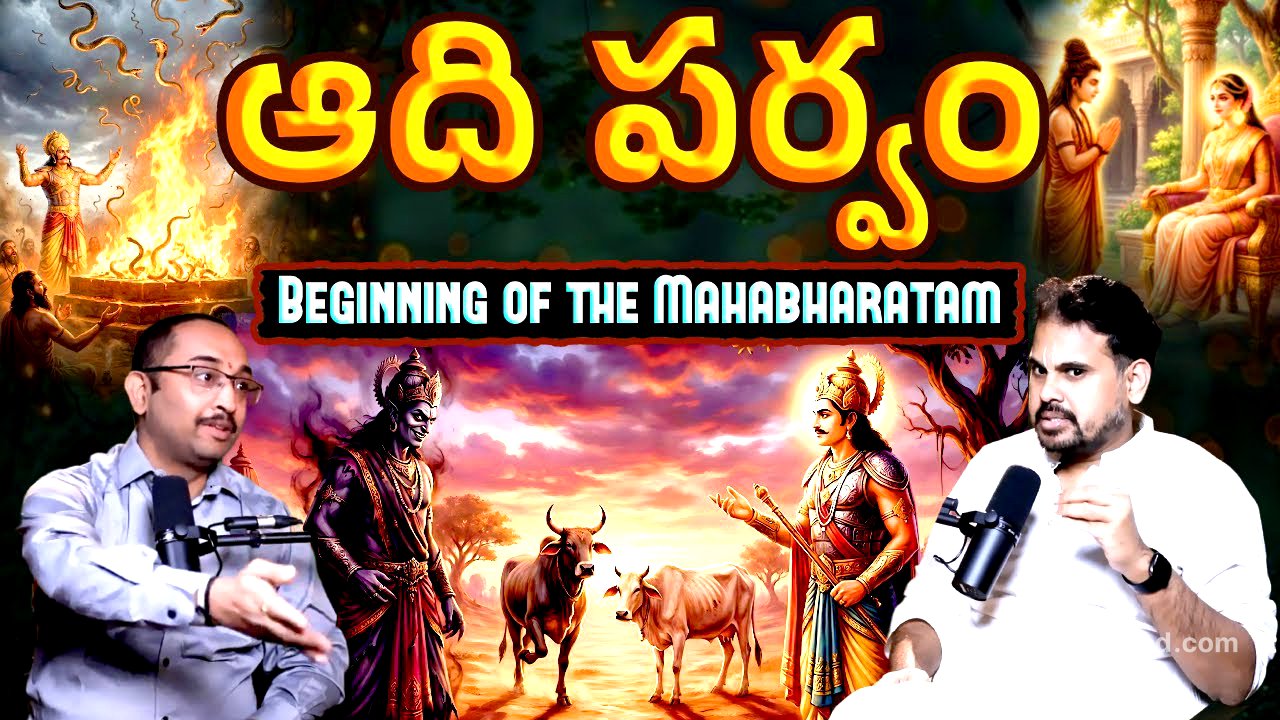
Alright ji, so in this podcast, KC Talks Telugu is discussing the first parva of Mahabharata, which is the Adi Parva. Vamsidhar is hosting and KC garu is explaining why they are discussing Adi Parva after Swargarohana Parva. Basically, they are talking about how the Pandavas went to Swarga, the importance of Mahabharata, and the story of Parikshit Maharaj and Kali. They also discuss the importance of listening to Bhagavat Katha for moksha.
- Pandavas' ascent to Swarga and their original divine forms.
- Dharma's subtle judgments and the philosophical reasons behind them.
- Parikshit Maharaj's encounter with Kali and the agreement made.
- The significance of Bhagavat Katha for attaining moksha.
Introduction to Adi Parva [0:13]
Vamsidhar welcomes everyone to KC Talks Telugu and introduces himself as a software employee. He mentions that he and his family regularly follow KC garu's Mahabharata podcast. In this episode, they will learn about the Adi Parva, the first parva of the Mahabharata, from KC garu. KC garu explains that they are discussing Adi Parva after Swargarohana Parva to connect the events that lead to the Adi Parva. He wants people to understand why Mahabharata was told, where it was told, and in what circumstances.
The Ascent of Pandavas and Dharma's Judgments [0:42]
KC garu explains that after the Pandavas ascended to Swarga, they merged back into their original divine forms. Dharmaraja merged into Yamadharma Raja, Bhima into Vayu, Arjuna into Indra, Draupadi into Durga, Parvati, and Saraswati, and Nakula and Sahadeva into Ashwini Devas. Dharmaraja made some remarks about the Pandavas' flaws while ascending, like Arjuna being boastful, Bhima eating excessively, Draupadi favoring Arjuna, Nakula being proud of his beauty, and Sahadeva being arrogant about his political knowledge. KC garu clarifies that Dharmaraja was indebted to the Pandavas, who always obeyed him and helped him win kingdoms. According to dharma shastra, pointing out the faults of someone you are indebted to cancels the debt.
The Narakadwara and Dharmaraja's Experience [6:10]
Dharmaraja had to enter Narakadwara (the gates of hell) and experience the horrors of the Vaitarani river. This happened because, on the 14th day of the Kurukshetra war, Dharmaraja told Dronacharya that Ashwatthama was dead, which was a half-truth. Krishna had asked Dharmaraja to do this to stop Dronacharya, but Dharmaraja didn't want to lie. Because of this one lie, he had to experience Narakadwara. After all this, the Pandavas merged into their divine forms, and Parikshit, who was born to Uttara, was blessed by them from above.
Reign of Parikshit and the Advent of Kali [10:02]
After 36 years of Kali Yuga, Parikshit ruled the earth with the help of Yuyutsu and Vajra. He married Madravati and had four sons. One day, while traveling in his kingdom, Parikshit saw a bull and a cow in distress. The bull had three broken legs, and the cow was crying. Parikshit learned that the bull represented Dharma and the cow represented Bhoomata (Mother Earth). They were suffering because Kali Yuga had begun. Parikshit, understanding that Kali had entered the world, drew his sword to kill Kali.
Parikshit's Agreement with Kali [16:16]
Kali appeared before Parikshit and explained that he had to come as part of the cycle of time. Parikshit, being a king, had to help Kali find a place to live. Parikshit allowed Kali to reside in places where people indulge in intoxication, meat consumption, prostitution, and gambling. However, Kali argued that these things were not happening in Parikshit's kingdom. Finally, Parikshit allowed Kali to reside where there is excessive gold. Parikshit then issued orders to prevent intoxication, meat consumption, gambling, and prostitution in his kingdom. He also advised people not to hoard excessive gold.
Parikshit Cursed and the Path to Moksha [25:31]
One day, Parikshit went hunting and became thirsty. He entered the ashram of a sage named Shamika, who was in deep meditation. When Shamika didn't respond, Parikshit got angry and put a dead snake around his neck. Shamika's son, Shringi, cursed Parikshit to die in seven days by a snake bite. Shamika woke up and regretted what his son had done. He went to Parikshit and apologized. Parikshit accepted the curse and decided to prepare for death. He appointed his son Janamejaya as the king and went to the banks of the Ganga to seek moksha.
The Arrival of Sukadeva Goswami and Bhagavat Katha [38:21]
On the banks of the Ganga, Narada, Vishwamitra, and other sages told Parikshit that Sukadeva Goswami would come and explain the path to moksha. Sukadeva Goswami arrived and narrated the Bhagavat Purana to Parikshit. Listening to the Bhagavat Katha for seven days, Parikshit attained moksha. A snake named Takshaka bit Parikshit, and his soul merged with the Supreme Lord. Janamejaya ruled the kingdom well, following Parikshit's rules.
Janamejaya's Snake Sacrifice and the Story of Utanka [46:43]
One day, a sage named Utanka told Janamejaya that Takshaka had killed his father because of a curse and also because of a past enmity. Utanka explained that Arjuna had killed Takshaka's wife during the Khandava Vana Dahana. Utanka instigated Janamejaya to perform a snake sacrifice to destroy the entire snake race. Janamejaya, influenced by Utanka's words, decided to perform the Sarpa Yaga. Utanka's story is that he was completing his studies and wanted to give Guru Dakshina to his Guru Patni. She asked for the earrings of Madayanti, the wife of King Sudhashana. Utanka went to get them, facing many obstacles from Takshaka.
The Sarpa Yaga and the Curse of Sarama [1:02:10]
Janamejaya started the Sarpa Yaga with great security. A puppy, the child of Sarama, entered the Yaga area. Janamejaya's brothers beat the puppy, suspecting it to be a spy. Sarama cursed Janamejaya's brothers to be fearful and restless. Because of the curse, Janamejaya's brothers became fearful and started behaving strangely.
The Narration of Mahabharata and the End of Sarpa Yaga [1:09:35]
Vaishampayana, a prominent saint, told Janamejaya the story of the Mahabharata to remove their fears. Vaishampayana explained the greatness of their lineage and the valor of their ancestors. While Vaishampayana was narrating the Mahabharata, Ugrashrava Sauti was listening. As the Sarpa Yaga was progressing, a sage named Astika arrived and stopped the sacrifice. Astika convinced Janamejaya to stop the sacrifice and forgive Takshaka. Janamejaya, influenced by Astika's words, stopped the Sarpa Yaga.
The Importance of Mahabharata and the Message of the Podcast [1:24:30]
Saunaka Rishi asked Ugrashrava Sauti about the importance of Dharma in Kali Yuga. Ugrashrava Sauti explained that Mahabharata is the fifth Veda and that listening to it can help people attain Dharma, Artha, Kama, and Moksha. He also explained that even if people cannot perform Yagya, they can still attain moksha by listening to Mahabharata and Bhagavat Katha. The podcast concludes by emphasizing the importance of avoiding intoxication, meat consumption, gambling, and prostitution, and by encouraging people to listen to Mahabharata and Bhagavat Katha for moksha.