TLDR;
This video provides a detailed overview of the Russian Civil War, exploring its causes, key players, major events, and devastating aftermath. It examines the social and political conditions leading up to the revolution, the conflict between the Red and White armies, and the eventual establishment of the Soviet Union. The video also touches on the long-lasting impact of the war on Russia's population, economy, and political landscape.
- The Russian Revolution was a fight for freedom from imperial rule due to widespread poverty and inequality.
- The Red Army (Bolsheviks) fought for freedom, while the White Army (anti-Bolsheviks) sought the return of the Tsars.
- The war resulted in millions of deaths and widespread devastation, leading to long-term economic and social challenges.
Introduction to Russia [0:08]
Russia is known for its diversity, vastness, and cultural richness. The country boasts unique natural sites, including the Curonian Spit and the Man-Pupu-Ner Plateau, which are recognised as UNESCO World Heritage sites. Despite its beauty, Russia has a history marked by pain and terror, particularly in the lead-up to the Russian Revolution. This revolution was a struggle against imperial rule, driven by widespread social and economic inequalities.
Causes of the Russian Revolution [1:07]
In the centuries leading up to the revolution, Russia was ruled by Tsars, whose reign was marked by inequality and exploitation. Aristocrats and nobles exploited the serfs and lower classes, leading to extreme wealth disparities and widespread poverty. Although some Tsars introduced reforms, they failed to address the fundamental imbalances in society. Serfs, despite being freed in 1861, remained indebted due to required payments to the government. Agricultural techniques were outdated, literacy rates were low, and peasants in southern and western Russia faced government control, leading to increased frustration. As the population grew, land became scarce, and many peasants migrated to cities in search of work, resulting in overcrowding, poor wages, and a lack of government reforms.
The Russian Civil War: Red Army vs. White Army [3:26]
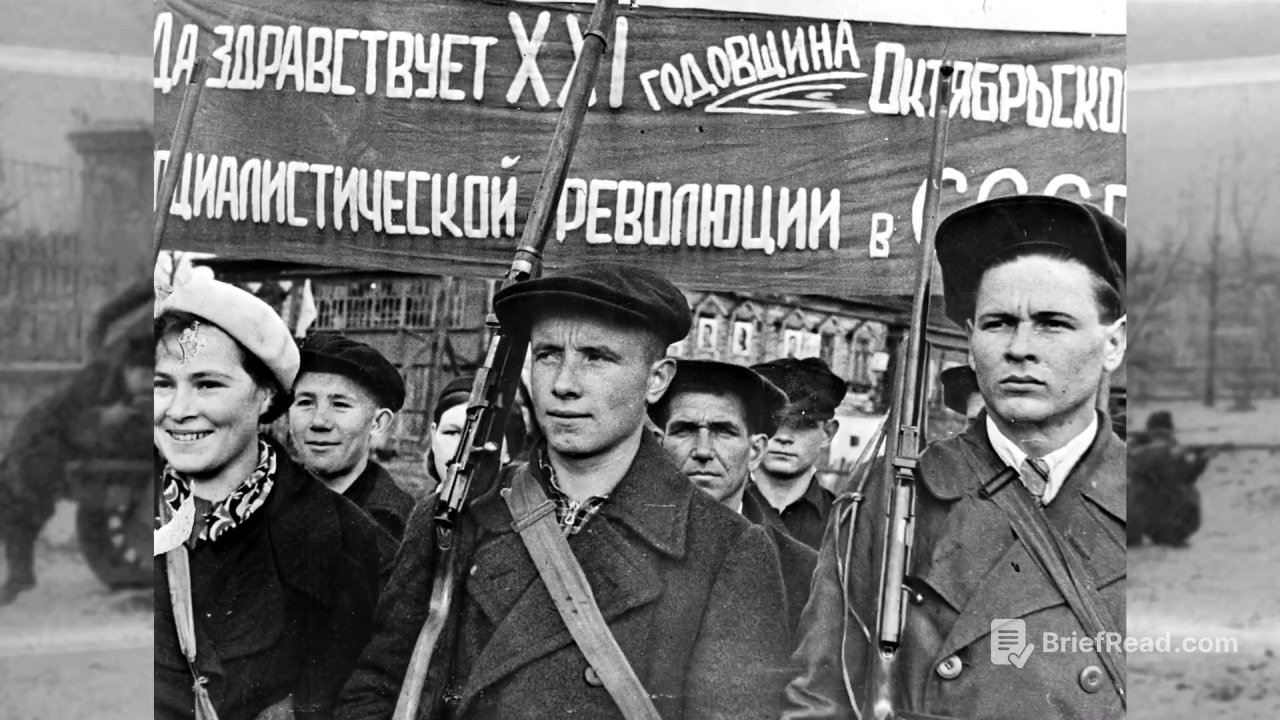
The Russian Civil War was a conflict between the Red Army (Bolsheviks), composed mainly of the working class and peasants, and the White Army (anti-Bolsheviks), who sought the return of the Tsars. Numerous smaller groups also took sides, and neighbouring countries became involved, turning the war into a widespread conflict. The war resulted in millions of lives lost and delayed Russia's path to peace. The Ural Regional Soviet executed the Romanov family in 1917 to prevent the return of the Tsars, but the killings were initially concealed.
The Red Army and its Formation [4:42]
Following the Bolshevik Revolution in 1917, the Communist government established the Red Army, replacing the imperial army and navy. Initially voluntary, military training became compulsory for peasants and workers. Leon Trotsky, the founder of the Red Army, served as People's Commissar from 1918 to 1924. Due to the army's composition of peasants and workers, finding capable officers was challenging. Trotsky recruited former imperial army officers, with over 50,000 serving in the Red Army, monitored by political advisors known as commissars. Families of imperial officers who refused to serve were held hostage to ensure loyalty.
The Anti-Bolshevik Movement (White Army) [6:03]
The anti-Bolsheviks, known as the Whites, revolted against the Bolsheviks, with the Treaty of Brest-Litovsk intensifying their anger. This treaty forced Bolshevik Russia to cede Baltic States to Germany, Kars Oblast to the Ottoman Empire, and recognise Ukraine's independence, along with paying significant compensation. Anti-Bolshevik groups, comprising republicans, middle-class citizens, landowners, liberals, pro-monarchists, conservatives, and reactionaries, arose both inside and outside Russia. Led by Generals Denikin, Yudenich, and Admiral Kolchak, the White Army controlled much of the Russian Empire during the war, particularly in remote regions like the Ural Region, Far East, Volga Region, and Siberia. They received support and arms from countries like the French Republic and the United Kingdom, who feared a Russian-German alliance, the Bolsheviks' refusal to repay Imperial Russia's loans, and the spread of Communist ideas.
Sequence of Events in the Russian Civil War [8:32]
The Russian Civil War can be divided into three periods. The first period, from the Revolution to the Truce, saw the involvement of allied forces following the Treaty of Brest-Litovsk. The Red Army seized Central Asia from the Provisional Government and White Army, establishing a Communist base in Steppe and Turkestan. The second period involved General Denikin leading the White Army from the south, General Yudenich marching from the northwest, and Admiral Kolchak advancing from the east, initially pushing back the Red Army. However, the Red Army, reformed by Trotsky, ended its alliance with anarchists and halted Kolchak's advance. By November, the Red Army, along with the Black Army, defeated Yudenich's and Denikin's armies. The third period involved a protracted cordon of the remaining White Army in Crimea, led by Pyotr Nikolayevich Wrangel, who was eventually driven out by the Red Army and Black Army in November 1920.
Conflict and the October Revolution [10:31]
The October Revolution, also known as the Red October or Bolshevik Revolution, saw the Bolsheviks directing the Red Guards (later the Red Army) to seize Petrograd. The armed forces took over villages and cities, and the Bolsheviks dissolved the Russian Constituent Assembly in 1918, replacing it with the Worker's Council or Soviet as the new government of Russia.
Beginning of the Anti-Bolshevik Revolutions [11:01]
Initial attempts to regain power from the Bolsheviks occurred in October 1917 with the Kerensky-Krasnov revolt. The Red Guards quickly crushed the Junker Mutiny in Petrograd. Early revolts against the Communists came from Cossack armies loyal to the Provisional Government, led by General Semenov of the Siberian Cossacks and General Kaledin of the Don Cossacks. Imperial army officers, including Tsar's Chief of Staff General Alekseev, also formed an army in Novocherkassk. In November 1917, the Bolsheviks declared the right to self-determination for all nations under Imperial Russia. They also formed the Turkestan Committee in Tashkent to take over the Provisional Government in Central Asia, succeeding in November 1917 with the support of the local working class.
Treaty of Brest-Litovsk [13:11]
The Bolsheviks sought peace with Germany and the Central Powers (Austria-Hungary, Germany, Bulgaria, and the Ottoman Empire). Lenin believed that Russia would be allowed to withdraw from World War I if it sponsored the German Emperor's Foreign Office. After an unsuccessful military campaign led by Aleksandr Kerensky, the then Minister of War for Russia, and widespread frustration among the Russian people, Lenin pursued the peace treaty. Despite attempts by British and French officials to convince Russia to continue in the war, a truce was signed between the Central Powers and Russia on December 16, 1917. The Germans launched Operation Faustschlag on February 18, 1918, facing no resistance from the Bolsheviks. Consequently, the Russians agreed to sign the Treaty of Brest-Litovsk, ceding lands and money to the German Empire.
Ukraine, South Russia and Caucasus - 1918 [14:47]
The Volunteer Army (anti-Bolsheviks from South Russia) retreated from Rostov towards Kuban to join forces with Cossacks against the Bolsheviks. Rostov was retaken by the Soviets the next day. General Kornilov, an important anti-Bolshevik leader, was killed, and General Denikin took his place. They fought through the Don, where the Cossacks were already battling the Bolsheviks. A short-lived Baku Commune was established on April 13, 1918. The Germans and their troops arrived in Poti on June 8 for the Caucasus Expedition. The Army of Islam, along with the Azerbaijan Democratic Republic, forced the Germans out of Baku on July 26, 1918. In June 1918, the White Army began their Kuban campaign, taking Yekaterinodar, Armavir, and Stavropol. By the beginning of 1919, the entire Northern Caucasus was under the control of the White Army. General Denikin and PN Krasnov united their armies, creating the Armed Forces of South Russia, led by Denikin.
Central Asia - 1918 [16:33]
Kokand, supporting the White Army in Central Asia, was overthrown by the Red Army in February 1918. Despite gaining strength, the Bolsheviks faced challenges from British allied forces and the White Army. British leaders Lt. Colonel Bailey, Major General Dunsterville, and General Malleson were sent to aid the White Army, but the Red Army drove them out. The Red Army expanded its influence in Central Asia, and the first regional congress of the Russian Communist Party gathered in Tashkent in June 1918 to support the Bolshevik Party's presence.
Siberia, Eastern Russia and Far East of Russia - 1918 [17:33]
The Czechoslovak Legion began in May 1918, taking control of Chelyabinsk in June. Russian officers ousted the Bolsheviks in Petropavlovsk and Omsk. Most of the Trans-Siberian Railroad between Ural and Lake Baikal was under the White Army, freeing Siberia from the Bolsheviks. By the end of July, the White Army moved west, taking over Ekaterinburg on July 26, 1918. Before this, the Bolsheviks assassinated Tsar Nicholas II and his family to prevent the Whites from restoring Imperial Rule. The Mensheviks supported peasants battling the Soviet for supplies and established the Committee of Members of the Constituent Assembly, called ‘Komuch’. The Czechoslovak Legions controlled much territory by July 1918, returning lands and factories to their owners and establishing socialist and democratic measures. Lenin sent Petrograd workers to the Kazan Front, and the War Commissar of the Bolshevik army implemented harsh measures to prevent desertions and revolts, including the death penalty for commissars showing detachment.
Eastern Anti-Bolshevik Forces and Admiral Kolchak [19:30]
The anti-Bolshevik forces in the east comprised the Siberian Army of the Provisional Government, the People’s Army of Komuch, and rebellious Cossacks. The Ufa Directorate appointed General V.G. Boldyrev to head these forces. The White Army, under Captain Kappel, took over Kazan on August 7, 1918, but the Red Army recaptured it on September 8, 1918. Samara and Simbirsk fell soon after, and the White Army moved back east to Orenburg and Ufa. Admiral Kolchak became dominant in Omsk and, in a coup on November 18, 1918, was declared the ‘Supreme Ruler of Russia’. Despite supporting the White Army, he disliked fellow supporters like the Polish 5th Rifle Division and Czechoslovak Legion. He was captured and handed over to the Bolsheviks, who killed him and his Prime Minister, Viktor Pepelyayev, on February 7, 1920.
Latvia, Estonia and Petrograd [20:46]
Estonia managed to expel the Red Army from its territories in January 1919. Riga was retaken on May 22, 1919, by the Baltic Landwehr from the Red Latvian Riflemen, but within a month, they were defeated by the Estonian 3rd Division, establishing the Republic of Latvia. General Nikolai Yudenich, with British and local support, organised an army in Northwest Estonia and attempted to take Petrograd with 20,000 men. Yudenich's army had six British tanks, which instilled fear in the enemy. On October 19, 1919, Yudenich's army reached the outskirts of Petrograd. Trotsky raised as many soldiers as possible, tripling the size of Yudenich’s army in a few weeks. Short on supplies, Yudenich's White Army retreated. Despite Finnish General Mannerheim's offer to help, the White Army received insufficient support, leading many to go into exile due to the Treaty of Tartu.
Central Asia - 1919 [22:06]
Britain withdrew most of its armies from Central Asia by February 1919. Despite the Red Army's strong hold, continuous assaults in European Russia weakened communications between Tashkent and Moscow. However, the Red Army continued to fight for Bolshevik Party support. The second regional conference in Central Asia established a regional bureau of Muslim organisations within the Russian Bolshevik Party. The Bolsheviks tried to impress locals, conveying their ability to maintain peace. By November 1919, communication problems were resolved, and the Red Army overthrew the Whites, regaining control of Central Asia.
Northern Russia - 1919 [23:11]
The British, along with the Americans, took Murmansk and Arkhangelsk. When Kolchak retreated in Siberia, the British also withdrew their troops to avoid being trapped in the ports during winter. The remaining White forces under Yevgenij Miller emptied the area by February 1920. In March 1919, the Whites began attacks on the eastern front, retaking Ufa by March 13. The Red Army, led by Tukhachevsky, launched counter-attacks in late April, capturing Elabuga on May 26, 1919, followed by Izevsk and Sarapul. Both armies experienced victories and defeats, but the Red Army grew stronger and retook areas lost to the White Army. The White Army retreated past Tobol and launched a final campaign in September 1919 to retake it. The Red Army counter-attacked on October 14, 1919, causing the Whites to retreat east. Omsk was taken by the Red Army on November 14, 1919. By December, the Whites had ceased to exist in Siberia.
South Russia - 1919 [25:10]
The Cossacks, despite their fighting prowess, lacked organisational and capitalising powers, leading to supply shortages by 1919. Their disorganisation contributed to their defeat when Antonov Ovseenko counter-attacked with the Bolshevik army in January 1919. The Red Army captured Keiv on February 3, 1919. General Denikin grew stronger in Donbass, leading to fierce battles between the Red and White Armies. Denikin’s Armed Forces of South Russia (AFSR) cleared the Red Army from the northern Caucasus and moved towards Tsaritsyn. In early May, the AFSR launched offensives on all fronts, winning most battles. The French, after briefly assisting the Whites, withdrew on April 8, 1919. Odessa and Crimea were also lost to the Red Army by June. Denikin's army took Belgorod and Kharnov, while Wrangel's White Army took Tsaritsyn on June 17, 1919. On June 20, 1919, Denikin issued the ‘Moscow Directive’, ordering the AFSR units to prepare for an offensive to take Moscow.
British Support and the White Army's Advance [26:47]
Despite withdrawing troops in 1919, Great Britain continued to support the White Army with supplies, weapons, and advisors. Major Ewen Cameron Bruce led a British tank mission, capturing the guarded city of Tsaritsyn in June 1919, for which he received the Distinguished Service Order. This mission resulted in the capture of 40,000 Red Army prisoners. As the White Army moved towards Saratov, Trotsky recognised the danger of Wrangel and Kolchak uniting. With Kolchak's forces withdrawing in the east, Red Army soldiers were freed from Siberia and proceeded to confront Denikin's forces, which posed the greatest threat to Moscow. The Red Army spread out and began fighting on all fronts.
Red Army Counterattacks and White Army Defeats [27:50]
On August 30, 1919, the Red Army retreated from Kiev, losing Orel and Kursk. Konstantin Mamontov led the Don Army, moving towards Voronezh but being defeated by Tukhachevsky's forces on October 24, 1919. Tukhachevsky's Red Army then advanced towards General Denikin's Volunteer Army. The White Army's movement against the Soviets peaked in September 1919, but Denikin's army was overstretched, lacking stability and reserves. Short on recruits, ammunition, and artillery, Denikin's army was decisively defeated in October and November 1919. Kiev was retaken by the Red Army on December 17, and the defeated Cossacks escaped towards the Black Sea.
White Army Retreat and Anarchist Resistance [29:04]
While retreating east and towards the centre, the White Army pushed back the Revolutionary Insurrectionary Army of Ukraine, the anarchist Black Army under Nestor Makhno, from Southern Ukraine and Crimea. Moscow refused to assist Makhno's Black Army with arms. The main body of the White forces, comprising Volunteers, the White Army, and the Don Army, retreated towards the Don to Rostov, while smaller bodies retreated to Crimea and Odessa. These smaller groups successfully protected Odessa and Crimea from the Bolsheviks in the winter of 1919-1920.
Ukraine, South Russia and Kronstadt - 1920-1921 [29:53]
The Armed Forces of South Russia retreated towards the Don to Rostov. General Denikin planned to hold the Don area and reorganise troops, but they were unable to hold it and retreated across Kuban towards Novorossiysk in February 1920. The evacuation of Novorossiysk was disastrous for the White Army. Allied forces evacuated around 40,000 men from Novorossiysk to Crimea without heavy equipment or horses, leaving 20,000 behind, some captured by the Red Army and others disseminated. Denikin stepped down, and Wrangel became the new Commander-in-Chief, reinstating the spirit of the troops and reforming the army.
Wrangel's Efforts and the Bolsheviks' Betrayal [30:54]
Throughout 1920, Wrangel's force remained organised in Crimea. The Bolshevik government signed a political and military agreement with the anarchists of Ukraine and their leader, Nestor Makhno. The Black Army swept Wrangel's White Forces in southern Ukraine, forcing them to retreat and preventing Wrangel from capturing the grain harvest. Hindered by the Black Army, Wrangel moved north and attacked, aiming to exploit the Red Army's defeat in the Polish-Soviet War of 1919-1920. However, the Red Army forced Wrangel's forces back into Crimea in November 1920. Both the Black and Red Armies pursued the White Forces.
Evacuation and Bolshevik Actions Against Anarchists [31:58]
The remnants of Wrangel's army were evacuated from Crimea to Constantinople on November 14, 1920, marking the last major conflict in Southern Russia between the Red and White Armies. After Wrangel's defeat, the Red Army disclaimed its treaty with Nestor Makhno and attacked the Black Army. The campaign to dissolve the anarchists of Ukraine began with an attempt to assassinate Nestor Makhno, using Cheka agents. This angered the anarchists, leading to a naval mutiny in Kronstadt, followed by a peasant revolt. The Red Army continuously attacked anarchist forces, and support for the Black Army increased in 1921.
Far East and Siberia - 1920-1922 [32:51]
Admiral Kolchak's army had crumbled in Siberia. After losing command over Omsk, Kolchak appointed General Grigory Semyoonov as the Siberian head of the White Army. Despite promises of safe passage to Irkutsk, Kolchak was captured and handed over to the Bolsheviks, who interrogated and shot him and his Prime Minister. Their bodies were thrown in the Angara River just before the White Army arrived. The remnants of Kolchak's army joined Semyonov's troops in Transbaikalia, forming the Far Eastern Army, supported by the Japanese. With Japanese help, they controlled Chita. However, as the Japanese withdrew from Transbaikalia, Semyonov was pushed back by the Red Army and forced to flee to China in November 1920.
Red Forces Take Vladivostok [33:55]
The Japanese had planned to take over Amur Krai but withdrew their armies due to the growing strength of Bolshevik armies in the Far East of Russia. Vladivostok was taken by the Red Forces on October 25, 1922, and the Provisional Priamur Government was dissolved.
Post War [34:14]
The Red Army won the war in Russia, Belarus, Tuva, Ukraine, Mongolia, and South Caucasus, leading to the establishment of the Soviet Union. Estonia, Lithuania, Finland, Poland, and Latvia gained independence. The Red Army continued to face attacks from Islamic Guerrillas known as ‘basmachi’. The Communist Party had to maintain its presence until 1934 due to continued revolts. Many Bolsheviks saw Communist rule as a permanent solution for Russia, but Lenin's policies and severity led to unpopularity.
Aftermath and Devastation [35:04]
Even after the war, unrest persisted, with 7,000,000 children roaming the streets due to the Great War and the Russian Civil War. Factories were destroyed, bridges crumbled, machines broken, mines flooded, and cattle and raw materials plundered. Epidemics and famine broke out, and industries stagnated. Approximately 125,000 Red Soldiers and 175,500 White soldiers, along with 450,000 military officers, died in the Civil War and Polish Soviet War. The Red Terror resulted in about 250,000 deaths, with 10,000 executed and 28,000 additional deaths in February 1922. Around 100,000 Jews were killed by the White Army, and 300,000 to 500,000 Cossacks died. Millions more lives were lost during the five years of unrest in Russia.
Long-Term Impact and Modern Russia [36:13]
The misery of the Russians did not end with the Civil War, as they endured further political instability and natural calamities. Today, Russia has a federal semi-presidential form of government, with the President as the Chief Executive. Boris Yeltsin was elected as the First President of Russia in 1991, and the current President is Vladimir Putin. The Russian Civil War is considered one of the deadliest wars in history, with an estimated 15 million deaths. Despite the bloodshed, Russia today stands as a rich, powerful, and beautiful country, with its capital in Moscow.
![Peppa Pig - Granny and Grandpa's Attic (42 episode / 2 season) [HD]](https://wm-img.halpindev.com/p-briefread_c-10_b-10/urlb/aHR0cDovL2ltZy55b3V0dWJlLmNvbS92aS9pWmltUlJDU3h6SS9ocWRlZmF1bHQuanBn.jpg)