TLDR;
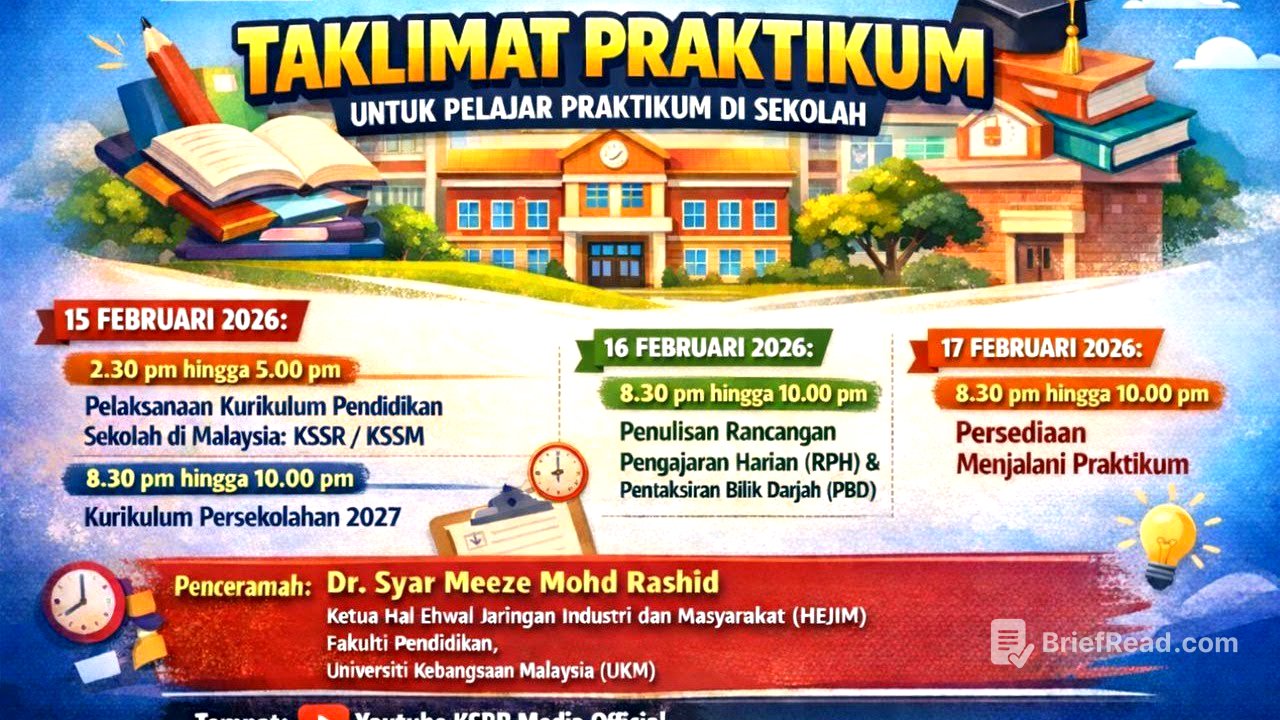
This video provides an overview of the upcoming 2027 school curriculum in Malaysia, focusing on its goals, framework, and key components. It emphasises the importance of producing "sejahtera" individuals, who are balanced in all aspects and contribute positively to society. The presenter highlights the need for teachers to be "premium" educators who not only impart knowledge and skills but also instil good character and morals in their students.
- The 2027 curriculum aims to produce well-rounded individuals who contribute positively to society.
- Teachers need to be "premium" educators, focusing on character and morals alongside knowledge and skills.
- The curriculum emphasises adab (manners/ethics) and the integration of technology in education.
Introduction: Curriculum 2027 Taklimat [4:17]
The speaker welcomes education students to a briefing on the 2027 school curriculum. They encourage students to view the session as a guide and express hope that the information shared will be beneficial. The speaker also mentions that a recording of the briefing will be available for a limited time. They recap the earlier discussion on the role of a teacher in Malaysia, which includes spreading the Rukun Negara ideology and shaping citizens based on the Falsafah Pendidikan Kebangsaan (FPK).
Recap of Falsafah Pendidikan Kebangsaan (FPK) [6:15]
The speaker revisits the FPK, highlighting its five key principles for creating ideal Malaysian citizens: balanced individuals (physically, emotionally, spiritually, and intellectually), grounded in faith and devotion to God, practising good values, contributing to the nation, and fostering unity and prosperity. They stress the importance of understanding rather than merely memorising the FPK's content. The speaker also touches on the concepts of pedagogy, andragogy, and heutagogy, noting that university students should be in the andragogy phase, taking more responsibility for their learning.
Introducing Kurikulum Persekolahan 2027 [23:02]
The speaker introduces the Kurikulum Persekolahan 2027, sharing their concerns about presenting it in front of representatives from the Ministry of Education (KPM). They clarify that the session is a sharing session to benefit everyone. The speaker mentions the recent announcement of the national education plan, divided into Rancangan Pendidikan Malaysia (RPM) for schools and Rancangan Pendidikan Tinggi Malaysia (RPTM) for higher education, both planned for ten years. The main goal of education in Malaysia is to develop "insan sejahtera" (prosperous individuals).
Theme 1: Pengenalan Kurikulum Persekolahan 2027 [32:07]
The speaker emphasises that the FPK aims to produce balanced individuals grounded in faith. They express disappointment that the FPK isn't promoted more widely and urge education students to share its uniqueness. The speaker explains that the Kurikulum Persekolahan 2027 aims to realise the aspirations of the FPK by focusing on integrated development, including knowledge, skills, and adab (manners/ethics). The speaker highlights that adab is a priority in the new curriculum, unlike in KSSR and KSSM where values were taught through application.
Kurikulum Persekolahan 2027 vs KSSR/KSSM [39:22]
The speaker clarifies that the Kurikulum Persekolahan 2027 isn't a drastic change like the transition from KBSR to KSSR. They mention the viral issue of Year 1 and Form 1 students learning history, which was blown out of proportion by the media. The speaker explains that the new curriculum replaces the KSSR Semakan 2017, with Kurikulum Prasekolah 2026 starting this year and Kurikulum Persekolahan 2027 starting next year. The change is driven by the dynamic landscape of work and life.
The Need for "Premium" Teachers [42:40]
The speaker stresses that teachers need to be "premium" educators because students can easily access information online. The role of teachers is now to guide students in using knowledge for good. The speaker expresses concern that students might think they don't need teachers, as AI can provide information. They emphasise that teachers need to focus on character development and adab. The speaker also addresses the issue of parents being overly protective of their children and the need for teachers to be aware of this dynamic.
Objectives of Kurikulum Persekolahan 2027 [58:30]
The speaker outlines the objectives of the Kurikulum Persekolahan 2027, which include strengthening literacy and numeracy, building student competencies through authentic learning experiences, reinforcing adab and values, developing various literacies (including digital literacy), and providing a flexible teaching framework for teachers. They reiterate the importance of understanding Pentaksiran Bilik Darjah (PBD) and avoiding reliance on worksheets alone. The speaker urges teachers to be creative and "premium" to engage students effectively.
Theme 2: Kerangka Kurikulum Persekolahan 2027 [1:02:52]
The speaker explains the framework of the Kurikulum Persekolahan 2027, which combines elements from KSSR and KSSM. The framework revolves around content, pedagogy, and assessment, with seven competencies to be applied in and out of the classroom: personal development, communication, responsibility, digital fluency, multiple literacies, thinking skills, and lifelong learning. The speaker stresses that teachers should focus on knowledge, skills, and adab to create "insan sejahtera".
Applying the Framework: An Example [1:07:32]
The speaker provides an example of how to apply the framework using a Bahasa Melayu lesson on writing formal letters. They explain that the curriculum uses abstract verbs, giving teachers flexibility in assessment. The speaker suggests incorporating competencies like personal development (through group activities) and digital fluency (by teaching email etiquette). They emphasise the importance of teaching adab in all activities, such as proper communication in groups and email etiquette.
Key Aspects of Insan Sejahtera [1:20:44]
The speaker highlights the key aspects of "insan sejahtera": balanced lives, lifelong learning, appreciation of unity, respect for diversity, responsible citizenship, and global competitiveness. They reiterate the need for teachers to be creative and resourceful, especially with readily available online resources. The speaker shares their frustration with trainee teachers who rely solely on textbooks and lectures during practicals.
Components of the Framework [1:25:46]
The speaker outlines the components of the framework: the core of "insan," emphasising adab, knowledge, and skills; the drivers of implementation, including content, pedagogy, and assessment; and the seven key competencies to guide students holistically. They then discusses each competency in detail, linking them back to the Falsafah Pendidikan Kebangsaan.
Competencies Explained [1:26:31]
The speaker explains each of the seven competencies: personal development (building self-awareness and discipline), communication (promoting effective and respectful communication), responsibility (fostering accountability towards society and the environment), digital fluency (teaching ethical use of technology), multiple literacies (encouraging critical analysis of information), thinking skills (developing creative and critical thinking), and lifelong learning (instilling a passion for continuous learning). They use examples to illustrate how these competencies can be integrated into teaching.
The Importance of Adab and Empathy [1:31:57]
The speaker stresses the importance of empathy and ethical behaviour in the digital age. They encourage students to use AI tools like ChatGPT to refine their communication and avoid causing offence. The speaker also shares anecdotes about students lacking empathy and critical thinking skills, highlighting the need for teachers to address these issues.
Theme 3: Tahap Persekolahan (School Stages) [1:44:38]
The speaker outlines the timeline for implementing the curriculum, with dissemination in 2025, preschool implementation in 2026, and Year 1 and Form 1 implementation in 2027. They present a tentative structure for school stages, including preschool, primary (three stages), and secondary (lower and upper). The speaker emphasises that character development should be integrated into all stages.
Theme 4: Persekitaran Persekolahan (School Environment) [1:46:27]
The speaker discusses the school environment under the new curriculum, noting that the information is still tentative. They mention potential changes to the timetable for standardisation, the need to strengthen 21st-century learning, the emphasis on digital integration, the importance of character-building programmes, and the use of PBD for assessment. The speaker highlights that the new curriculum replaces Elemen Merentas Kurikulum (EMK) with competencies.
Theme 5: Mata Pelajaran (Subjects) [1:50:57]
The speaker presents the planned subjects for primary school, divided into three stages. They clarify that history is taught in Years 5 and 6, dispelling rumours about it being taught in Year 1. The speaker mentions the addition of technology and digital literacy as compulsory subjects. They also discuss additional subjects for special education and new subjects like Arabic communication and Malaysian Sign Language.
Additional Subjects and Programmes [1:53:40]
The speaker explains that Arabic communication is for Muslim students only, while Malaysian Sign Language is for schools with hearing-impaired students to promote inclusivity. They reiterate that the programme for character building will take 15 minutes before class. The speaker also outlines the subjects for secondary school, noting the addition of technology and digital literacy. They highlight the importance of guidance counsellors in implementing the new programmes.
Theme 6: Pentaksiran Bilik Darjah (Classroom Assessment) [2:00:35]
The speaker discusses PBD, emphasising the importance of understanding Pentaksiran Berasaskan Sekolah (PBS). They reiterate the three forms of assessment: observation, oral, and written. The speaker expresses hope that the new curriculum will provide a more structured and simplified approach to recording data. They highlight that PBD should incorporate the seven key competencies.
Rumusan (Conclusion) [2:02:51]
The speaker concludes by reiterating that the Kurikulum Persekolahan 2027 emphasises meaningful learning, adab, knowledge, and skills, supported by systematic evidence of learning. They urge teachers to be "premium" educators who serve as role models for their students. The speaker encourages self-reflection and continuous improvement to become effective teachers.