TLDR;
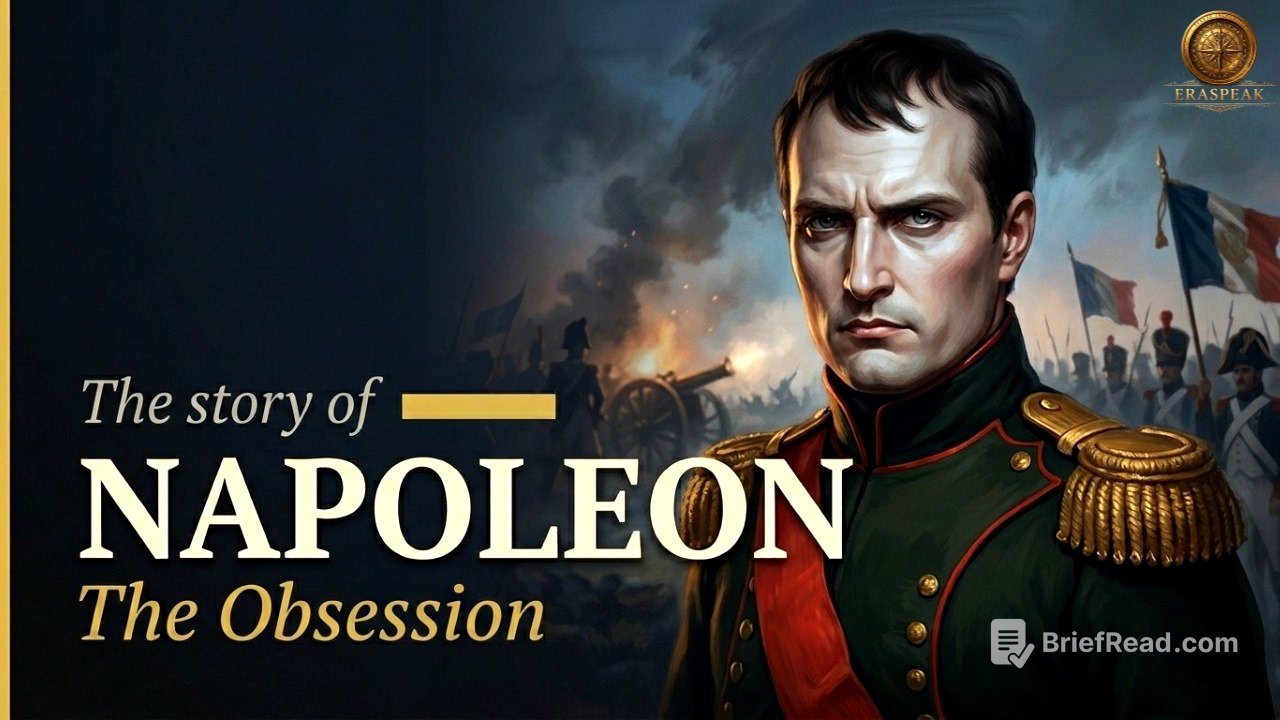
This video explores the life and legacy of Napoleon Bonaparte, from his rise to power as a military genius to his eventual downfall. Key points include:
- Napoleon's early struggles and ambition on Corsica.
- His rapid ascent during the French Revolution and military successes.
- The impact of his campaigns in Europe, Egypt, and the consequences of his desire for expansion.
- The critical turning points in his reign, culminating in his losses and exile.
The Man at the Top [0:00]
In 1812, Napoleon Bonaparte commanded the largest army in European history, with 600,000 soldiers. Despite immense power and wealth, he yearned for more, a hunger that would eventually lead to his downfall. To understand him, we must start from his origins, growing up as an outsider on Corsica, a small island in the Mediterranean, where he faced isolation and ridicule. His tenacity and dedication to self-improvement set him on a path of ambition.
The Boy from Corsica [0:44]
Napoleon was born in Corsica in 1769. His family's shift from Italian to French rule complicated his identity. At nine, he was sent to mainland France for military school, where he faced prejudice due to his accent and attire. Rather than resorting to violence, he outperformed his peers in academics, showing early signs of his relentless ambition to prove his worth and rise above his circumstances.
The French Revolution — A Door Opens [2:35]
The French Revolution in 1789 transformed a broken France, providing a pivotal opportunity for Napoleon. At just 20 years old, he began to make a name for himself during the siege of Toulon in 1793, leveraging his tactical skills to recapture the port. This success marked the beginning of his ascent, culminating in his appointment as commander of the French army in Italy.
The Italian Campaign — The Climb Begins [4:05]
Appointed to lead a struggling army in Italy, Napoleon inspired his troops with promises of riches and victory. In just a year, he executed a series of rapid conquests against larger Austrian forces, showcasing his remarkable military strategy. By 1798, he expanded his ambitions to Egypt, aiming to establish himself as a historical figure akin to Alexander the Great.
Egypt and the Road to Power [5:54]
Napoleon's Egyptian campaign aimed to expand France's influence, but setbacks mounted as the British navy destroyed his ships and disease ravaged his troops. Rather than face the consequences, Napoleon returned to France, manipulating public perception of his campaign to maintain his status as a hero and consolidating power by seizing control of the French government in a coup.
Emperor of the French [6:14]
In 1804, Napoleon crowned himself Emperor of the French in Notre Dame Cathedral, solidifying his rise from a Corsican outsider to the ruler of an empire. He controlled France, Italy, and significant parts of Europe, expanding his power swiftly and methodically, challenging traditional monarchy in Europe.
Austerlitz — The Greatest Victory [6:51]
Napoleon's triumph at the Battle of Austerlitz in December 1805 is hailed as his greatest military masterpiece. By outsmarting and manipulating enemy forces through tactical deception, he led his army to a stunning victory over the Austrians and Russians, asserting his dominance in Europe.
The Cracks Begin — Britain and Spain [8:46]
Despite his victories, challenges emerged, particularly with Britain, as Napoleon attempted to cripple its economy with a trade embargo. This strategy backfired, leading to resentment among European nations reliant on British trade. Additionally, his intervention in Spain sparked resistance and guerrilla warfare, a costly distraction that drained French resources over several years.
Joséphine — The Price of Empire [11:07]
Napoleon's personal life mirrored his ambitions as he divorced his first love, Joséphine, to marry Austrian royalty for political reasons and secure an heir. This decision highlighted the personal sacrifices he made in pursuit of greater power, resulting in an unrepairable fracture in his emotional life.
Russia — The Point of No Return [12:09]
In 1812, Napoleon confronted Tsar Alexander I of Russia, amassing the Grande Armee of 600,000 soldiers to assert dominance. However, the Russians retreated and scorched the earth, leading to a disastrous invasion. The subsequent retreat during a harsh winter decimated his forces, marking a turning point in his fortunes.
The Fall — Leipzig and Abdication [14:29]
Post-Russian campaign, Europe united against Napoleon, leading to catastrophic defeats such as the Battle of Leipzig in 1813. Overwhelmed, Napoleon was forced to abdicate in 1814, marking the end of his reign as he gave up power with little more than a pen in a moment of profound isolation.
Escape from Elba — The Hundred Days [17:59]
In 1815, Napoleon escaped from exile on Elba and returned to France, where he regained power without bloodshed. He quickly prepared for battle against the united Allied forces, knowing time was limited to assert his ambitions once again.
Waterloo [19:25]
The decisive Battle of Waterloo on June 18, 1815, saw Napoleon face significant challenges. Delays and late reinforcements for Wellington’s army led to a crushing defeat for Napoleon. As his Imperial Guard faltered, chaos ensued within his ranks, leading to a swift collapse of his power.
Saint Helena — The End [21:48]
Following his defeat, Napoleon was exiled to Saint Helena, a remote island where he spent his final years in isolation. His once-great ambition dwindled to dictating memoirs—a stark contrast to his past glory as he reflected on his life, ultimately passing away in 1821.
Legacy and Lesson [23:10]
Napoleon's legacy is complex and multifaceted, as he profoundly impacted laws, national identities, and governance across Europe with lasting effects. While he instigated significant reforms and modernisation, his ego and relentless pursuit of power precipitated immense suffering. The world wrestles with how to view his legacy—balancing the freedom he ignited against the chaos he wrought.
Outro [27:29]
The video concludes by reflecting on Napoleon's insatiable drive for more and the philosophical musings it provokes about ambition and its consequences, highlighting how his hunger for power culminated in loneliness and solitude.