TLDR;
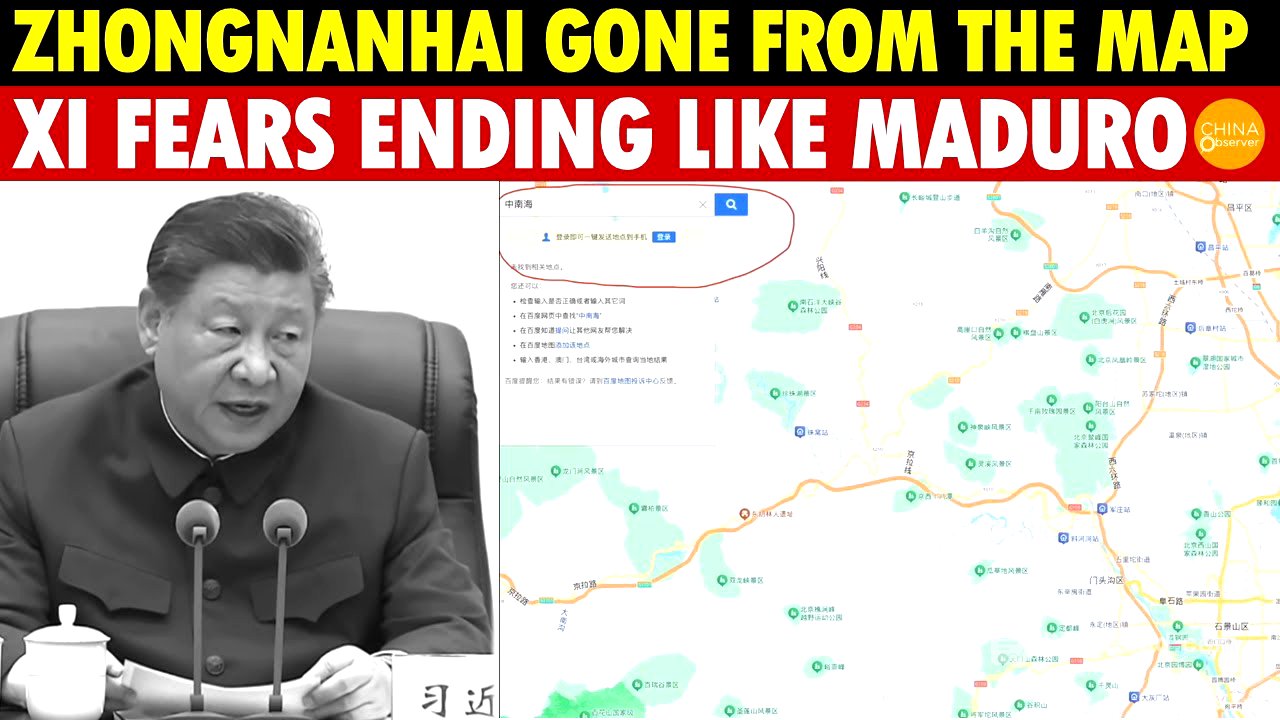
This video discusses the heightened sense of fear and insecurity within the Chinese Communist Party (CCP) leadership, particularly Xi Jinping, following events such as the capture of Venezuelan President Maduro and growing internal and external pressures. It examines incidents like the disappearance of Zhongnanhai from Chinese map apps, tightened security measures in Beijing, and the spread of anti-government sentiment among the Chinese populace. The video suggests that these events have exposed the CCP's vulnerabilities and triggered a state of paranoia within the regime.
- Xi Jinping's fear intensified after Maduro's capture, leading to increased security measures and paranoia about internal threats.
- The CCP faces unprecedented internal and external crises, including anti-government protests and economic decline.
- There's growing dissent within China, with individuals openly challenging the CCP's authority.
Intro [0:00]
Chinese netizens noticed that searching for Zhongnanhai, the location of the Chinese government, on Chinese map apps often yields no results or redirects to a distant suburb. This was mocked as a foolish move by the Xi Jinping authorities. The incident is linked to the capture of Nicolas Maduro in Venezuela, which reportedly terrified the CCP leadership.
Jonan Hai's Disappearance and Public Reaction [1:55]
The disappearance of Jonan Hai from maps became a surreal joke and reflects Xi Jinping's fear and anxiety. Following Maduro's capture, airspace controls over Beijing were tightened, and drone restrictions were enforced, indicating a high level of security usually seen before war or systemic risks. This atmosphere of extreme national fear reveals the pressure felt by the Xi regime.
Decapitation Strikes and US Military Signalling [2:55]
The Maduro incident highlighted the US's willingness to carry out decapitation strikes against hostile regimes, intensifying Xi Jinping's fears. A tweet from veteran US national security journalist Bill Girtz, suggesting a Soleimani-style drone strike on Beijing if China attacks Taiwan, further heightened these concerns. Girtz is seen as a mouthpiece for the Pentagon, conveying messages that US officials prefer not to state directly.
US Strategy and Potential Successors [4:06]
Former US Department of Defense official Tony Hu explained that the US government sometimes uses journalists like Girtz to release sensitive information. Hu emphasised that the US treats decapitation strikes with extreme caution but has a high success rate. In China's case, potential successors like Central Military Commission Vice Chairman Jang Yo or General Yang could be communicated with if Xi were removed, as the PLA cannot defeat the US military.
International Perspectives and Trump's Warnings [5:51]
Japanese House of Councillors member Sakihei referred to Putin, Xi Jinping, and Kim Jong-un as "the three dictator brothers," noting that the US military's operation in Venezuela shattered their illusion of invincibility. Trump had previously warned Xi that he would bomb Beijing if China made a move on Taiwan, intensifying Xi's fears of both external threats and internal coups.
Internal Threats and the Tunnel Explosion [7:24]
An article highlighted the risk of CIA infiltration and coordination with domestic agents, suggesting that traitors around leaders like Maduro could compromise security. Rumours of a military ambush leading to a tunnel explosion near Beijing circulated, with some interpreting it as an assassination attempt on Xi Jinping. The lack of official media coverage of the incident fuelled these speculations.
Xi Jinping's Security Measures and Internal Purges [10:42]
Since taking office in 2012, Xi Jinping has ruled with authoritarian control, fearing democratic forces and using anti-corruption campaigns to purge disloyal officials. These purges have created numerous enemies who could pose internal threats. Following Maduro's capture, Xi reportedly strengthened his personal security team and activated underground bunker systems around Beijing.
Extreme Security Measures and Lack of Confidence [12:25]
Julie Ren revealed extreme security measures taken during Xi's visits, such as clearing entire areas and deploying thousands of security personnel. During the BRICS Summit in South Africa, Xi's team shipped furniture from China to replace the hotel's furnishings as an anti-assassination precaution. These measures expose a deep fear and lack of confidence in the regime.
External Pressures and Anti-Government Sentiment [13:24]
The CCP faces unprecedented internal and external crises. During a military parade in Beijing, extreme security measures were implemented, restricting residents' movements and suppressing dissent. Anti-government protests in Iran have resonated with mainland Chinese netizens, who express frustration over social control and economic decline.
Open Challenges to the CCP [15:36]
A man released a video openly challenging the CCP, calling on people to resist tyranny. This act struck a chord with many mainlanders, who expressed support and a sense of national awakening. The growing dissent reflects a point where ordinary people are no longer afraid of death, questioning how much longer the CCP's tyranny can last.