TLDR;
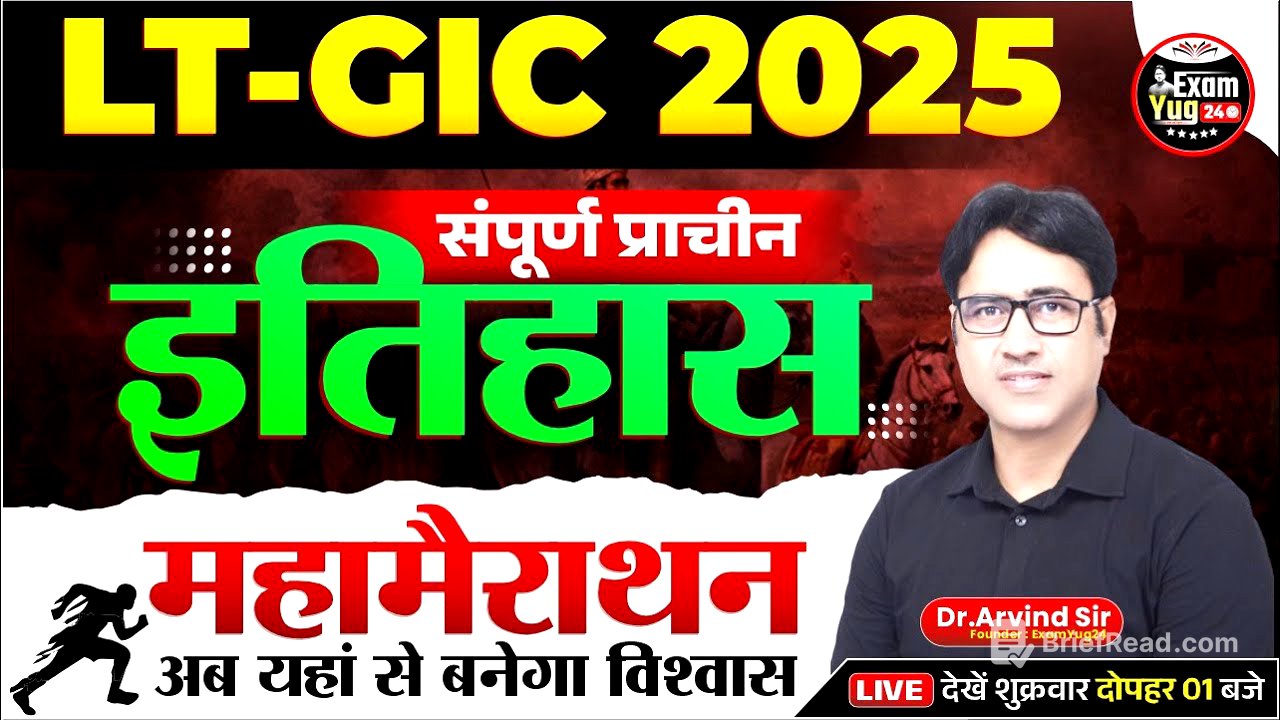
This YouTube video by Examयुग 24, hosted by Dr. Arvind Kumar Singh, provides a comprehensive overview of ancient Indian history, focusing on key dynasties and periods. The session aims to build confidence by covering chapter-wise questions from the Chola period to the Gupta period, including the Mauryan era, Jainism, Buddhism, the Vedic period, and the Indus Valley Civilisation. The video includes detailed explanations, mnemonic devices for remembering key facts, and practice questions to reinforce learning.
- Covers key dynasties and periods in ancient Indian history.
- Includes chapter-wise questions and detailed explanations.
- Provides mnemonic devices for remembering key facts.
- Offers practice questions to reinforce learning.
Introduction [0:11]
Dr. Arvind Kumar Singh welcomes viewers to the session, which aims to build confidence in ancient history. The session will cover the Chola, Gupta, and other periods, following the syllabus and including a variety of questions. The host encourages viewers to share the session to make it a historical success.
Chola Dynasty: Key Rulers and Events [0:53]
The session begins with questions about the Chola dynasty. Rajaraja I was not the first Chola ruler to perform the Ashvamedha Yagna; it was Rajadhiraja I, as mentioned in the Manimangalam inscription. Rajaraja I built the Brihadeeswarar Temple. Chau Ju-kua, a 13th-century Chinese traveller, mentioned the Chola's justice system and their practice of chewing betel leaves. Rajaraja I did not defeat Vijayabahu; it was Kulottunga I who had marital relations with him. Rajaraja I built the Brihadeeswarar Temple in Thanjavur, which features Chola-era paintings, and he built a Vishnu temple in Nagapattinam, not a Shiva temple. Rajaraja I captured northern Sri Lanka, destroying Anuradhapura and making Polonnaruwa his capital, renaming it Jananathamangalam. Rajaraja I issued gold, silver, and copper coins with Nagari script, and he introduced coins with standing and seated figures.
Chola Dynasty: Marital Alliances and Local Governance [9:47]
Rajendra I married his daughter Amanga Devi to Rajaraja Narendra of Vengi, resulting in the birth of Kulottunga I. Orders given by the king to local institutions in the Chola period were called Sri Mukha. The Eravesvara Temple in Darasuram was built by Rajaraja II, while Kulottunga II built the Kampeshwar Temple. The residential capital of the Cholas was Palayarai, while Kanchi served as the sub-capital.
Chola Dynasty: Battles, Administration, and Trade [14:17]
Parantaka I was defeated by Krishna III of the Rashtrakuta dynasty in the Battle of Takkolam in 949 AD. The administrative units of the Chola kingdom in descending order were Mandalam, Valanadu/Kottam, Nadu, Kurram, and Grama. Manigramam referred to a guild of internal traders, while Nanadesi referred to those trading with Southeast Asia. Madurai Konda was a title taken by Parantaka I after conquering Madurai. Rajaraja I and Rajendra I commemorated their victories by building temples.
Chola Dynasty: Temple Architecture and Royal Titles [21:44]
Gangaikonda Cholapuram is renowned for its temple architecture, built by Rajendra I after his victory in the Ganges region. Chola temples, such as the Brihadeeswarar Temple, were known for their towering spires and Gopurams. Udan Kuttam referred to a group of officials in the Chola kingdom. The Battle of Koppam was fought between the Western Chalukyas and the Cholas, where Rajadhiraja was killed. Nagaram was a term used for mercantile settlements in South India.
Chola Dynasty: Land Revenue, Social Structure, and Royal Lineage [27:49]
Maderai Konda was a title taken by Parantaka I after conquering Madurai. Land revenue collected in the Chola period was measured in Kalam. The Chola kingdom was known for its autonomous governance. Rajaraja Chola's original name was Arimolivarman, and he assumed titles like Mummidi Chola and Jagajay Konda. Nadalam was not an existing administrative unit in the Chola kingdom. Kulottunga I made grants to the Chudamani Vihara.
Chola Dynasty: Irrigation, Royal Patronage, and Key Battles [31:50]
The tank committee of Uttaramerur was known as Eri Variyam. Adhirajendra was assassinated during a public revolt, marking the end of the main Chola lineage. The most important feature of the Chola Empire was its local autonomy. The Battle of Takkolam in 949 AD involved the Chola and Rashtrakuta dynasties, with Rajaditya participating on the Chola side. Rajaraja I reorganised the Valanadu administrative unit. Jayamkondar was a prominent poet in the court of Kulottunga I.
Chola Dynasty: Sri Lankan Conquests and Land Divisions [42:01]
Rajaraja I's conquest of Sri Lanka involved defeating Mahendra V, destroying Anuradhapura, and establishing Polonnaruwa as the capital, renaming it Jananathamangalam. Key land divisions and taxes included Vetti (forced labour), Irai (tax), and Padikaval (watchman tax). The Brihadeeswarar Temple in Thanjavur, built by Rajaraja I, is a Dravidian-style Shiva temple made of granite with a 13-story Vimana. Membership in Chola-era committees required owning land, being between 35-70 years old, and having knowledge of the Vedas.
Chola Dynasty: Sati, Religious Tolerance, and Royal Achievements [46:15]
The wives of Parantaka II and Rajendra I committed Sati. Vaishnava saint Ramanuja had to leave Srirangam due to Kulottunga I. Rajendra I conquered the entire island of Sinhala. The correct chronological order of Chola rulers is Sundara Chola, Uttama Chola, Rajaraja I, and Rajendra I. Rajendra I expanded the empire through campaigns in Sumatra and Java. Aditya I defeated the Pallava ruler Aparajita and assumed the title "Tondaimanadu."
Chola Dynasty: Temple Construction and Administrative Terms [52:20]
Rajaraja I and Rajendra I built temples to commemorate their victories. Chaturvedimangalam referred to a settlement for Brahmins. The Uttaramerur inscription provides details about the tank committee. Adirajendra was killed in a public revolt. The Chola dynasty was known for its autonomous governance. The Takolam war involved the Chola and Rashtrakuta dynasties. Rajaraja I reorganised the Valanadu administrative unit.
Chola Dynasty: Royal Conquests and Land Revenue [57:51]
Jayankondar was a court poet of Kulottunga I. Rajaraja I's conquest of Sri Lanka involved defeating Mahendra V and destroying Anuradhapura. Key land divisions and taxes included Vetti (forced labour), Irai (tax), and Padikaval (watchman tax). The Brihadeeswarar Temple in Thanjavur, built by Rajaraja I, is a Dravidian-style Shiva temple made of granite with a 13-story Vimana. Membership in Chola-era committees required owning land, being between 35-70 years old, and having knowledge of the Vedas.
Gupta Dynasty: Origins and Key Inscriptions [1:04:58]
The session transitions to the Gupta period. Allen called Chandragupta I's coins "commemorative coins" and linked the Guptas' origin to the Vaishyas. The Supia inscription of Skandagupta traces the Gupta dynasty from Ghatotkacha, not Sri Gupta. The Prayag Prasasti was engraved by Tilabhatta and does not contain any dates or mention of the Ashvamedha Yagna. The 21st line of the Prayag Prasasti mentions the second campaign of Aryavarta and the Atavika states, with the Atavika states located between Ghazipur and Jabalpur.
Gupta Dynasty: Society, Culture, and Royal Marriages [1:10:34]
Mrichchhakatika describes the love story of a poor Brahmin, Charudatta, and a courtesan, Vasantasena, and mentions that one can engage in any trade to survive. Udranga in the Gupta period referred to land revenue, which was typically 1/6th of the produce. Sati was known during the Gupta period, and chewing betel leaves was a common practice. Prabhavati Gupta, daughter of Chandragupta II, married the Vakataka ruler Rudrasena II to gain support against the Shakas. Bhasa wrote two plays before Abhijnanashakuntalam.
Gupta Dynasty: Key Figures and Administrative Terms [1:14:35]
Vatsabhatti was the author of the Mandasor inscription. Sarthavaha was the head of the merchant guild. The Gupta-era brick temple in Bhitargaon features true arches. The Brihat Samhita was written by Varahamihira, not Aryabhata. Rajaraja I's naval achievements included conquering the Maldives. The term Chaturvedimangalam referred to land grants to Brahmins.
Gupta Dynasty: Religious Practices and Royal Lineage [1:18:21]
The Gupta rulers followed Vaishnavism and used the Garuda symbol on their coins. The correct chronological order of Gupta rulers is Sri Gupta, Ghatotkacha, Chandragupta I. Rajendra I expanded the empire through campaigns in Sumatra and Java. The Valanadu administrative unit was reorganised during the reign of Rajaraja I.
Gupta Dynasty: Administration, Society, and Religious Beliefs [1:22:30]
A guild (Shreni) was an organisation of people of one or more castes engaged in the same occupation. The Yajnavalkya Smriti granted widows the right to inherit property after their sons. Narada Smriti stated that if there were no sons, the state would take over the property and care for the widow. The state regulated weights and measures, as mentioned by Narada. The Purva Shaila sect belonged to the Purva Mimamsa school of thought.
Gupta Dynasty: Land Measurement and Royal Patronage [1:27:04]
Kulya Vapa, Nala, and Nivartana were terms used for land measurement in ancient India. The term "Dinara" referred to a gold coin. Aryabhata composed the Dasgeetika. The Gupta era is associated with the Kali Yuga calendar. Faxian visited India during the reign of Chandragupta II. V.A. Smith referred to Samudragupta as the "Napoleon of India." Decentralisation was a key feature of Gupta administration.
Gupta Dynasty: Royal Titles and Key Inscriptions [1:31:38]
Vishnugopa was the ruler of Kanchi during the time of Samudragupta. The Junagadh inscription mentions Pushyagupta, Sudarshan, and Chakrapalita. Rajaraja I's naval achievements included conquering the Maldives. The term Chaturvedimangalam referred to a settlement for Brahmins. The Chola king Kulottunga I granted tax exemptions to the Chudamani Vihara.
Gupta Dynasty: Religious Practices and Royal Lineage [1:36:15]
The Gupta rulers followed Vaishnavism and used the Garuda symbol on their coins. The correct chronological order of Gupta rulers is Sri Gupta, Ghatotkacha, Chandragupta I. Rajendra I expanded the empire through campaigns in Sumatra and Java. The Valanadu administrative unit was reorganised during the reign of Rajaraja I.
Mauryan Dynasty: Administration and Key Figures [1:40:00]
Pindakara was a tax levied on entire villages in the Mauryan period. Karshapana was a commonly used coin. Megasthenes noted the absence of slavery in India, attributing it to the kind treatment of slaves by their masters. Ashoka's Puranic name was Ashokavardhana, but he rarely used his personal name in inscriptions. The Taxila inscription mentions the name Ashoka.
Mauryan Dynasty: Key Battles and Administrative Terms [1:43:56]
Aditya I defeated the Pallava ruler Aparajita and assumed the title "Tondaimanadu." The Valanadu administrative unit was reorganised during the reign of Rajaraja I. Jayamkondar was a court poet of Kulottunga I. Rajaraja I's conquest of Sri Lanka involved defeating Mahendra V and destroying Anuradhapura. Key land divisions and taxes included Vetti (forced labour), Irai (tax), and Padikaval (watchman tax). The Brihadeeswarar Temple in Thanjavur, built by Rajaraja I, is a Dravidian-style Shiva temple made of granite with a 13-story Vimana.
Mauryan Dynasty: Society, Culture, and Royal Patronage [1:47:51]
The Chola king Kulottunga I granted tax exemptions to the Chudamani Vihara. The tank committee of Uttaramerur was known as Eri Variyam. Adirajendra was killed in a public revolt. The most important feature of the Chola Empire was its local autonomy. The Battle of Takkolam in 949 AD involved the Chola and Rashtrakuta dynasties, with Rajaditya participating on the Chola side. Rajaraja I reorganised the Valanadu administrative unit.
Mauryan Dynasty: Royal Lineage and Key Inscriptions [1:52:32]
The correct chronological order of Chola rulers is Sundara Chola, Uttama Chola, Rajaraja I, and Rajendra I. Rajendra I expanded the empire through campaigns in Sumatra and Java. Aditya I defeated the Pallava ruler Aparajita and assumed the title "Tondaimanadu." The Valanadu administrative unit was reorganised during the reign of Rajaraja I. Jayamkondar was a court poet of Kulottunga I.
Mauryan Dynasty: Royal Conquests and Land Revenue [1:56:40]
Rajaraja I's conquest of Sri Lanka involved defeating Mahendra V and destroying Anuradhapura. Key land divisions and taxes included Vetti (forced labour), Irai (tax), and Padikaval (watchman tax). The Brihadeeswarar Temple in Thanjavur, built by Rajaraja I, is a Dravidian-style Shiva temple made of granite with a 13-story Vimana. Membership in Chola-era committees required owning land, being between 35-70 years old, and having knowledge of the Vedas.
Mauryan Dynasty: Religious Tolerance and Royal Achievements [2:00:36]
The wives of Parantaka II and Rajendra I committed Sati. Vaishnava saint Ramanuja had to leave Srirangam due to Kulottunga I. Rajendra I conquered the entire island of Sinhala. The correct chronological order of Chola rulers is Sundara Chola, Uttama Chola, Rajaraja I, and Rajendra I. Rajendra I expanded the empire through campaigns in Sumatra and Java. Aditya I defeated the Pallava ruler Aparajita and assumed the title "Tondaimanadu."
Mauryan Dynasty: Administration and Key Inscriptions [2:04:31]
The tank committee of Uttaramerur was known as Eri Variyam. Adirajendra was killed in a public revolt. The most important feature of the Chola Empire was its local autonomy. The Battle of Takkolam in 949 AD involved the Chola and Rashtrakuta dynasties, with Rajaditya participating on the Chola side. Rajaraja I reorganised the Valanadu administrative unit.
Mauryan Dynasty: Royal Conquests and Land Revenue [2:08:35]
Jayankondar was a court poet of Kulottunga I. Rajaraja I's conquest of Sri Lanka involved defeating Mahendra V and destroying Anuradhapura. Key land divisions and taxes included Vetti (forced labour), Irai (tax), and Padikaval (watchman tax). The Brihadeeswarar Temple in Thanjavur, built by Rajaraja I, is a Dravidian-style Shiva temple made of granite with a 13-story Vimana. Membership in Chola-era committees required owning land, being between 35-70 years old, and having knowledge of the Vedas.
Mauryan Dynasty: Religious Tolerance and Royal Achievements [2:12:34]
The wives of Parantaka II and Rajendra I committed Sati. Vaishnava saint Ramanuja had to leave Srirangam due to Kulottunga I. Rajendra I conquered the entire island of Sinhala. The correct chronological order of Chola rulers is Sundara Chola, Uttama Chola, Rajaraja I, and Rajendra I. Rajendra I expanded the empire through campaigns in Sumatra and Java. Aditya I defeated the Pallava ruler Aparajita and assumed the title "Tondaimanadu."
Mauryan Dynasty: Administration and Key Inscriptions [2:16:16]
The tank committee of Uttaramerur was known as Eri Variyam. Adirajendra was killed in a public revolt. The most important feature of the Chola Empire was its local autonomy. The Battle of Takkolam in 949 AD involved the Chola and Rashtrakuta dynasties, with Rajaditya participating on the Chola side. Rajaraja I reorganised the Valanadu administrative unit.
Mauryan Dynasty: Royal Conquests and Land Revenue [2:20:01]
Jayankondar was a court poet of Kulottunga I. Rajaraja I's conquest of Sri Lanka involved defeating Mahendra V and destroying Anuradhapura. Key land divisions and taxes included Vetti (forced labour), Irai (tax), and Padikaval (watchman tax). The Brihadeeswarar Temple in Thanjavur, built by Rajaraja I, is a Dravidian-style Shiva temple made of granite with a 13-story Vimana. Membership in Chola-era committees required owning land, being between 35-70 years old, and having knowledge of the Vedas.
Mauryan Dynasty: Religious Tolerance and Royal Achievements [2:24:31]
The wives of Parantaka II and Rajendra I committed Sati. Vaishnava saint Ramanuja had to leave Srirangam due to Kulottunga I. Rajendra I conquered the entire island of Sinhala. The correct chronological order of Chola rulers is Sundara Chola, Uttama Chola, Rajaraja I, and Rajendra I. Rajendra I expanded the empire through campaigns in Sumatra and Java. Aditya I defeated the Pallava ruler Aparajita and assumed the title "Tondaimanadu."
Mauryan Dynasty: Administration and Key Inscriptions [2:28:19]
The tank committee of Uttaramerur was known as Eri Variyam. Adirajendra was killed in a public revolt. The most important feature of the Chola Empire was its local autonomy. The Battle of Takkolam in 949 AD involved the Chola and Rashtrakuta dynasties, with Rajaditya participating on the Chola side. Rajaraja I reorganised the Valanadu administrative unit.
Mauryan Dynasty: Royal Conquests and Land Revenue [2:32:26]
Jayankondar was a court poet of Kulottunga I. Rajaraja I's conquest of Sri Lanka involved defeating Mahendra V and destroying Anuradhapura. Key land divisions and taxes included Vetti (forced labour), Irai (tax), and Padikaval (watchman tax). The Brihadeeswarar Temple in Thanjavur, built by Rajaraja I, is a Dravidian-style Shiva temple made of granite with a 13-story Vimana. Membership in Chola-era committees required owning land, being between 35-70 years old, and having knowledge of the Vedas.
Mauryan Dynasty: Religious Tolerance and Royal Achievements [2:36:17]
The wives of Parantaka II and Rajendra I committed Sati. Vaishnava saint Ramanuja had to leave Srirangam due to Kulottunga I. Rajendra I conquered the entire island of Sinhala. The correct chronological order of Chola rulers is Sundara Chola, Uttama Chola, Rajaraja I, and Rajendra I. Rajendra I expanded the empire through campaigns in Sumatra and Java. Aditya I defeated the Pallava ruler Aparajita and assumed the title "Tondaimanadu."
Jainism and Buddhism: Key Concepts and Figures [2:40:09]
The Sarvastivada school of Buddhism was prominent in Mathura and Kashmir. The main theme of the Ashtasahasrika Prajnaparamita literature is the spiritual principles developed by Bodhisattvas. The Sravasti is the place where the most number of discourses were given by Buddha. The Jataka tales mention Hinasipa as butchers, hunters, and trappers. Rajagriha, Vaishali, and Kundalvan are the places where Buddhist councils were held.
Jainism and Buddhism: Key Concepts and Figures [2:44:10]
The Buddhist concept of "Kalyana Mitra" refers to the Noble Eightfold Path. The phrase "Sabbe Sankhara Anicca" is attributed to the Buddha. The Jain concept of Anekantavada is a theory of pluralistic realism. The Svetambara and Digambara sects differ primarily in their adherence to monastic discipline. The Uvasagadasao describes the stories of ten famous Jain merchants. Jainism adopted Prakrit as its language.
Jainism and Buddhism: Key Concepts and Figures [2:48:31]
Mahavira was called "Jina" because he conquered ignorance and attained enlightenment. The correct chronological order is Parshvanatha, Mahavira, Buddha, and Bhadrabahu. Samprati's second capital was Ujjain. Ahimsa is not one of the Triratnas of Jainism. Mahavira rejected the Vedic concept of creation and did not believe in a supreme being. The Purva Shaila sect belonged to the Purva Mimamsa school of thought.
Vedic Period: Key Concepts and Figures [2:52:57]
Kulyavapa, Nivartana, and Nala were used to measure land in ancient India. The term "Dinara" referred to a gold coin. Aryabhata composed the Dasgeetika. The Gupta era is associated with the Kali Yuga calendar. Faxian visited India during the reign of Chandragupta II. V.A. Smith referred to Samudragupta as the "Napoleon of India." Decentralisation was a key feature of Gupta administration.
Vedic Period: Society and Religious Practices [2:56:40]
Vishnugopa was the ruler of Kanchi during the time of Samudragupta. The Junagadh inscription mentions Pushyagupta, Sudarshan, and Chakrapalita. Rajaraja I's naval achievements included conquering the Maldives. The term Chaturvedimangalam referred to a settlement for Brahmins. The Chola king Kulottunga I granted tax exemptions to the Chudamani Vihara.
Vedic Period: Royal Lineage and Key Inscriptions [3:00:45]
The correct chronological order of Chola rulers is Sundara Chola, Uttama Chola, Rajaraja I, and Rajendra I. Rajendra I expanded the empire through campaigns in Sumatra and Java. Aditya I defeated the Pallava ruler Aparajita and assumed the title "Tondaimanadu." The Valanadu administrative unit was reorganised during the reign of Rajaraja I. Jayamkondar was a court poet of Kulottunga I.
Vedic Period: Royal Conquests and Land Revenue [3:04:51]
Rajaraja I's conquest of Sri Lanka involved defeating Mahendra V and destroying Anuradhapura. Key land divisions and taxes included Vetti (forced labour), Irai (tax), and Padikaval (watchman tax). The Brihadeeswarar Temple in Thanjavur, built by Rajaraja I, is a Dravidian-style Shiva temple made of granite with a 13-story Vimana. Membership in Chola-era committees required owning land, being between 35-70 years old, and having knowledge of the Vedas.
Vedic Period: Religious Tolerance and Royal Achievements [3:08:54]
The wives of Parantaka II and Rajendra I committed Sati. Vaishnava saint Ramanuja had to leave Srirangam due to Kulottunga I. Rajendra I conquered the entire island of Sinhala. The correct chronological order of Chola rulers is Sundara Chola, Uttama Chola, Rajaraja I, and Rajendra I. Rajendra I expanded the empire through campaigns in Sumatra and Java. Aditya I defeated the Pallava ruler Aparajita and assumed the title "Tondaimanadu."
Vedic Period: Administration and Key Inscriptions [3:12:55]
The tank committee of Uttaramerur was known as Eri Variyam. Adirajendra was killed in a public revolt. The most important feature of the Chola Empire was its local autonomy. The Battle of Takkolam in 949 AD involved the Chola and Rashtrakuta dynasties, with Rajaditya participating on the Chola side. Rajaraja I reorganised the Valanadu administrative unit.
Vedic Period: Royal Conquests and Land Revenue [3:16:54]
Jayankondar was a court poet of Kulottunga I. Rajaraja I's conquest of Sri Lanka involved defeating Mahendra V and destroying Anuradhapura. Key land divisions and taxes included Vetti (forced labour), Irai (tax), and Padikaval (watchman tax). The Brihadeeswarar Temple in Thanjavur, built by Rajaraja I, is a Dravidian-style Shiva temple made of granite with a 13-story Vimana. Membership in Chola-era committees required owning land, being between 35-70 years old, and having knowledge of the Vedas.
Vedic Period: Religious Tolerance and Royal Achievements [3:20:54]
The wives of Parantaka II and Rajendra I committed Sati. Vaishnava saint Ramanuja had to leave Srirangam due to Kulottunga I. Rajendra I conquered the entire island of Sinhala. The correct chronological order of Chola rulers is Sundara Chola, Uttama Chola, Rajaraja I, and Rajendra I. Rajendra I expanded the empire through campaigns in Sumatra and Java. Aditya I defeated the Pallava ruler Aparajita and assumed the title "Tondaimanadu."
Vedic Period: Administration and Key Inscriptions [3:24:48]
The tank committee of Uttaramerur was known as Eri Variyam. Adirajendra was killed in a public revolt. The most important feature of the Chola Empire was its local autonomy. The Battle of Takkolam in 949 AD involved the Chola and Rashtrakuta dynasties, with Rajaditya participating on the Chola side. Rajaraja I reorganised the Valanadu administrative unit.
Vedic Period: Royal Conquests and Land Revenue [3:28:48]
Jayankondar was a court poet of Kulottunga I. Rajaraja I's conquest of Sri Lanka involved defeating Mahendra V and destroying Anuradhapura. Key land divisions and taxes included Vetti (forced labour), Irai (tax), and Padikaval (watchman tax). The Brihadeeswarar Temple in Thanjavur, built by Rajaraja I, is a Dravidian-style Shiva temple made of granite with a 13-story Vimana. Membership in Chola-era committees required owning land, being between 35-70 years old, and having knowledge of the Vedas.
Vedic Period: Religious Tolerance and Royal Achievements [3:32:51]
The wives of Parantaka II and Rajendra I committed Sati. Vaishnava saint Ramanuja had to leave Srirangam due to Kulottunga I. Rajendra I conquered the entire island of Sinhala. The correct chronological order of Chola rulers is Sundara Chola, Uttama Chola, Rajaraja I, and Rajendra I. Rajendra I expanded the empire through campaigns in Sumatra and Java. Aditya I defeated the Pallava ruler Aparajita and assumed the title "Tondaimanadu."
Vedic Period: Administration and Key Inscriptions [3:36:54]
The tank committee of Uttaramerur was known as Eri Variyam. Adirajendra was killed in a public revolt. The most important feature of the Chola Empire was its local autonomy. The Battle of Takkolam in 949 AD involved the Chola and Rashtrakuta dynasties, with Rajaditya participating on the Chola side. Rajaraja I reorganised the Valanadu administrative unit.
Vedic Period: Royal Conquests and Land Revenue [3:40:54]
Jayankondar was a court poet of Kulottunga I. Rajaraja I's conquest of Sri Lanka involved defeating Mahendra V and destroying Anuradhapura. Key land divisions and taxes included Vetti (forced labour), Irai (tax), and Padikaval (watchman tax). The Brihadeeswarar Temple in Thanjavur, built by Rajaraja I, is a Dravidian-style Shiva temple made of granite with a 13-story Vimana. Membership in Chola-era committees required owning land, being between 35-70 years old, and having knowledge of the Vedas.
Vedic Period: Religious Tolerance and Royal Achievements [3:44:57]
The wives of Parantaka II and Rajendra I committed Sati. Vaishnava saint Ramanuja had to leave Srirangam due to Kulottunga I. Rajendra I conquered the entire island of Sinhala. The correct chronological order of Chola rulers is Sundara Chola, Uttama Chola, Rajaraja I, and Rajendra I. Rajendra I expanded the empire through campaigns in Sumatra and Java. Aditya I defeated the Pallava ruler Aparajita and assumed the title "Tondaimanadu."
Vedic Period: Administration and Key Inscriptions [3:49:00]
The tank committee of Uttaramerur was known as Eri Variyam. Adirajendra was killed in a public revolt. The most important feature of the Chola Empire was its local autonomy. The Battle of Takkolam in 949 AD involved the Chola and Rashtrakuta dynasties, with Rajaditya participating on the Chola side. Rajaraja I reorganised the Valanadu administrative unit.
Vedic Period: Royal Conquests and Land Revenue [3:53:03]
Jayankondar was a court poet of Kulottunga I. Rajaraja I's conquest of Sri Lanka involved defeating Mahendra V and destroying Anuradhapura. Key land divisions and taxes included Vetti (forced labour), Irai (tax), and Padikaval (watchman tax). The Brihadeeswarar Temple in Thanjavur, built by Rajaraja I, is a Dravidian-style Shiva temple made of granite with a 13-story Vimana.