TLDR;
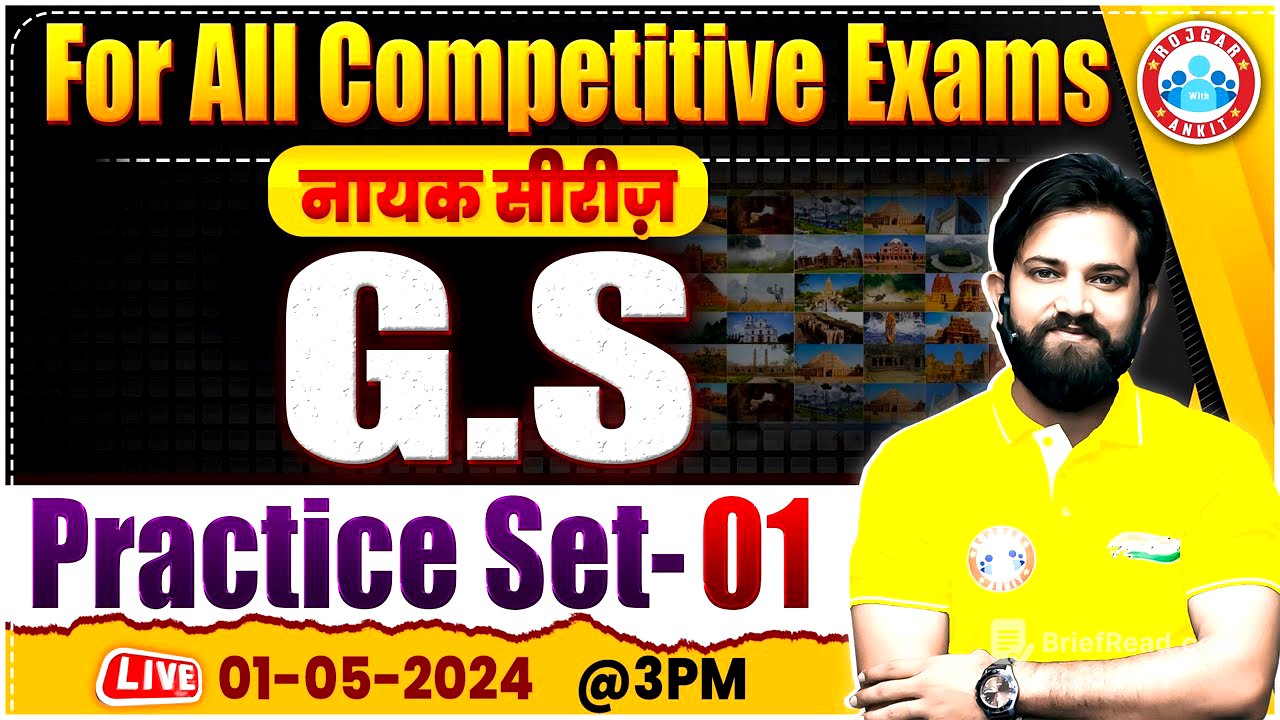
This YouTube video is the inaugural session of the "Nayak Series" by Rojgar with Ankit, aimed at helping students excel in various 2024 competitive exams. The series consists of 40 practice sets, each with 40 questions, designed to comprehensively cover GS topics from basic to advanced levels. The instructor emphasises the importance of focus, daily revision using the "scan technique", and interlinking each class with the previous one for better understanding. The session also includes a discussion on effective note-making, subject-wise question distribution, and strategies to tackle the GS section with confidence.
- The "Nayak Series" aims to make students "Nayak" (hero) in upcoming exams.
- Focus on daily revision using the "scan technique".
- Series covers GS topics from basic to advanced levels.
Introduction to the Nayak Series [0:08]
The session begins with a motivational message, emphasising the importance of hard work and dedication to achieve success. The "Nayak Series" is introduced as a practice session for all one-day exams, scheduled from Monday to Saturday, with a target of completing 40 sets. The instructor promises that this series will help students become "Nayak" in their respective exams, highlighting the essential qualities of a focused and determined student. He stresses the need for students to commit to the entire 40-day journey, dedicating approximately 60 hours to the series.
Importance of Revision and Note-Making [2:18]
The instructor stresses the importance of daily revision and maintaining enthusiasm throughout the course. He suggests making hand-written notes for better physical memory and introduces the "scan technique" for effective revision, which involves reading the material and then trying to recall it with eyes closed. He also promises that each class will be interconnected, building upon the previous one, and encourages students to revise before attending the next class. The series aims to cover 8,000 updated questions, spanning from basic to advanced levels, with an estimated completion date around 15th June.
Subject-Wise Question Distribution and Exam Strategy [4:46]
The session outlines the subject-wise distribution of questions in each set, including static GK, Polity, History, Geography, Economics, Science, and Current Affairs. The instructor advises students to keep a screenshot of the distribution chart for reference. He also addresses the common question of how to make notes, recommending hand-written notes and daily revision. He mentions that PDFs of the class will be available on the Rojgar With Ankit application.
Discussion on World Labour Day and Motivation [3:03]
The instructor acknowledges that it is 1st May, which is World Labour Day, and draws a comparison between the hard work of labourers and the effort required from students to secure their future. He encourages students to promise themselves that they will work hard and succeed, assuring them that with dedication, any challenging content can be mastered.
First Question: Intangible Cultural Heritage [10:53]
The first question is about the Mudiyettu, a traditional theatre form from Kerala, recognised by UNESCO as an Intangible Cultural Heritage (ICH). The instructor explains the difference between tangible and intangible heritage, providing examples like the Taj Mahal (tangible) and traditional practices (intangible). He mentions that India has 15 recognised ICH elements and 42 World Heritage Sites, categorised into cultural, natural, and mixed sites. He also lists other ICH recognitions from India, such as Koodiyattam, Vedic chanting, Ramlila, Chhau dance, Kalbelia, Yoga, Kumbh Mela, and Durga Puja, and the recent inclusion of Garba from Gujarat.
Second Question: Folk Dance of Meghalaya [16:00]
The second question focuses on the folk dance of Meghalaya, with the correct answer being "Laho". The instructor provides a mnemonic to remember the various dances of Meghalaya: Nongkrem, Behdienkhlam, Shad Suk Mynsiem, Bangala, and Khasi Dance. He also briefly mentions the classical dances of Kerala, Kathakali and Mohiniyattam.
Third Question: Kirana Gharana [19:01]
The third question is about Gangubai Hangal's association with the Kirana Gharana. The instructor explains what a Gharana is (a place where music originated and was taught) and mentions that the Kirana Gharana is from Muzaffarnagar, Uttar Pradesh. He identifies the founder as Bhai Karim Khan and lists prominent artists such as Baldev Singh Bali, Bhimsen Joshi, Abdul Wahid Khan, and Upendra Bhatt, providing memory aids to remember these names.
Fourth Question: Harishankar Bhattacharya and Musical Instruments [22:43]
The fourth question asks about the instrument Harishankar Bhattacharya is known for, with the answer being the Sitar. The instructor uses a story about Sita to help remember related names like Pandit Ravi Shankar, Nikhil Banerjee, and Arvind Parikh. He also lists other musicians and their associated instruments: K. Subramaniam and K. Vedantham (Violin), Shivkumar Sharma and Bhajan Sopori (Santoor), and Bundu Khan and Sultan Khan (Sarangi).
Fifth Question: Chithirai Festival [26:33]
The fifth question is about the Chithirai festival, which is celebrated in Tamil Nadu. The instructor mentions other festivals of Tamil Nadu, such as Jallikattu, Pongal, and Puthandu (Tamil New Year), and asks the students to name the New Year festival of Kerala.
Sixth Question: India's Hockey World Cup Victory [28:08]
The sixth question asks when India first won the Hockey World Cup, with the answer being 1975. The instructor provides additional details, such as India has only won the World Cup once, defeating Pakistan in the final held in Malaysia. He also discusses the first Hockey World Cup in 1971, held in Barcelona, and the recent 2023 World Cup held in Bhubaneswar, India, where Germany won against Belgium. The next World Cup will be held in Belgium and the Netherlands in 2026.
Seventh Question: Vocal Music Form of Punjab [32:07]
The seventh question is about a vocal music form from Punjab, with the answer being Tappa. The instructor also mentions other music forms from Punjab, such as Jugni, Lorian, and Ghorian, providing memory aids to remember them.
Eighth Question: Oldest Tennis Tournament [33:48]
The eighth question asks about the oldest tennis tournament in the world, with the answer being Wimbledon. The instructor explains the order of the four Grand Slam tournaments (Australian Open, French Open, Wimbledon, US Open) and their court surfaces (grass for Wimbledon, clay for French Open, and hard court for Australian and US Open). He also mentions the winners of the Australian Open 2024: Jannik Sinner (men's singles), Aryna Sabalenka (women's singles), and Rohan Bopanna with Matthew Ebden (men's doubles).
Ninth Question: Booker Prize Winner Kiran Desai [38:57]
The ninth question asks which book was written by Booker Prize winner Kiran Desai, with the answer being "The Inheritance of Loss". The instructor mentions that Kiran Desai and her mother, Anita Desai, are both famous authors. He lists other books by Kiran Desai, such as "Hullabaloo in the Guava Orchard" and "Emblems of Transformation", and books by Anita Desai, such as "Fasting, Feasting" and "In Custody".
Tenth Question: First Session of the Constituent Assembly [40:43]
The tenth question is about when the first session of the Constituent Assembly took place, with the answer being 9th December 1946. The instructor provides additional details, such as the Constituent Assembly was established on 6th December 1946, based on the French custom. He mentions that J.B. Kripalani gave the first address, Sachchidananda Sinha was the temporary chairman, and Rajendra Prasad became the permanent chairman on 11th December. The objective resolution was passed on 13th December, presented by Pandit Nehru. The first session lasted from 9th to 23rd December 1946.
Eleventh Question: Advisor to the Constituent Assembly [44:02]
The eleventh question asks who was the advisor to the Constituent Assembly, with the answer being B.N. Rau. The instructor mentions that B.N. Rau also prepared the first draft of the constitution in October 1947, which included 243 articles.
Twelfth Question: Formation of the Constituent Assembly [45:09]
The twelfth question asks about the basis for the formation of the Constituent Assembly, with the answer being the Cabinet Mission Plan of 1946. The instructor mentions that the Cabinet Mission arrived in Delhi on 24th March 1946, and presented its proposal on 16th May 1946. The chairman of the Cabinet Mission was initially Patrick Lawrence, but later Mountbatten took over.
Thirteenth Question: Chairman of the Provincial Constitution Committee [47:27]
The thirteenth question asks who was the chairman of the Provincial Constitution Committee, with the answer being Sardar Patel. The instructor mentions that Sardar Patel was also the chairman of the advisory committee on fundamental rights. J.B. Kripalani was the chairman of the sub-committee for fundamental rights, and H.C. Mukherjee was the chairman of the sub-committee for minorities. Nehru was in charge of the Union Power Committee and the Union Constitution Committee. Rajendra Prasad was in charge of the Rules and Steering Committee.
Fourteenth Question: Adoption of the Indian Constitution [49:51]
The fourteenth question asks when the Indian Constitution was adopted by the Constituent Assembly, with the answer being 26th November 1949. The instructor mentions that 26th November is celebrated as Law Day, and Republic Day is celebrated on 26th January because the constitution was implemented on that day. The constitution took 2 years, 11 months, and 18 days to complete, with a total of 165 meetings.
Fifteenth Question: Women Members in the Constituent Assembly [51:25]
The fifteenth question asks about the total number of women members in the Constituent Assembly, with the answer being 15. The instructor mentions that 11 women signed the constitution. He lists some of the prominent women members, such as Vijayalakshmi Pandit (who resigned), Rajkumari Amrit Kaur (India's first health minister), Sucheta Kriplani (first female CM of UP), Sarojini Naidu (first governor, but died before the constitution was implemented), Leela Roy (who resigned), Hansa Mehta, Kamala Chaudhary, G. Durgabai, Renuka Roy, Malti Chaudhary (who resigned), Dakshayani Velayudhan (the only Dalit woman), Begum Aijaz Rasul (the only Muslim woman), Annie Mascarene, and Ammu Swaminathan (the first to sign the constitution).
Sixteenth Question: Oldest Fossil of Prehistoric Man in India [56:08]
The sixteenth question asks where the oldest fossil of prehistoric man was found in India, with the answer being Hathnora, Madhya Pradesh. The instructor mentions that the human skull was found in 1982 by the Archaeological Survey of India (ASI) and was named Narmada Man.
Seventeenth Question: Discovery of Bhimbetka Caves [57:18]
The seventeenth question asks which archaeologist first discovered the Bhimbetka caves, with the answer being V.S. Wakankar. The instructor mentions that the caves were discovered in 1957 and were included in the UNESCO World Heritage list in 2003. The caves are based on the Mahabharata.
Eighteenth Question: Earliest Evidence of Systematic Agriculture in India [58:55]
The eighteenth question asks where the earliest evidence of systematic agriculture was found in India, with the answer being Mehrgarh, Pakistan. The instructor mentions that the evidence of wheat and barley was found near the Bolan River. He also mentions that the current oldest site is Lahuradeva in Uttar Pradesh, where evidence of rice cultivation dating back to 9000 BC has been found. Mehrgarh also provides the first evidence of settled life and domesticated buffalo.
Nineteenth Question: First Grain Used by Humans [1:01:34]
The nineteenth question asks which grain was first used by humans, with the answer being barley.
Twentieth Question: Location of Navdatoli [1:01:57]
The twentieth question asks in which state Navdatoli is located. The correct answer is Madhya Pradesh. The instructor corrects an earlier mistake where he incorrectly stated it was in Gujarat. He also mentions other sites like Lothal (Gujarat), which is the oldest dockyard, and asks students to name the locations of Rupar, Dholavira, Rangpur, Banawali, and Atranjikhera.
Twenty-First Question: States on the Coastline of India [1:03:52]
The twenty-first question asks how many states in India are located on the coastline, with the answer being nine. The instructor lists the states: Gujarat, Maharashtra, Goa, Karnataka, Kerala, Tamil Nadu, Andhra Pradesh, Odisha, and West Bengal. He mentions that there are five states on the western coast and four on the eastern coast. The longest coastline belongs to Gujarat, followed by Andhra Pradesh and Tamil Nadu, while the shortest belongs to Goa. The longest coastline for a Union Territory is Andaman and Nicobar, and the shortest is Lakshadweep.
Twenty-Second Question: Location of Kanyakumari [1:07:05]
The twenty-second question asks about the location of Kanyakumari, with the answer being north of the equator. The instructor explains that India starts at 8 degrees 4 minutes north latitude and extends to 37 degrees 6 minutes north latitude, placing it in the northern hemisphere.
Twenty-Third Question: 10-Degree Channel [1:08:20]
The twenty-third question asks which pair of islands is separated by the 10-degree channel, with the answer being Andaman and Nicobar Islands. The instructor also mentions that the 8-degree channel separates Maldives and Minicoy, the 9-degree channel separates Lakshadweep and Minicoy, and the 11-degree channel separates Amindivi and Cannanore.
Twenty-Fourth Question: Southernmost Point of India [1:11:23]
The twenty-fourth question asks about the southernmost point of India, with the answer being Indira Point. The instructor mentions that Indira Point is also known as Pygmalion Point and Parsons Point. Kanyakumari is known as Cape Comorin. He also discusses the northernmost point (Indira Col), easternmost point (Kibithu in Arunachal Pradesh), and westernmost point (Guhar Moti in Gujarat), along with their latitudes and longitudes.
Twenty-Fifth Question: First Sunrise in India [1:14:59]
The twenty-fifth question asks in which state the sun rises first in India, with the answer being Arunachal Pradesh. The instructor mentions that the sun rises around 4 AM in Dong village, Arunachal Pradesh. The first sunset occurs in Gujarat.
Twenty-Sixth Question: Type of Indian Economy [1:16:16]
The twenty-sixth question asks what type of economy India has, with the answer being a developing economy. The instructor explains that a developing economy is a mixed economy, with both public and private sectors coexisting. He lists the characteristics of a developing economy, such as agriculture being the main occupation, a large population, unbalanced economic growth, low per capita income, and hidden unemployment.
Twenty-Seventh Question: Characteristics of the Indian Economy [1:18:15]
The twenty-seventh question asks which characteristic is not a feature of the Indian economy, with the answer being a lack of natural resources. The instructor mentions that India has a low energy efficiency, low per capita income, and low capital formation rate, but it does not lack natural resources.
Twenty-Eighth Question: Poverty Assessment in India [1:20:21]
The twenty-eighth question asks who assesses poverty in India, with the answer being the NITI Aayog Task Force. The instructor mentions that previously, the National Sample Survey Office (NSSO) and the Central Statistics Office (CSO) were responsible, but they were merged in 2019 to form the Ministry of Statistics and Programme Implementation (MOSPI), which now assesses poverty.
Twenty-Ninth Question: Five-Year Plans [1:22:11]
The twenty-ninth question asks which Five-Year Plan did not start on its scheduled time. The instructor lists the periods of all the Five-Year Plans and mentions that the Planning Commission was replaced by NITI Aayog in 2015.
Thirtieth Question: Incorrect Match [1:24:27]
The thirtieth question asks which of the following pairs is not correctly matched, with the answer being the Richter scale for humidity. The instructor mentions that the Richter scale measures earthquakes, and humidity is measured by a hygrometer. He also mentions that atmospheric pressure is measured by a barometer, and wind speed is measured by an anemometer.
Thirty-First Question: Incorrect Match of Units [1:25:47]
The thirty-first question asks which of the following pairs is not correctly matched, with the answer being the activity of radioactive material measured in Curies. The instructor mentions that the activity of radioactive material is measured in Becquerels.
Thirty-Second Question: Change of Water into Vapour [1:26:39]
The thirty-second question asks what the change of water into vapour is called, with the answer being a physical change. The instructor explains the difference between physical and chemical changes, mentioning that physical changes are reversible, while chemical changes are not.
Thirty-Third Question: pH Value of Alkaline Solution [1:29:09]
The thirty-third question asks what the pH value of an alkaline solution is, with the answer being always greater than 7. The instructor explains the pH scale, mentioning that acidic solutions have a pH less than 7, neutral solutions have a pH of 7, and alkaline solutions have a pH greater than 7.
Thirty-Fourth Question: Water-Soluble Vitamin [1:31:19]
The thirty-fourth question asks which vitamin is water-soluble, with the answer being Vitamin C. The instructor mentions that vitamins B and C are water-soluble, while vitamins A, D, E, and K are fat-soluble.
Thirty-Fifth Question: Vitamin Produced by the Human Body [1:32:03]
The thirty-fifth question asks which vitamin is produced by the human body, with the answer being Vitamin D. The instructor mentions that Vitamin K is produced by bacteria in the intestine, and Vitamin D is produced with the help of sunlight.
Thirty-Sixth Question: Renamed Stadium [1:33:07]
The thirty-sixth question asks which stadium has been renamed as Niranjan Shah Stadium, with the answer being Saurashtra Cricket Stadium. The instructor mentions that the M. Chinnaswamy Stadium is in Bangalore, and asks students to name the location of the M.A. Chidambaram Stadium.
Thirty-Seventh Question: First Woman to Win GD Birla Award [1:33:57]
The thirty-seventh question asks who is the first woman scientist to win the G.D. Birla Award, with the answer being Aditi SenDe. The instructor mentions that the award is given to scientists under 50 years of age and was established in 1991. Aditi SenDe received the award for computing innovation.
Thirty-Eighth Question: Best Film at Dadasaheb Phalke Awards [1:34:52]
The thirty-eighth question asks which film won the Best Film award at the Dadasaheb Phalke International Film Festival Awards 2024, with the answer being Jawan. The instructor mentions that Shah Rukh Khan won the Best Actor award for Jawan, Nayanthara won the Best Actress award for Jawan, Sandeep Reddy Vanga won the Best Director award for Animal, and Bobby Deol won the Best Villain award for Animal.
Thirty-Ninth Question: ICC Award for Best Cricketer [1:36:17]
The thirty-ninth question asks which male cricketer won the ICC Award for the best player of the year 2023, with the answer being Pat Cummins. The instructor mentions that Pat Cummins is the captain of Australia and was the second most expensive player in the IPL. Mitchell Starc was the most expensive player. He also mentions that Virat Kohli won the ODI Player of the Year, Usman Khawaja won the Test Player of the Year, and Suryakumar Yadav won the T20 Player of the Year.
Fortieth Question: PM Vishwakarma Yojana [1:38:23]
The fortieth question asks which ministry launched the PM Vishwakarma Yojana, with the answer being the Ministry of Micro, Small, and Medium Enterprises. The instructor mentions that the scheme provides financial assistance of ₹15,000 to workers. He assigns homework to the students to find out who the current Minister of Micro, Small, and Medium Enterprises is.
Conclusion and Homework [1:39:36]
The instructor concludes the session, apologising for the initial 15 minutes spent on discussion. He promises to create a strategy video for the upcoming exams. He encourages students to commit to the 40 sets and promises to deliver quality content. He asks students to comment after the video, promising to complete the 40 sets and be ready for the 2024 exams. He ends with a motivational message and a song.