TLDR;
This video provides a comprehensive guide to understanding and applying word stress in English pronunciation. It explains the importance of word stress, defines syllables, and outlines the three types of stress: primary, secondary, and weak. The video also presents nine rules for determining word stress in various contexts, including nouns, adjectives, verbs, and words with specific suffixes. Additionally, it highlights how stress can change the meaning and class of a word, and encourages learners to build word families to better understand stress patterns.
- Importance of word stress for clear communication.
- Three types of stress: primary, secondary, and weak.
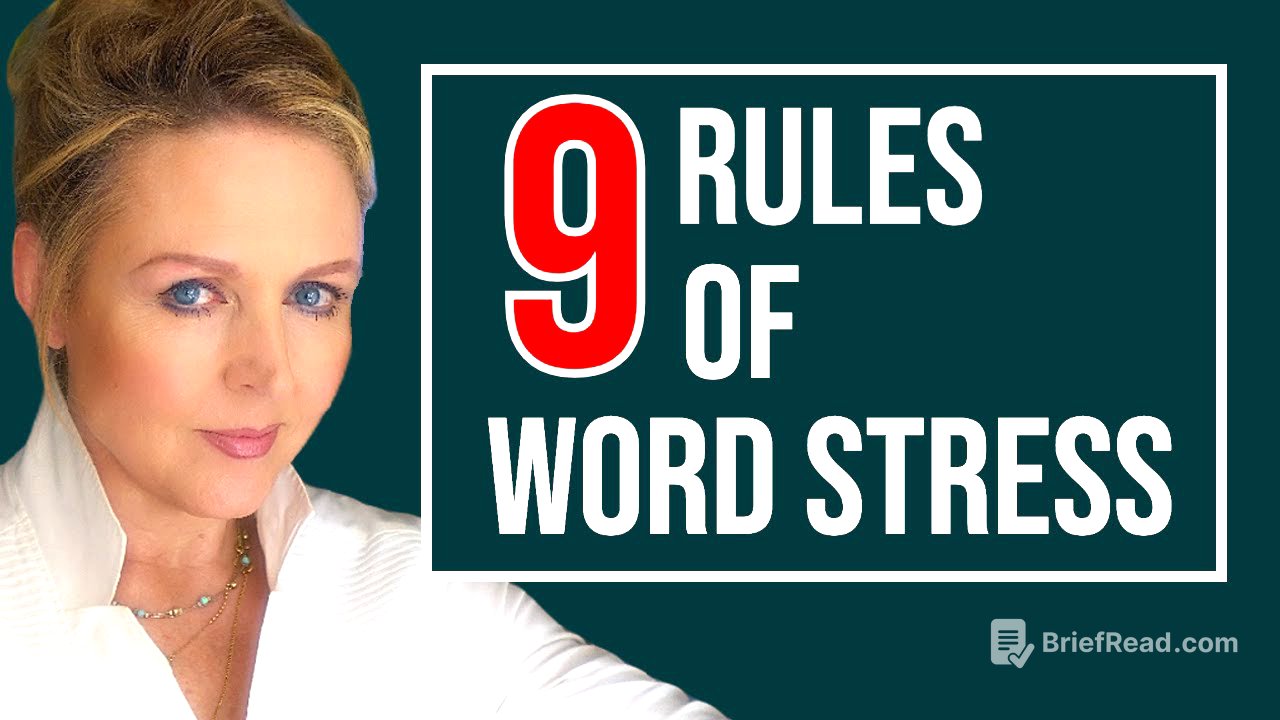
- Nine rules for determining word stress in English.
Introduction [0:00]
The video introduces the importance of word stress in English pronunciation. Correct stress is crucial because it can change the meaning of a word and ensure clear communication. Incorrect stress can make speech difficult to understand, as demonstrated by the example of "elephant" versus "elephant". The video aims to provide viewers with the necessary information to master word stress.
Stress & Syllables Explained [0:39]
Word stress is defined as the emphasis given to a syllable or syllables within a word. A syllable is a unit of sound that typically contains a vowel sound. For instance, "cat" has one syllable, while "picture" has two. It's important to note that not every syllable is stressed, and consonants are generally not stressed unless they sound like a vowel, such as the letter 'Y' in "physical".
3 Types of Stress [1:52]
There are three types of stress in English syllables: primary, secondary, and weak. Primary stress is the strongest emphasis in a word, indicated by an apostrophe in phonemic script, as in "banana" (ba-NAH-na). Secondary stress is less strong than primary stress but still noticeable, marked by a comma, as in "organisation" (or-ga-ni-ZA-tion). Weak stress involves no emphasis, and the vowel often takes the schwa sound.
The 9 Stress Rules [3:52]
The video outlines nine rules to help determine word stress, acknowledging that exceptions exist.
- Two-syllable nouns typically have stress on the first syllable (e.g., "picture," "mirror," "bottle").
- Two-syllable adjectives also usually have stress on the first syllable (e.g., "pretty," "perfect," "common," "helpful").
- Two-syllable verbs tend to have stress on the second syllable (e.g., "provide," "believe," "decide," "begin"). Changing the stress in these words can also change the word class, such as "export" (noun) becoming "to export" (verb).
- Words ending in "IC" have stress on the penultimate syllable (e.g., "music," "heroic," "graphic," "magnetic," "electric").
- Words ending in "SION" and "TION" also have stress on the penultimate syllable (e.g., "invasion," "pollution," "education," "conversation").
- Words ending in "CY," "TY," "PHY," and "GY" have stress on the ante-penultimate syllable (e.g., "democracy," "visibility," "photography," "psychology").
- Words ending in "al" have stress on the ultimate syllable (e.g., "physical", "critical", "magical", "hysterical").
- For compound nouns, the stress is on the first part (e.g., "Blackbird," "Bookcase," "Greenhouse").
- For compound adjectives, the main stress is on the second part (e.g., "old-fashioned," "well-known").
The video advises learning word families to understand stress patterns, using "educate," "education," and "educational" as examples.