TLDR;
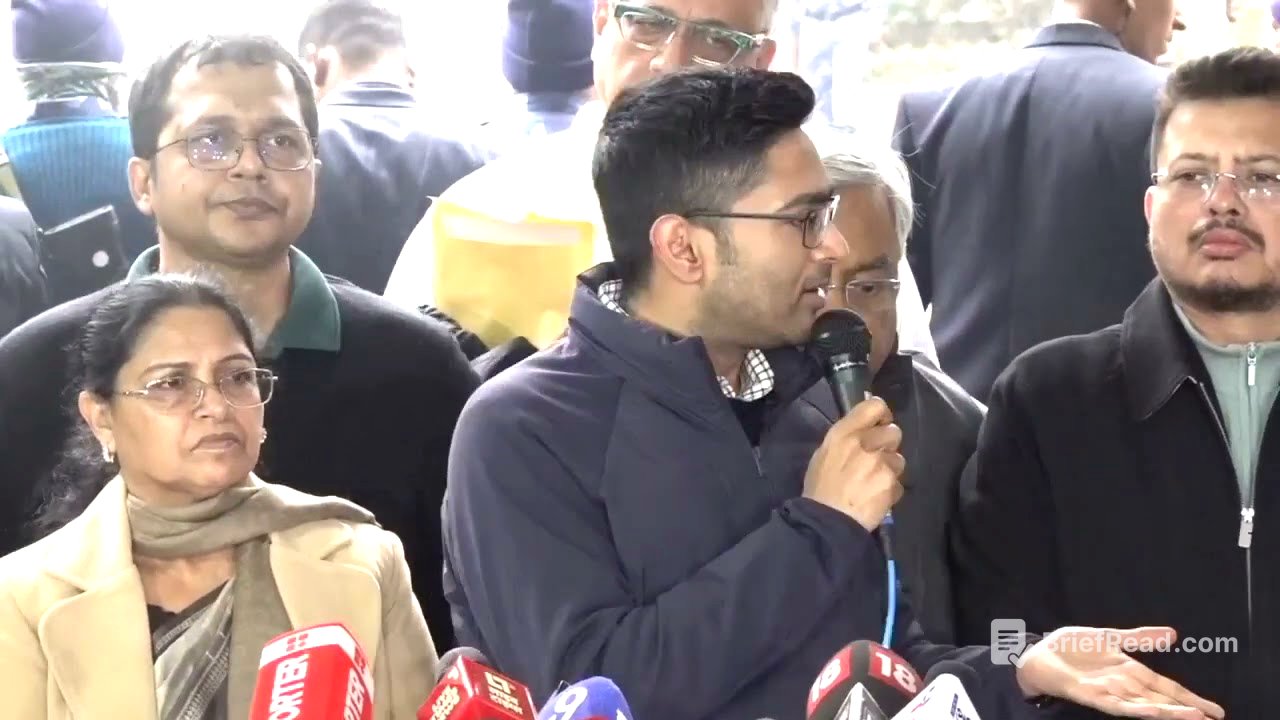
Abhishek Banerjee discusses a meeting between Trinamool Congress representatives and the Election Commission of India, highlighting concerns about voter list discrepancies, selective targeting, and the handling of senior citizens and individuals with disabilities during the electoral process. He accuses the BJP of defaming Bengal and alleges that the Election Commission is being influenced to manipulate voter lists, calling for transparency and criticising the lack of concrete answers from the commission. Banerjee urges opposition parties to focus on voter list irregularities rather than EVMs, accusing the BJP of orchestrating voter theft through software manipulation and selective enforcement.
- Concerns over voter list discrepancies and selective targeting.
- Allegations of BJP defaming Bengal and manipulating voter lists.
- Calls for transparency and criticises the Election Commission's lack of answers.
- Urges opposition parties to focus on voter list irregularities.
Introduction [0:14]
Abhishek Banerjee states that a delegation from Trinamool Congress, consisting of 10 Members of Parliament and senior ministers from the West Bengal government, met with the full bench of the Election Commission, including the Chief Election Commissioner and two Election Commissioners. The meeting, which lasted for two and a half hours, covered 10 key issues. This follows a previous delegation a month prior that posed five questions to the Election Commission, none of which received satisfactory answers, and the responses have not been made public.
Concerns Regarding the Electoral Roll Assistant Officer (AERO) Login [1:21]
Banerjee highlights issues with the AERO login system, where cases of logical discrepancies are uploaded in a piecemeal fashion. He points out flaws in the associated app, noting that even when a case is marked as "Found Okay" after document submission, hearing notices are still generated. The Election Commission acknowledged potential technical glitches but provided no concrete explanation.
Treatment of Senior Citizens and Individuals with Disabilities [2:29]
Banerjee raises concerns about the harassment of senior citizens, particularly those with medical conditions or mobility issues, who are being called for hearings and made to wait for extended periods. He mentions that a delegation from West Bengal's CEO office had requested that those over 85 not be called for hearings, which resulted in a notification. He also requests that individuals over 60 with medical conditions, comorbidities, or disabilities be spared from attending these hearings, but the Chief Election Commissioner has only said he will consider the matter without making any firm commitment. Banerjee emphasises that Trinamool is the only party raising these issues with both the Chief Electoral Officer and the Election Commission.
Allegations of Selective Targeting and Infiltration [4:35]
Banerjee addresses allegations of selective targeting and infiltration, accusing the BJP of defaming Bengal by claiming that there are millions of Rohingya and Bangladeshi immigrants in the state. He challenges the Election Commission to release a list detailing how many of the 5.8 million people whose names were removed from the draft list are Bangladeshi or Rohingya. He argues that if the Election Commission cannot provide this information, they should either apologise for defaming Bengal or release the list. He also questions why micro-observers are selectively placed only in Bengal when other states have higher deletion percentages in the Summary Revision of Electoral Rolls (SRER).
Inconsistencies in Document Verification and Third-Party Agencies [8:06]
Banerjee questions the feasibility of District Officers (DOs) verifying documents within five days, especially when those documents originate from outside West Bengal. He also inquires about a third-party agency, Data Mission, allegedly hired by the Election Commission to conduct surveys in Bengal, which the commission denies knowledge of. Banerjee challenges the commission to release CCTV footage of the meetings to verify the truth. He questions how the CEO's office can issue directives without the Election Commission's approval and consent.
Concerns About Name Deletion and Voter Mapping [10:19]
Banerjee raises concerns about names being deleted from the electoral roll without informing the Electoral Registration Officers (EROs), using backend software. He questions how names can be deleted without Form 7 being filled. While the commission states that names are deleted if enumeration forms are not filled, Banerjee asks who is responsible for errors leading to wrongful deletions. He also addresses the misinterpretation of voter mapping data, noting that initial reports suggested 45% of people were unmapped, but the draft list revealed that approximately 89% were mapped.
Migrant Workers and Hearing Venues [12:14]
Banerjee discusses the issue of migrant workers being called for hearings, despite assurances that family members could submit forms on their behalf. He highlights the need for decentralised hearing venues to avoid harassment. He questions why Booth Level Agent 2s (BLA2s) are not allowed at hearing venues when they are permitted at polling stations and during enumeration form distribution. He accuses the Election Commission of avoiding a formal circular on this matter to prevent legal challenges.
Allegations of Voter List Manipulation and the Role of the BJP [13:50]
Banerjee asserts that voter list manipulation is a form of electoral theft, more significant than issues with Electronic Voting Machines (EVMs). He claims that the BJP has been successful in elections due to this manipulation, citing high strike rates in states like Maharashtra, Delhi, and Bihar. He accuses the Election Commission of operating based on WhatsApp directives rather than official circulars, preventing legal challenges.
Demands for Transparency and Accountability [15:53]
Banerjee questions why the Election Commission is not making the logical discrepancy list public and why BLA2s are barred from hearing venues. He demands decentralisation of hearing venues and relief for senior citizens and individuals with medical conditions. He suggests the Chief Election Commissioner is following directions from higher authorities, implying a lack of independence.
Confrontation and Challenges to the Election Commission [16:36]
Banerjee recounts a confrontational exchange during the meeting, where the Chief Election Commissioner allegedly raised his voice and pointed fingers. Banerjee asserts his accountability to the people of West Bengal and challenges the commissioner to release the meeting footage. He accuses the commissioner of thinking the people of Bengal are subservient and challenges the BJP to use all available agencies against them, confident that the people of Bengal will still win.
Appeal to Opposition Parties and Concerns About Voter Suppression [23:34]
Banerjee appeals to opposition parties to recognise and address the voter list irregularities, which he describes as a form of electoral theft through software manipulation. He highlights discrepancies in the voter list, such as deceased individuals being listed as alive. He questions the speed at which the Election Commission sanitised the voter list, suggesting manipulation. He accuses the government of trying to decide who gets to vote, reversing the democratic process.
Final Remarks and Call to Action [27:41]
Banerjee reminds the Election Commission that the constitution will outlast the BJP's rule and urges them to operate within the bounds of the law. He shares his experiences with other political parties and encourages them to fight on the ground level. He reiterates that the people will decide who wins, not the BJP. He urges all parties to work together to stop the electoral roll theft and uphold the constitution.