TLDR;
This video provides a detailed overview of upper body exercises, categorising them by movement (push, pull, rotation), direction (horizontal, vertical, diagonal), and lever involvement (hip and knee dominance). It covers movement analysis, functional anatomy, muscle actions, and coaching cues for various exercises like rows, pull-ups, bench press, shoulder press, medicine ball throws, and wood chops. The importance of core stability, scapula motion, grip strength, and controlled movements for injury prevention and maximising exercise benefits are emphasised.
- Upper body exercises are categorised into push, pull and rotation.
- Exercises are further divided into horizontal, vertical and diagonal movements.
- Key aspects include movement analysis, functional anatomy and coaching cues.
- Core stability, scapula motion and grip strength are crucial for effective and safe exercise.
Introduction to Upper Body Exercises [0:00]
The video introduces upper body exercises, differentiating them into pull and push movements, further divided into horizontal and vertical directions. Lower body exercises have been previously discussed based on lever classifications (hip dominant, knee dominant, and hip and knee combined) along with movement analysis. The focus shifts to horizontal pull exercises.
Horizontal Pull Exercises [0:36]
Horizontal pull exercises, such as seated rows and bent-over rows, engage muscles like rhomboids, trapezius, pectoralis major, and deltoids. These exercises occur in the transverse plane, requiring a neutral spine and controlled movements throughout the full range of motion. It's important to avoid rounding the shoulders and ensure athletes complete the entire movement to maximise benefits.
Bent Over Row: Phases and Key Variables [2:45]
The bent-over row is broken down into phases: the hip hinge start position with a neutral spine and core activation, the pulling phase where the barbell is pulled towards the lower chest engaging rhomboids and traps, and the lowering phase with a controlled descent. Key variables include maintaining hip hinge mechanics, a neutral spine, and proper scapula retraction for a full range of motion.
Vertical Pull Exercises [5:25]
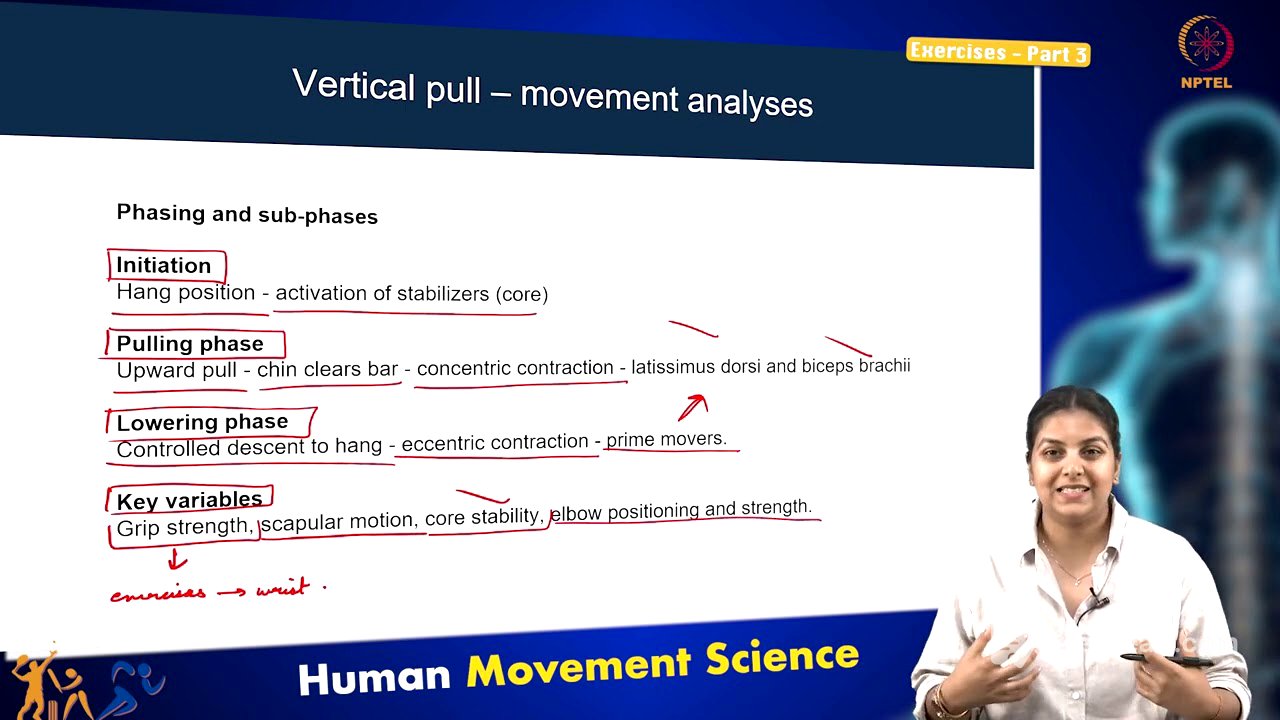
Vertical pull exercises, such as pull-ups and lat pulldowns, involve muscles like lats (latissimus dorsi), biceps brachii, pectoralis major, and deltoids. These movements occur in the frontal plane, involving shoulder adduction and elbow flexion. Coaching cues emphasise maintaining a neutral spine and pulling through the entire range of motion.
Pull-Up: Phases and Key Variables [7:01]
The pull-up is divided into phases: initiation from a hang position, activating the core; the pulling phase, lifting until the chin clears the bar, engaging lats and biceps; and the lowering phase, with a controlled descent back to the hang. Key variables include grip strength, scapula motion (protraction, retraction, elevation, depression), core stability, and elbow positioning.
Horizontal Push Exercises [9:52]
Horizontal push exercises, like bench press and push-ups, involve pushing weight away from the body. Major muscles include the pectoralis major and deltoids, with lats and triceps brachii acting as antagonist muscles. These movements occur in the transverse plane, involving shoulder adduction and elbow extension. Maintaining a neutral spine and controlled push through a full range of motion are crucial.
Bench Press: Phases and Key Variables [11:48]
The bench press is broken down into the lowering phase (bar to chest with eccentric contraction), the lowest position (bar to chest, stabilisers activated), and the lifting phase (concentric contraction of shoulder adductors, triceps, and anterior deltoid). Key variables include grip strength and width, balance, elbow stability, scapular motion, and core stability. Using dumbbells can help identify and address strength imbalances between limbs.
Vertical Push Exercises [14:17]
Vertical push exercises, such as the shoulder press, involve pressing weight overhead in a vertical direction. Major muscles include the deltoids (anterior and middle), triceps brachii, lats, and rhomboids. These movements occur in the frontal plane, involving shoulder overhead adduction and elbow extension. Coaching cues emphasise maintaining a neutral spine and a controlled push through a full range of motion.
Shoulder Press: Phases and Key Variables [16:03]
The shoulder press includes a lifting phase (pushing weight overhead with concentric contraction of deltoids and triceps) and a lowering phase (controlled descent with eccentric contraction of the same muscles). Key variables include grip strength and width, elbow path, and scapular motion stability (elevation and depression).
Rotational Exercises [17:35]
Exercises can also be categorised by direction, such as rotation in the transverse plane or diagonal rotation. An example of a rotational exercise is the medicine ball throw, which develops explosive strength.
Medicine Ball Throw: Phases and Key Variables [20:11]
The medicine ball throw is divided into the wind-up phase (weight away from target, pre-stretching obliques), the throwing phase (rapid rotation towards the target with concentric contraction), and the deceleration phase (controlled eccentric contraction). Key variables include hip and shoulder separation, a stable trunk and core, and tracking arm and hand pathways.
Diagonal Rotational Exercises [22:59]
Diagonal rotation exercises, like the wood chop, mimic chopping wood and involve diagonal body rotation.
Wood Chop: Phases and Key Variables [24:54]
The wood chop includes a start position (activating stabilisers, weight pulled away from pulley), a chopping phase (diagonal rotation with concentric contraction of obliques and rectus abdominis), and a return phase (controlled eccentric contraction). Key variables include stance and foot position, torso rotation, and tracking arm trajectory.
Conclusion and Summary [26:47]
The module summarises exercise as a planned, structured, and repeated physical activity to enhance physical fitness and overall health. Well-rounded training programs enhance physical capabilities and skill in the context of specific sports. Exercises are categorised based on actions (push and pull), direction (vertical, horizontal, and rotational), and lever involvement (hip and knee dominant). The module provides insights into designing exercise programs and applying human movement science principles to exercises.