TLDR;
This video explores Athenian culture through its food and social dynamics, revealing how deeply ingrained traditions shape daily life. It covers everything from the significance of Greek cuisine and coffee culture to the challenges posed by tourism and the complex relationship with history and neighbouring cultures.
- Food is central to Greek culture, deeply connected to health, religion, and social gatherings.
- Athens is experiencing rapid changes due to tourism, affecting local communities and traditions.
- The city balances its rich history with modern challenges, striving to maintain its unique identity.
Introduction to Greek Cuisine and Athenian Culture [0:00]
The video begins with a personal anecdote about growing up near a Greek neighbourhood in Queens, New York, but not fully appreciating Greek cuisine until visiting Athens. The host introduces Julia and Duke, a mother-son duo who run food tours, emphasising the importance of fresh, simple ingredients in Greek cooking. The video highlights the ancient Greek philosophy of food as medicine and its central role in nurturing both health and soul, setting the stage for a journey into how food shapes Athenian life.
Exploring Athens: Vibrancy and Culinary Traditions [1:03]
The host expresses his fascination with Athens' vibrant atmosphere, contrasting it with negative perceptions held by some Australians. The first stop is a tasting of bugata, a northern Greek pie made with homemade filo, semolina flour, butter, sugar, and milk, popular for its simplicity and accessibility. The significance of Greek coffee is also discussed, noting its use in fortune telling and watering plants. The tour then proceeds to the food market, showcasing a variety of spices, herbs, and cured meats, some from shops dating back to the early 20th century. Dolma, stuffed grape leaves, are highlighted as a beloved dish enjoyed year-round.
The Greek Diet: Seasonality, Simplicity, and Religion [5:21]
Julia explains the core principles of the Greek diet: seasonality, simplicity, and freshness. She describes a simple green bean dish (Barbo fasula) made with fresh ingredients and olive oil, paired with feta cheese, bread, and cold wine or beer. The connection between Greek Orthodox religion and dietary practices is explored, particularly the fasting periods that influence the prevalence of plant-based dishes. The importance of preserving traditional recipes is highlighted through a visit with sisters who run a food blog dedicated to their grandmother's recipes, including stuffed vegetables (you're y).
Yogurt, Souvlaki, and Grandmother's Touch [8:17]
The tour continues with a visit to a shop that brings yogurt from the island of Lesbos, known for its high-fat content and traditional clay pot preparation, which is considered a prebiotic. The perfect bite of souvlaki is demonstrated, consisting of grilled bread, tomato, meat, and french fries, reminiscent of a Greek Sunday lunch prepared by a grandmother. The host experiences being personally fed, highlighting the nurturing aspect of Greek food culture.
Yummy Sta and the History of Feta [9:34]
The final food stop features yummy sta, stuffed peppers or tomatoes with rice, herbs, and vegetables. The history of feta cheese is explored, tracing its origins back to Homer's Iliad and Odyssey, where it was described as being made by the Cyclops Polyphemus. The legal battle to protect feta as a uniquely Greek product is discussed, similar to France's protection of champagne, emphasising its authenticity and originality.
Tourism and Transformation in Koukaki [11:49]
The video shifts focus to the impact of tourism on Athenian neighbourhoods, particularly Koukaki, which has experienced significant transformation due to short-term rentals. Christine, a local resident, discusses the challenges of rising rents and changing demographics, with many properties being converted into Airbnbs. Despite these challenges, she highlights the tradition of sitting down for coffee and engaging in long chats, a central aspect of Greek culture.
Coffee Culture and Sharing Plates [13:40]
Christine elaborates on the Greek coffee culture, noting the emphasis on quality and the social aspect of lounging and chatting. She attributes this to the warm climate, which encourages people to gather and relax. Sharing plates is common, reflecting a communal approach to dining. The discussion touches on defining Greek food, with Christine mentioning warm vegetable dishes like Briami, and the host tries a deconstructed bugata.
Exploring Zahar and the Communal Feeling of Athens [17:21]
Christine takes the host to Zahar, an old neighbourhood with beautiful, expensive houses. The communal feeling of Athenian neighbourhoods is highlighted, with unique shops and essential services within a 15-minute walk. The conversation transitions to a visit to Upper Petralona, a more homey neighbourhood with fewer tourists, where residents enjoy their balconies and plants.
Meze and the Multicultural Vibe of Athens [20:02]
The pair enjoy meze, small plates of food shared at the table, reinforcing the communal aspect of Greek culture. They sample various dishes, including Crete cheese with honey and figs, and green beans. Christine shares her love for Athens' multicultural vibe, noting the mix of Athenians, non-Athenians, Greeks, and non-Greeks, which contributes to a growing and healthy cultural landscape.
Piraeus and the Views from Kastella Hill [23:01]
The video expands beyond central Athens to Piraeus, an ancient port and burgeoning area. The host meets Yorgos, an engineer and documentary photographer, and they climb Kastella Hill for views of the city. The vast urban sprawl is noted, prompting reflection on how Greeks relate to their history.
Relating to History and the Ottoman Influence [25:11]
Yorgos discusses the irony of Greeks being proud of their ancient history but not deeply connected to it, sometimes using it as a basis for entitlement. He highlights the significant influence of the Ottoman Empire on Greek culture, in addition to the Golden Age of ancient Greece.
The Complex Relationship with Turkey [26:51]
The video addresses the strained relationship between Greece and Turkey, stemming from nearly 400 years of Ottoman occupation and the Greco-Turkish War, which led to a massive population exchange and the erasure of Turkish influences. Despite this divisive past, Yorgos believes Greeks and Turks are culturally close. He also reflects on Greece's identity, suggesting it is neither fully East nor West but a unique blend of cultures.
Symposiums, Uzo, and Greek Tetris [30:36]
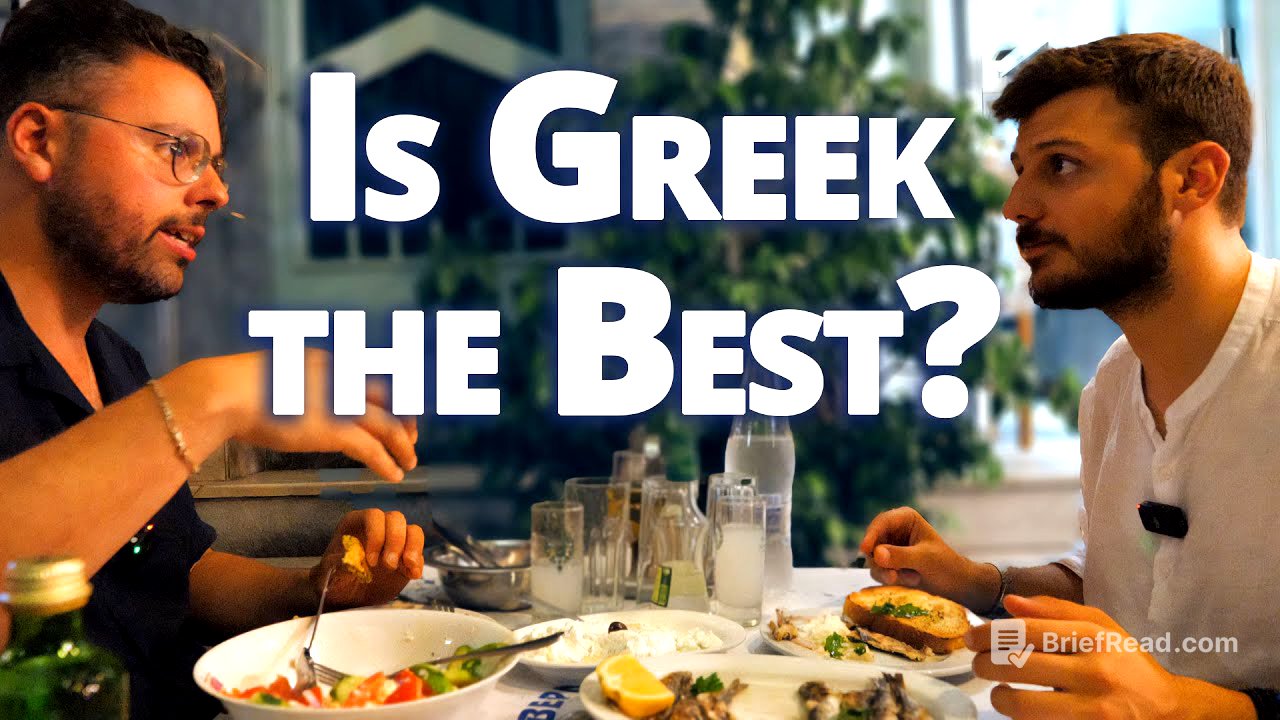
Yorgos connects modern Greek conversations to the ancient art of Symposium, where wine drinking and idea sharing were central. He demonstrates the proper way to serve uzo, a traditional drink from his island of Lesbos. The meal includes bread with olive oil and oregano, Greek salad, and fried zucchini. The concept of "Greek Tetris" is introduced, referring to the art of fitting all the dishes on the table.
Greek Dinner Rituals and Philotimo [33:43]
Yorgos describes the steps of a typical Greek dinner, from salad and starters to the main course, dessert, fruit, and coffee. He explains the concept of philotimo, a unique Greek value encompassing friendship and honour, exemplified by helping a colleague without expecting personal gain. He contrasts this with the individualistic nature of American culture.
European Identity and Spontaneity [35:53]
Yorgos discusses Greece's relationship with Western Europe, noting a desire to emulate certain aspects like human rights and gender equality, but also a resistance to the individualism and rigid planning of some European cultures. He values the spontaneity of Greek social interactions, such as impromptu after-work drinks.
The Changing Face of Athens and the Dark Side of Tourism [37:18]
Yorgos expresses concern that Athens is changing for the worse due to over-investment in tourism, potentially making the city centre unaffordable for locals. He highlights the proliferation of Airbnb rentals and the resulting increase in rent prices. While acknowledging the benefits of tourism, he stresses the need for regulations to protect local residents.
The Positive Side of Athens and a Final Meal [38:56]
Despite his concerns, Yorgos praises Athens' multicultural side, with its diverse population and entertainment options. The video concludes with a meal of fried red mullet (barboni), symbolising the essence of summer.
Conclusion [40:15]
The host reflects on the contrasts within Athens, acknowledging the challenges faced by locals alongside the city's famous landmarks and vibrant taverns. He emphasises that food and history are just two pieces of a larger puzzle, with architecture and the built environment also playing a significant role in Athenian life. The video promotes an upcoming episode exploring Athens' urban planning.