TLDR;
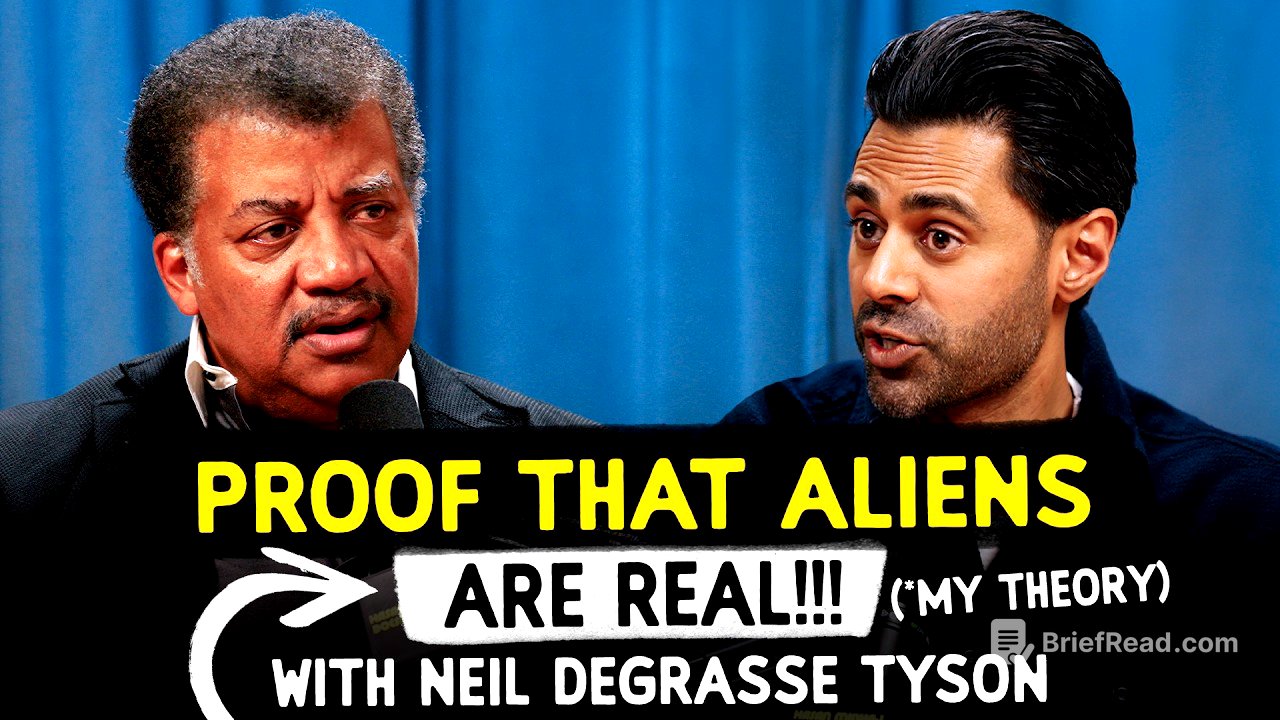
This episode features a conversation with Neil deGrasse Tyson, covering a wide array of topics from UAPs and alien encounters to the importance of science literacy and space exploration. Tyson shares insights from his new book, answers questions from children, and touches on the influence of his father's civil rights activism on his perspective. The discussion also addresses climate change, the role of NASA versus private space enterprises, and the necessity of promoting scientific understanding in governance.
- UAPs are unidentified and should be investigated further without jumping to conclusions about alien origins.
- Eyewitness testimony is the lowest form of evidence in science.
- Science illiteracy among lawmakers is a significant concern.
- Space exploration provides a crucial perspective on Earth and drives technological innovation.
- Financial incentives are key to driving societal change and progress.
Cold Open [0:00]
The discussion begins with a reflection on the significance of seeing Earth from space, highlighting how it transcends geopolitical boundaries and colour-coded representations. The speaker expresses appreciation for Neil deGrasse Tyson's ability to maintain a broad perspective, focusing on big ideas rather than getting caught up in transient political issues. This perspective is seen as crucial in an era where viewpoints often narrow to the scale of a mobile phone.
Opening Monologue [0:44]
Hasan Minhaj introduces the episode with Neil deGrasse Tyson, noting Tyson's knack for "dropping bars" of wisdom. He previews the conversation, which includes discussions on UFOs, horoscopes, and Tyson's new book, "Just Visiting This Planet," where he answers questions from children as the character Merlin. The monologue sets a light-hearted tone while highlighting the depth of Tyson's insights.
UAPs [2:12]
The conversation addresses the recent House Oversight Committee hearings on Unidentified Anomalous Phenomena (UAPs). Tyson emphasises the "U" in UAP stands for "Unidentified," cautioning against drawing conclusions without sufficient evidence. He advocates for embracing the unknown and conducting further research rather than immediately assuming alien origins. Tyson contrasts the fuzzy, low-resolution images of alleged UAPs with the highly detailed images from the James Webb Space Telescope, questioning why the best evidence for alien visitation is so lacking in clarity.
Eyewitness Testimonies and the Enigma App [5:12]
Tyson dismisses eyewitness testimony as the lowest form of evidence in science, noting its inherent unreliability. He points out the ubiquity of smartphones capable of capturing high-resolution images and videos, questioning why there isn't better visual evidence of alien crafts or beings. Minhaj introduces the Enigma app, described as "Yelp for UFOs," and presents a reported sighting in Manhattan. Tyson remains sceptical, suggesting the presented video evidence appears to be an internal reflection of the camera lens.
Alien Graph [13:01]
The discussion shifts to a light-hearted analysis of aliens in pop culture, plotted on a graph with axes of "dumb to smart" and "peaceful to hostile." Tyson humorously categorises various alien portrayals, such as the Predator being "smart and hostile." He then reflects on how portrayals of hostile aliens often mirror humanity's own behaviour towards less technologically advanced civilisations. Tyson suggests that the concept of aliens often fills the gaps in our understanding, similar to the historical use of "God of the gaps."
What scares Neil de Grasse Tyson? [19:22]
Tyson expresses his greatest fear: the profound science illiteracy among those who control laws and legislation. He warns that this lack of understanding can unravel an informed democracy and dismantle civilisation. Tyson stresses the importance of objective truths established through scientific methods and cautions against laws based on personal belief systems, which could lead to a theocracy. He highlights the Founding Fathers' wisdom in omitting God from the Constitution to prevent religious coercion.
Neil’s new book, “Just Visiting This Planet” [22:21]
Tyson introduces his new book, "Just Visiting This Planet: Further Scientific Adventures of Merlin from Omnicious," explaining that it's a collection of Q&A answered by a fictional character from Andromeda. The Merlin character allows him to have fun while answering scientific questions.
Answering questions from kids [25:05]
Tyson, in character as Merlin, answers questions from children. He explains why the North Pole is warmer than the South Pole, discusses the inevitability of meteor impacts, and describes what happens when you go inside a black hole. He also touches on why turtles breathe through their butts and explains why time goes slower in space than on Earth. Finally, he clarifies that no one can hear music played in space because there is no medium to transmit sound waves.
Is the Sun a star? [37:28]
The discussion explores the nature of the sun, clarifying that it is indeed a star, despite ancient Greek classifications of it as a planet. Tyson notes the ongoing solar boom and the increasing use of renewable energy, particularly in China. He also discusses the potential of portable nuclear power stations for remote areas and innovative energy storage solutions like lifting heavy blocks to store gravitational potential energy.
Arthur the Aardvark [47:10]
The conversation shifts to a discussion about the PBS show Arthur, with Tyson recalling the terrifying original illustrations of the characters. This leads to a broader discussion about the National Science Foundation and the importance of science in various aspects of life, including health, industry, security, and wealth.
Solar Panels [50:46]
Tyson explains why it took so long for solar panels to become widespread, citing the historical advantages of oil, including established infrastructure and relatively low cost. He points out that the infrastructure for oil consumption was largely funded by taxpayers. Tyson also touches on the need for advancements in energy storage to fully utilise solar power and warns about the potential consequences of climate change, such as rising sea levels and extreme weather events.
Neil’s Father the Civil Rights Activist [56:11]
Tyson shares how his father, a civil rights activist, influenced his perspective. His father taught him that it's not enough to be right; one must also be effective in creating change. Tyson emphasises the importance of financial incentives in driving societal progress, recalling his father's belief that change happens when someone can profit from it.
Space X’s Advancements [59:17]
Tyson clarifies his previous statement about Elon Musk, acknowledging that Musk's primary contribution to space exploration is reducing the cost of access to space, thereby opening it up to new industries. He also credits Musk with popularising electric cars in America. Tyson reiterates that financial incentives are crucial for driving change and points to the rapid adoption of automobiles in the early 20th century as an example.
Will we be a multi-planetary species? [1:06:11]
Tyson argues against the likelihood of humanity becoming a multi-planetary species, citing the immense cost and lack of compelling drivers such as survival, praise of royalty/deity, or financial gain. He suggests that it would be more practical to address problems on Earth, such as asteroid deflection or virus control, than to terraform Mars and transport billions of people there. Tyson concludes that space exploration should be driven by curiosity and the desire for exploration, not by a perceived need to escape Earth.
Importance of NASA vs. Private Space Enterprise [1:12:12]
Tyson defends the importance of NASA, arguing that private enterprises are driven by short-term profits, while NASA can take a long-term view on exploration and innovation. He highlights how NASA's push to miniaturise electronics for space travel led to the portable electronics industry. Tyson also points out that many environmental protections, such as the banning of leaded gas and DDT, occurred during the Apollo missions, demonstrating the broader benefits of space exploration. He concludes by emphasising that governments need violence or fear as a driver, or the promise to get rich.