TLDR;
The Chinese Communist Party's (CCP) National People's Congress has revealed a continued increase in the defence budget, albeit at a slower pace, amidst a backdrop of economic challenges and international scrutiny. China's economic growth target has been adjusted downwards, reflecting a cautious outlook, while concerns persist about the accuracy of official GDP figures. The defence spending, though officially lower than previous years, remains a point of contention, with hidden expenditures and corruption within the military raising further questions. The treatment of veterans and systemic corruption within the military add to the complexities, drawing parallels with the late stages of the Soviet Union.
- China's defence budget increased for the fifth consecutive year, but at a slower pace.
- Economic growth targets have been revised downwards, signalling caution.
- Hidden military expenditures and systemic corruption are major concerns.
China's Economic Slowdown and Revised Growth Targets [0:00]
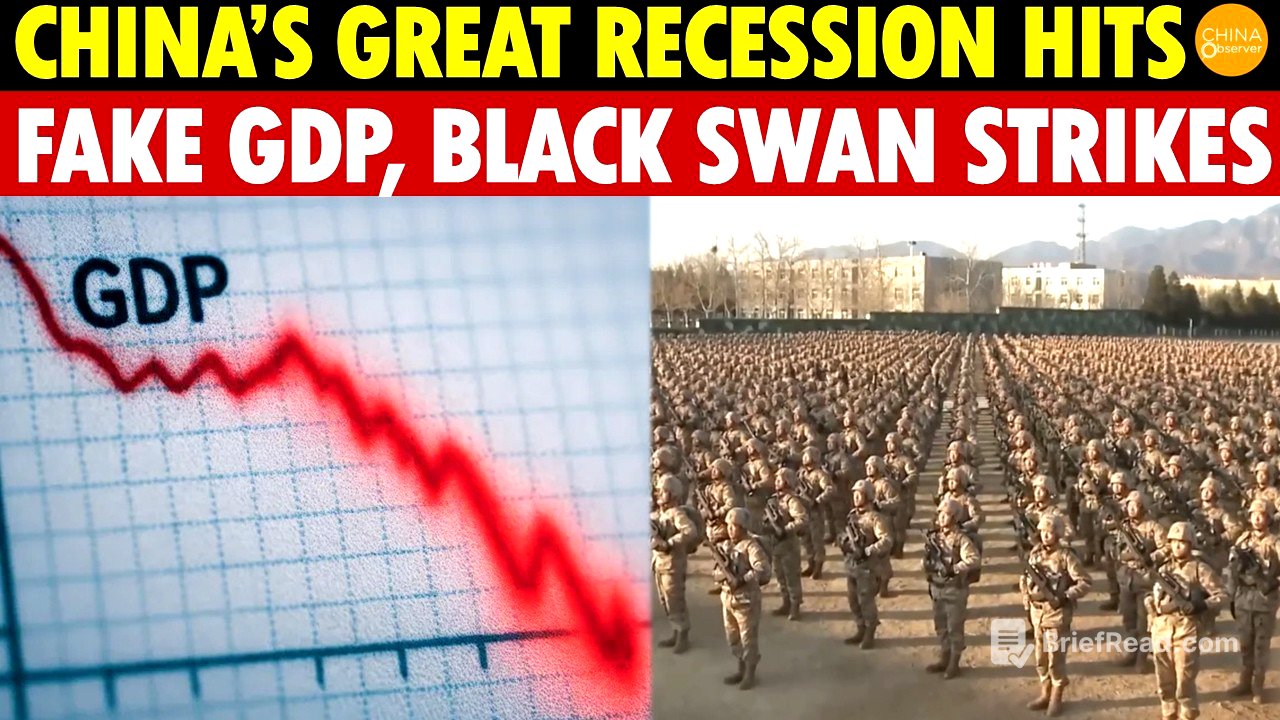
The CCP's National People's Congress opened with the announcement of a defence budget increase for the fifth consecutive year, exceeding the GDP growth target. Premier Lee Chang set the 2026 economic growth target at 4.5 to 5%, a downward adjustment from previous targets, reflecting a more cautious economic outlook. Analysts suggest the real growth may be lower than official figures, potentially nearing stagnation or negative growth. Political commentator Chen Po Kong argues that China's economy has been in continuous decline under Xi Jinping, exacerbated by trade wars and instability in key oil-supplying countries like Venezuela and Iran.
Unsustainable Economic Model and External Pressures [1:02]
Chen Kong highlights that China's economic model, reliant on investment and exports, is no longer sustainable, with the real estate industry's collapse causing significant economic damage. Despite a reported 5% GDP growth in 2025, international observers question its authenticity, citing indicators like electricity consumption and freight volume. External pressures, including turmoil in Venezuela and Iran affecting cheap oil supplies, and the US-China trade war, further strain China's economy. The trade war, with high tariffs and supply chain shifts, has damaged China's export-driven growth, with high-end manufacturing moving out of the country.
Defence Spending and Economic Priorities [2:31]
The 2026 government work report set the economic growth target at 4.5 to 5%, viewed by experts as an acknowledgement of economic decline amidst deflation, income stagnation, and high unemployment. China's defence spending has drawn international attention, correlating with overall economic growth. Economist Davy J. Wong notes that while defence budget adjustments align with GDP growth, the continued prioritisation of military spending over economic development reflects a "military first" policy. Shenpong states that the CCP's aggressive military policies are inevitable, mirroring North Korea's approach.
Regional Military Balance and International Concerns [4:19]
China's increasing military activities in the South China Sea, East China Sea, and Taiwan Strait have heightened global scrutiny of Beijing's defence spending. The International Institute for Strategic Studies reported that China's share of total military spending in Asia reached 44% in 2025, raising concerns among neighbouring countries. Taiwanese media reported China's defence spending is 11 times that of Taiwan, posing a direct threat to Taiwan's security. Bloomberg highlighted the invisible scale of China's defence spending, estimating that Beijing's actual spending could be significantly higher than reported.
Hidden Military Expenditures and Strategic Ambiguity [5:49]
Analysis suggests Beijing's budget does not fully reflect its military power, excluding spending on paramilitary forces and naval power. These hidden expenses obscure the true scale of China's military spending. The Center for Strategic and International Studies noted that China's military spending has increased from 1/6th of the US's in 2012 to about 1/3 in 2024, surpassing Japan and South Korea. International think tanks like the Stockholm International Peace Research Institute (SIPRI) estimate China's actual defence spending could be much higher than official figures.
Structural Underestimation of Defence Budget [7:32]
Nikkei Asian Review pointed out that China does not include weapons research and development costs or military aviation expenses in its official defence budget. International think tanks have repeatedly highlighted the structural underestimation of China's defence budget, with substantial investments in core research and development often categorised under other budget items. State-owned enterprises engage in projects under the guise of civil aviation or high-tech industries, securing R&D funding that supports China's civil-military integration strategy. Military-civil integration is a core element of China's defence strategy, involving investments in cutting-edge technologies.
Official Justifications and International Skepticism [9:26]
Critics argue that these blurred boundaries make China's military spending appear low-key. Chinese officials defend their defence spending as reasonable and restrained, aimed at safeguarding national sovereignty and territorial integrity. CCP spokespersons emphasise that China's defence spending as a percentage of GDP is lower than America's, but this argument fails to alleviate international concerns, especially in the Indo-Pacific. The issue of hidden spending extends to specific areas like veterans' benefits, which are often shifted to administrative budgets.
Veterans' Benefits and Welfare Disparities [10:24]
China's military faces human rights issues, particularly in the treatment of veterans. The US spends significantly more on veterans' benefits than China, highlighting stark differences in military welfare policies. China's settlement process for its 57 million veterans is relatively simple, lacking long-term support, especially for rural veterans. In contrast, the US adopts a lifelong benefit system for veterans, including healthcare, education, and disability allowances.
Systemic Corruption and Military Purges [12:17]
China's military faces severe systemic corruption, which has become a focal point for international attention. Under Xi Jinping's leadership, there has been a continuous effort to purge corruption within the Chinese military, raising doubts about its combat preparedness. The capture of Central Military Commission Vice Chairman Jong Yosa and Joint Staff Department Chief Leo Jan Lee sparked global outcry, indicating intense power struggles within the CCP and military. The Center for Strategic and International Studies revealed that a significant number of generals and lieutenant generals have been purged since 2022.
Impact of Purges and Future Implications [13:27]
Many senior military officers closely connected to Xi Jinping have been dismissed in the purges, with the CCP claiming they were guilty of serious corruption. The lack of transparency and oversight mechanisms can lead to various scandals, with high-level corruption potentially affecting military equipment systems and rocket forces. International think tanks warn that while these purges may strengthen Xi Jinping's control in the short term, they could weaken the PLA's strategic deterrence and combat effectiveness in the long term. The current situation of the CCP seems to resemble the late stages of the Soviet Union, facing a declining economy, weak consumer spending, and lowering living conditions.