TLDR;
This video provides an overview of the Malaysian education system, focusing on the curriculum, its development, and the underlying philosophies. It stresses the importance of teachers understanding and implementing the national ideology and educational philosophy to cultivate well-rounded, patriotic citizens.
- The Malaysian education system is built on the principles of tolerance, inclusivity, and a focus on holistic development.
- Teachers play a crucial role in shaping students' understanding of the Rukun Negara and the Falsafah Pendidikan Kebangsaan (FPK).
- The curriculum is designed to promote not only academic excellence but also moral values, national unity, and a sense of responsibility towards the country.
Introduction [0:09]
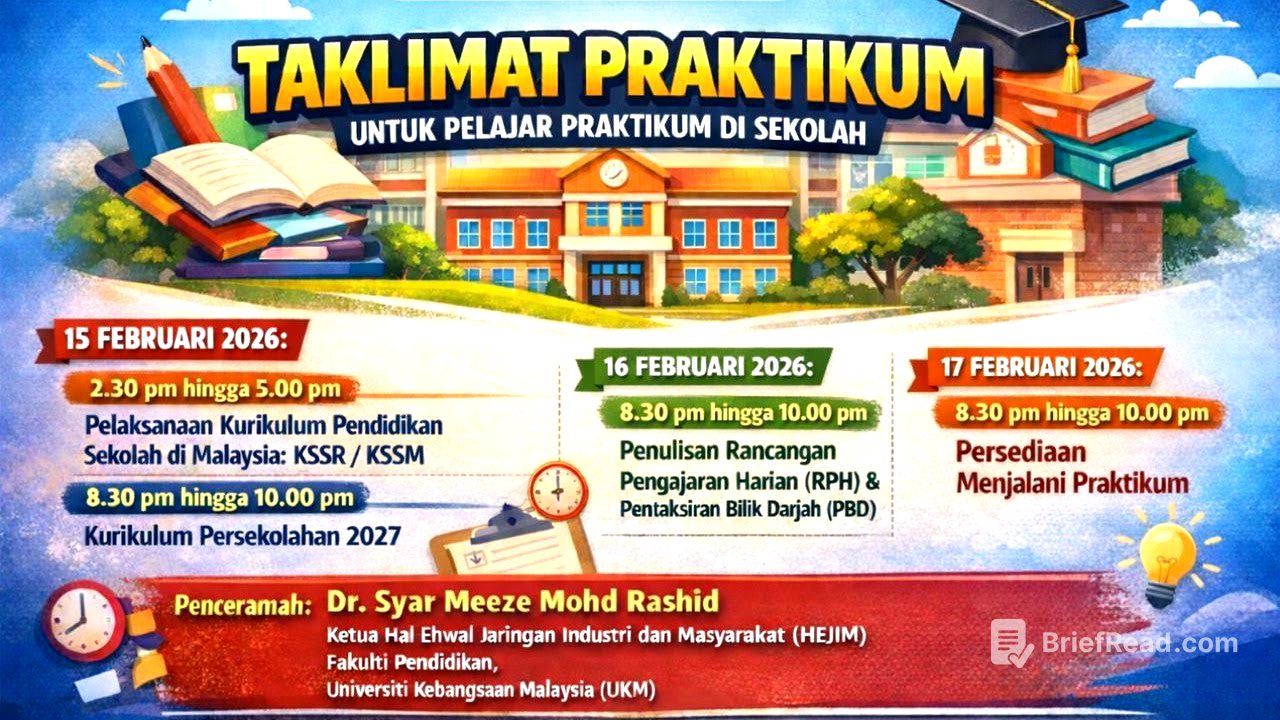
The video begins with a recitation and a greeting to the students of PLMA and ISMP. The speaker apologises for conducting the briefing during their holiday but explains that it's necessary to prepare them for their upcoming practical training. The speaker clarifies that while the KPI only requires two briefings, the additional sessions on curriculum and lesson planning are out of personal initiative to ensure the students are well-prepared. The speaker emphasises the importance of UKM graduates being knowledgeable and competent in education, to uphold the university's reputation.
The Pledge of Malaysian Teachers [0:13]
The video includes a rendition of the "Kami Guru Malaysia" (We are Malaysian Teachers) song, highlighting the commitment of teachers to the nation's children and the importance of the Rukun Negara as a guide. The speaker stresses that teachers should understand the meaning behind the song and their role in spreading the national ideology.
Core Values of Malaysian Society [20:42]
The speaker highlights Malaysia's unique position as a tolerant nation with diverse religions, ethnicities, and languages. The speaker outlines four fundamental aspects of Malaysian unity: a constitutional monarchy, Islam as the official religion, Bahasa Melayu as the national language, and the special rights of Bumiputeras. The speaker stresses that these aspects are balanced with tolerance and inclusivity towards other cultures and religions.
The Role of Teachers in Malaysia [28:43]
The speaker defines the role of teachers in Malaysia as more than just educators; they are responsible for spreading the national ideology, the Rukun Negara, to the students. The speaker explains that the Rukun Negara is the foundation of the Falsafah Pendidikan Kebangsaan (FPK), which aims to create well-rounded individuals who are balanced in terms of physical, emotional, spiritual, and intellectual development. The speaker encourages the students to embody the five characteristics of a true Malaysian citizen: balance, faith in God, moral values, contribution to the nation, and harmony.
Falsafah Pendidikan Kebangsaan (FPK) [46:22]
The speaker emphasises the uniqueness of Malaysia's FPK, which explicitly places faith and obedience to God as the foundation of human development. The speaker contrasts this with Western philosophies that often avoid religious elements in education. The speaker highlights that while other countries may focus on academic achievement and economic productivity, Malaysia aims to create individuals who are moral, knowledgeable, and contribute to the well-being of society.
The Structure of Education in Malaysia [1:10:29]
The speaker outlines the documentation process in Malaysian education, starting with the FPK, followed by the Rancangan Pendidikan Negara (RPN) which is divided into Rancangan Pendidikan Malaysia and Rancangan Pendidikan Tinggi Malaysia. The speaker explains the role of the Kurikulum Standard Sekolah Rendah (KSSR) and Kurikulum Standard Sekolah Menengah (KSSM) as the standard curriculum models. The speaker stresses the importance of the Dokumen Standard Kurikulum dan Pentaksiran (DSKP) as the primary reference for teachers, rather than textbooks.
Rancangan Pendidikan Malaysia (RPM) 2026-2035 [1:22:29]
The speaker introduces the new Rancangan Pendidikan Malaysia (RPM) 2026-2035, which focuses on creating "insan sejahtera" (prosperous individuals) who are ethical, knowledgeable, skilled, resilient, and confident. The speaker outlines the seven core strategies of the RPM, which include optimising student learning experiences, transforming education for the future, improving physical and digital infrastructure and fostering collaboration among educational institutions.
Pendekatan Pembelajaran Manusia (Human Learning Approaches) [1:30:30]
The speaker explains the three approaches to human learning: pedagogy, andragogy, and heutagogy. Pedagogy is teacher-led learning, typically used in primary and secondary schools. Andragogy is adult learning, where learners are more self-directed. Heutagogy is self-determined learning, often used in higher education. The speaker stresses that teachers need to understand these approaches to effectively guide students at different stages of their education.
Kurikulum Standard: KSSR and KSSM [1:47:24]
The speaker explains that the KSSR and KSSM are based on pedagogy, focusing on shaping and guiding students. The speaker contrasts this with the Kurikulum Persekolahan 2027, which aims to integrate primary and secondary education into a single framework. The speaker stresses that while the curriculum is important, teachers should not rely solely on textbooks but should use the DSKP as their main guide.
Pelaksanaan Kurikulum (Curriculum Implementation) [2:19:15]
The speaker outlines the four processes involved in curriculum implementation: pendekatan (approach), strategi (strategy), kaedah (method), and teknik (technique). The speaker stresses the importance of using the pendekatan inkuiri (inquiry approach), which involves engaging students in exploration, explanation, and expansion activities. The speaker also outlines various teaching strategies, such as directive, mediative, and generative, and stresses the importance of tailoring these strategies to the students' needs and learning styles.
Mata Pelajaran di Sekolah (Subjects in School) [2:56:17]
The speaker provides an overview of the subjects taught in Malaysian schools, from primary to secondary level, including special education and religious schools. The speaker highlights the emphasis on Bahasa Melayu, English, and Islamic education, as well as the inclusion of subjects that promote holistic development, such as physical education and arts. The speaker also touches on the importance of STEM education in fostering innovation and problem-solving skills.
Conclusion [3:22:33]
In closing, the speaker reiterates the importance of teachers understanding and implementing the national ideology and educational philosophy. The speaker encourages teachers to avoid sensitive issues and to promote tolerance and inclusivity in their classrooms. The speaker apologises for any shortcomings and expresses hope that the briefing has been beneficial to the students.