TLDR;
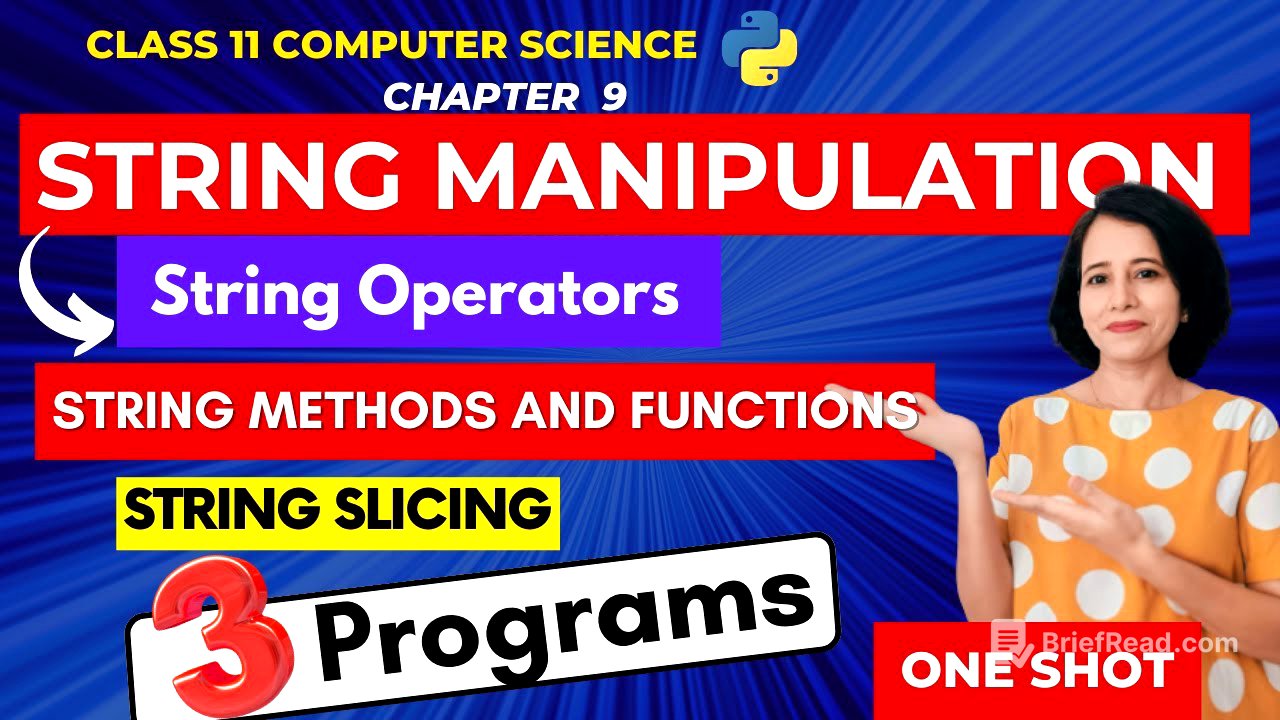
This video provides a comprehensive overview of string manipulation in Python, covering essential concepts such as string definition, immutability, and traversal. It explains various operators applicable to strings, including concatenation, replication, membership, and comparison. Additionally, the video details numerous built-in string functions and methods for tasks like case conversion, whitespace removal, and substring manipulation. The tutorial concludes with practical programming examples demonstrating how to count uppercase/lowercase characters, digits, symbols, words, and how to check if a string is a palindrome.
- String definition, immutability and traversal
- String operators: concatenation, replication, membership and comparison
- String functions and methods with code examples
Introduction to String Manipulation [0:00]
The video introduces the concept of string manipulation in Python, outlining the topics to be covered, including string operators, functions, and methods. It recaps the definition of a string as a sequence of characters, which can be enclosed in single, double, or triple quotes. Strings in Python are immutable, meaning their content cannot be changed in place; any modification results in a new string object. Individual characters within a string can be accessed using indexing, both in the forward (starting from 0) and backward (starting from -1) directions.
Traversing a String [1:27]
Traversing a string involves accessing each element (character) of the string one by one. This can be achieved using loops, such as a for loop with the in operator or the range function. The range function is used to iterate over the indices of the string, starting from 0 up to the length of the string. By using these methods, each character can be accessed and manipulated as needed.
String Operators [3:24]
Python offers several operators for string manipulation. The concatenation operator (+) combines two strings into one. The replication operator (*) repeats a string a specified number of times. Membership operators (in and not in) check if a character or substring exists within a string, returning True or False. Comparison operators (==, !=, >, <, >=, <=) compare strings character by character based on their Unicode values, with the ord() function providing the Unicode value of a character and the chr() function returning the character for a given Unicode value.
String Slicing [11:57]
String slicing allows extracting a portion of a string using indices. The syntax string[start:stop:step] is used, where start is the starting index, stop is the ending index (exclusive), and step is the increment between indices. Variations include omitting start (defaults to 0), omitting stop (defaults to the end of the string), and using negative indices to traverse the string in reverse.
String Functions and Methods [16:31]
Python provides numerous built-in functions and methods for string manipulation. The len() function returns the number of characters in a string. The capitalize() method converts the first character of a string to uppercase. The count() method counts the occurrences of a substring within a string, optionally specifying start and end indices for the search. The find() method returns the lowest index of a substring, or -1 if not found, while the index() method does the same but raises a ValueError if the substring is not found.
String Validation Methods [24:32]
String validation methods are used to check the characteristics of a string. isalnum() returns True if all characters are alphanumeric. isalpha() returns True if all characters are alphabets. isdigit() returns True if all characters are digits. islower() returns True if all characters are lowercase. isspace() returns True if all characters are spaces. isupper() returns True if all characters are uppercase.
Case Conversion and Whitespace Removal Methods [30:40]
String methods for case conversion include lower(), which converts the string to lowercase, and upper(), which converts the string to uppercase. For whitespace removal, lstrip() removes leading whitespace, rstrip() removes trailing whitespace, and strip() removes both leading and trailing whitespace.
String Verification and Transformation Methods [34:15]
The startswith() method checks if a string starts with a specified substring, returning True or False. The endswith() method checks if a string ends with a specified substring, also returning True or False. The title() method converts a string to title case, where the first letter of each word is capitalised. The istitle() method checks if a string is in title case. The replace() method replaces occurrences of a substring with another substring.
String Joining and Splitting Methods [39:11]
The join() method concatenates elements of a sequence (e.g., list, tuple) into a single string, using a specified string as a separator between elements. The split() method splits a string into a list of substrings based on a specified separator (default is space). The partition() method splits a string into a tuple of three parts: the part before the first occurrence of a separator, the separator itself, and the part after the separator.
Demonstration of String Methods [45:43]
The video demonstrates the practical application of several string methods. It shows how to use the len() function to calculate the number of characters in a string, the capitalize() method to convert the first letter of a string to uppercase, and the count() method to count the occurrences of a substring. Additionally, it demonstrates the use of find() and index() methods to find the index of a substring, as well as lower() and upper() methods to change the case of a string.
Counting Characters in a String Program [50:45]
A program is presented to count uppercase characters, lowercase characters, digits, and symbols in a string. The program iterates through each character of the string and uses methods like isupper(), islower(), and isdigit() to check the type of character. It also checks for symbols by ensuring the character is not alphanumeric and not a space.
Counting Words and Characters Program [55:16]
The video demonstrates a program to count the number of words and characters in a given string. The split() function is used to split the string into words, and the len() function is used to count the number of words. The len() function is also used to count the total number of characters in the string, including spaces.
Palindrome String Program [56:57]
The video provides a program to check if a given string is a palindrome. The program reverses the string using string slicing with a negative index ([::-1]) and then compares the original string with the reversed string. If both strings are equal, the program outputs that the string is a palindrome; otherwise, it indicates that the string is not a palindrome.