TLDR;
This lecture introduces rotational motion and kinetics, explaining its relevance to human movement and sports. It covers key concepts such as moment, torque, and couple, and their relationship to linear kinetics. The lecture also discusses moment of inertia, angular momentum, and the importance of force application in causing rotation. Finally, it introduces free-body diagrams as a tool for analysing rotational systems.
- Rotational dynamics is crucial for understanding human movement, especially in sports.
- Moment, torque, and couple are key concepts in rotational kinetics.
- Free-body diagrams are essential tools for analysing rotational systems.
Introduction to Rotational Motion [0:16]
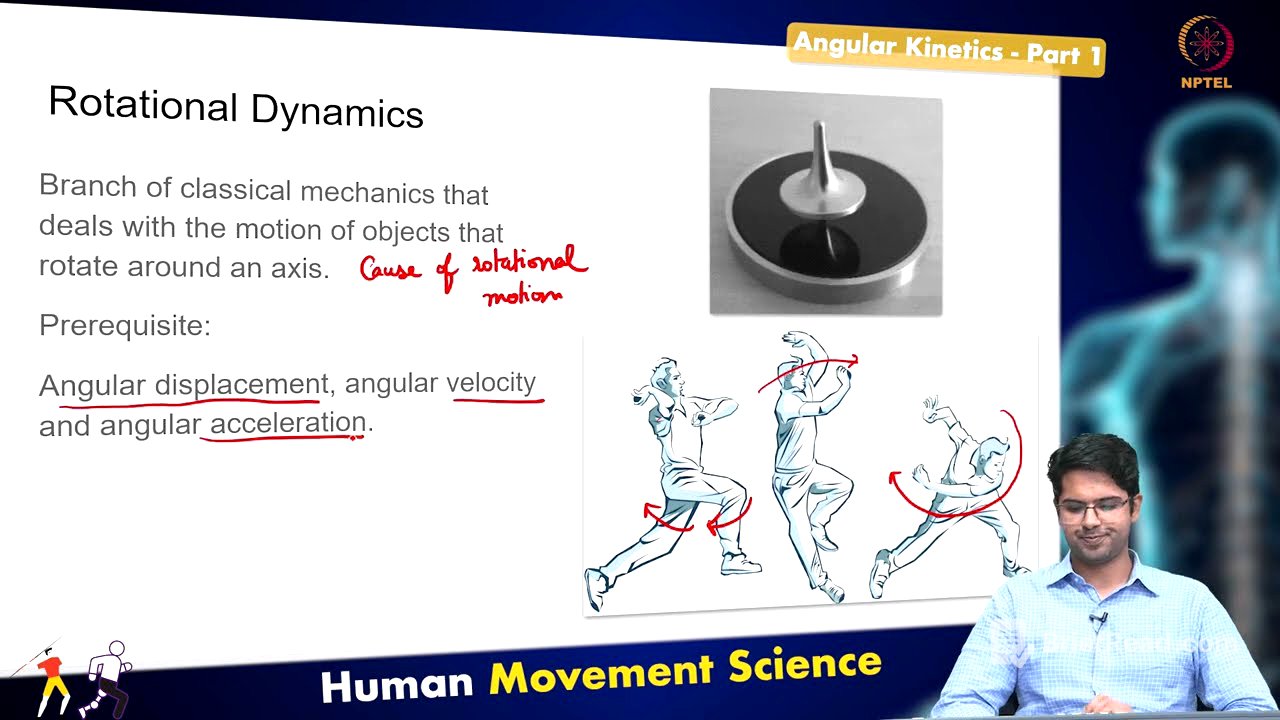
The lecture begins by defining rotational dynamics as the branch of classical mechanics dealing with objects rotating about an axis. It highlights the importance of understanding the cause of rotational motion, particularly in the context of human movement and sports, using the example of a cricket bowling action to illustrate the involvement of rotary motion in joint movements. The lecture emphasises the need to recall displacement, velocity and acceleration.
Why Study Rotational Kinetics? [3:04]
Building on the bowling action example, the lecture explains the importance of understanding the rotary forcing required to move individual joint segments, which is intuitive from a physiological perspective when considering muscle action. In addition to linear forces between joints, the lecture highlights the significance of joint moments and introduces key terms such as moment, torque, and couple, which will be explored further.
Understanding Moment [5:35]
The lecture defines moment as the tendency of a linear force to cause rotary motion about a specific point, measured as the force multiplied by the perpendicular distance between the point of force and the line of force. It explains how to calculate the moment of a force using both the perpendicular distance and the distance to the point of action, incorporating the angle between the force and the distance vector. The scope is limited to planar kinetics.
Torque as the Rotational Analogue of Force [8:55]
Torque is introduced as the rotational analogue of force, representing a twisting force that cannot be represented by a linear vector. It is mathematically defined as the time derivative of angular momentum. The lecture draws parallels between linear and rotational systems, explaining how mass in a linear system corresponds to moment of inertia in a rotational system, and how force corresponds to moment or torque.
Moment of Inertia and Angular Momentum [11:54]
The lecture defines angular momentum and explains the equivalences between linear and rotational systems. Mass in a linear system is analogous to moment of inertia in a rotational system, where moment of inertia is quantified by the mass and the square of the distance to the mass. Angular momentum is then defined as the product of moment of inertia and angular velocity.
Practical Examples of Torque [15:28]
The lecture uses the example of a merry-go-round to illustrate how the distribution of mass affects the torque required to achieve a certain velocity. It explains that it is easier to rotate a merry-go-round when a person is closer to the axis of rotation due to the reduced moment of inertia. Another example involves rotating an object tied to a string, demonstrating how the torque required increases with the distance of the object from the centre of rotation.
Couple of Force [20:00]
The lecture introduces the concept of a couple of force, where two equal and opposite forces act on a system, resulting in no net linear force but causing rotational motion. It explains that the resultant moment is the product of one of the forces and the perpendicular distance between the two forces. This illustrates that even without linear motion, rotational motion can occur due to the application of equal and opposite forces.
Eccentricity of Force and Free-Body Diagrams [23:42]
The lecture emphasises the importance of the point of force application in causing rotation, using the example of pushing a merry-go-round. It explains that applying force at the edge of the merry-go-round results in easier rotation compared to applying force at the centre. The eccentricity of the force from the axis of rotation is essential for causing rotation. The lecture then introduces free-body diagrams as a tool for analysing systems and defining the dynamics of systems in rotational analysis.