TLDR;
Ben Rhodes, former Deputy National Security Advisor to Barack Obama, answers internet questions on geopolitics. He discusses the risk of World War III, the AI race between the US and China, the strained relationship between Iran and the US, and the ineffectiveness of sanctions. He also touches on the rise of right-wing control, potential solutions for Gaza, Israeli settlements in the West Bank, and the use of the term "genocide" concerning Israeli actions in Gaza. Furthermore, he addresses Osama bin Laden's appeal to some young Americans, the role of nuclear weapons in maintaining peace, hostile US-China relations, the possibility of China invading Taiwan, China's activities in the South China Sea, Putin's motives in Ukraine, and the potential for another Arab Spring. Finally, he examines cyberattacks, the similarities between Modi and Trump, the geopolitical implications of Arctic shipping, Trump's Greenland aspirations, and Biden's immigration policies.
- Risk of World War III is uncomfortably close due to conflicts in Europe, the Middle East, and potential conflict in the Taiwan Strait.
- China may be winning the AI race due to its focus on industrial efficiency and robotics, which are highly relevant to developing countries.
- Sanctions are generally ineffective and often harm the populations of the targeted countries more than their governments.
WW3 [0:14]
The world is uncomfortably close to World War III, with major conflicts already occurring in Europe (Ukraine) and the Middle East (Gaza). A potential conflict in the Taiwan Strait could trigger a global war, involving Eastern Europe, the Middle East, and East Asia. The rise of nationalist, strongman leaders in powerful countries like the US, Russia, China, and Israel increases the risk of territorial expansion and clashes, further undermining international rules and institutions designed to prevent world wars.
China and the AI Race [2:31]
The AI race between the US and China is not just about who reaches Artificial General Intelligence (AGI) first, but also about whose technology the rest of the world will use. If most of the world ends up running on Chinese AI, it would give China extraordinary leverage over those countries, potentially creating economic dependencies and opportunities for espionage. China is focused on AI for industrial efficiency and robotics due to its aging population, which may be more attractive to developing countries than American AI designed for service-based economies.
Why Iran and The U.S. are at odds [6:26]
The strained relationship between Iran and the US stems from the 1979 Iranian Revolution, which ousted a US-backed autocratic government, leading to a fundamental opposition to American domination. The US, on the other hand, does not take humiliation well, as seen with Cuba, and has never forgotten the hostage crisis in Iran. This has led to a state of conflict, often through proxies, and decades of US sanctions that have devastated Iran's economy. Political constituencies in the US are committed to regime change in Iran, further complicating any diplomatic rapprochement.
Sanctions [11:02]
Sanctions are generally ineffective in changing the behaviour of targeted countries and often harm the populations more than the governments. Heavily sanctioned countries like Russia, Cuba, North Korea, and Venezuela have not changed their behaviour, and sanctions have only entrenched the Cuban government in power. The US's use of sanctions is resented by the rest of the world, and they often empower the very people they are trying to undercut, such as the Iranian Islamic Revolutionary Guard.
When did “globalist” become derogatory? [13:34]
The term "globalist" became a negative, insulting term after the 2008 global financial crisis, which fuelled resentment towards political, security, and financial elites perceived as out of touch. This resentment has driven populism and anger, leading to a focus on nationalism and sovereignty. While nationalism appeals to some in the short term, it carries the danger of conflict, whereas globalism is criticised for its out-of-touch elites.
The ascendency of The Right [15:40]
The shift towards right-wing control is due to people feeling unsettled by the disruptions of globalisation, including the encroachment on traditional identities and the financial crisis. Right-wing populists have captured this backlash by offering an "us versus them" politics, focusing on nationalism and stigmatising liberal elites and migrants. This trend is happening worldwide, from the US to Brazil, Hungary, Russia, India, Turkey, Israel, and the Philippines.
Solutions for Gaza [19:28]
Potential solutions for the current state in Gaza are limited and complex. One possibility is Israeli control, which would likely lead to Palestinians being pushed into smaller areas. Another is a redevelopment plan involving a multinational force to provide security after Hamas is demilitarised, followed by significant reconstruction efforts. The best solution would be a broader Palestinian-Israeli settlement with a different Palestinian leadership negotiating a Palestinian state in Gaza and the West Bank, but there is no indication that Israel is interested in such a resolution.
Israel and The West Bank [22:37]
Israel is building settlements in the West Bank to control and ultimately annex the territory. Under international law, the West Bank is occupied Palestinian territory where settlements are illegal. The growth of Israeli settlements, particularly since 2009, is making a Palestinian state in the West Bank impossible, with checkpoints, security barriers, and demolition of Palestinian homes. The future may involve either a de facto annexation or Palestinians living under military occupation with second-class citizenship.
Why do people use the term genocide to describe Israeli actions in Gaza? [24:47]
The term "genocide" is used to describe Israeli actions in Gaza due to the intent to destroy a people in whole or in part, not just the number of people killed. Statements by Israeli leaders, the conduct of military operations, and the political objective to eliminate Palestinians as a category of people with a right to sovereign territory contribute to this view. Organisations, including a UN Commission of Inquiry and human rights groups, have pointed to these factors as evidence of genocide. However, others argue it is a legitimate war of self-defence following Hamas's attacks on October 7th, though Israel has likely violated laws of war.
Osama bin Laden and post-9/11 America [30:20]
Some young Americans sympathise with Osama bin Laden due to his critiques of American society and foreign policy, including imperialism and climate change. They also view the US reaction to 9/11 as excessive, given the invasions of Afghanistan and Iraq and the trillions of dollars spent. However, it's important to remember bin Laden's actions, which involved murdering thousands of people, and his support for repressive regimes like the Taliban. George Bush's claim that bin Laden attacked the US because he hated their freedoms is seen as inaccurate; rather, bin Laden opposed US foreign policy.
Nukes for peace [33:09]
Nuclear weapons are not the greatest tool for peace, despite the argument that they make war less likely due to mutually assured destruction. Conflicts have still occurred despite the existence of nuclear weapons, and nuclear-armed superpowers may feel emboldened to support proxy wars or invade smaller countries. Nuclear weapons provide a sense of security until they are used, and the proliferation of these weapons increases the risk of nuclear conflict.
US/China relations timeline [34:54]
US-China relations became hostile after Donald Trump's first election, but structural reasons were already leading in this direction. China's growth as an emerging power challenged the US's superpower status. The US had hoped that bringing China into the global system would lead to democratisation and adherence to international rules, but China continued to break rules on trade, intellectual property, and human rights. Trump launched a trade war with China, leading to a collapse in communication and a growing competition between the two countries.
When will Xi invade Taiwan? [38:13]
There is no guarantee that China will invade Taiwan, but it is a significant concern. China views Taiwan as unfinished business from the Chinese Civil War in 1949, while Taiwan is reluctant to be part of China due to its democratic evolution and the crushing of Hong Kong's autonomy. China's military capabilities are expected to be ready for an operation to retake Taiwan around 2027. A potential perfect storm could occur in 2028 if a DPP politician wins Taiwan's presidential election and Trump is re-elected in the US. The US faces a complicated decision on whether to intervene militarily, given the risk of a larger war with China.
China in the South China Sea [45:42]
China claims the entire South China Sea, a claim that is seen as absurd by other countries bordering the sea, such as Vietnam and the Philippines. This matters to the rest of the world because a tremendous amount of the world's shipping goes through the South China Sea. China has become more aggressive, building military structures on rocks and harassing fishing and military vessels of smaller Southeast Asian countries. China argues that the US is interfering in its sphere of influence, but smaller countries want disputes resolved under international law.
Why does Putin want Ukraine? [48:22]
Putin wants Ukraine for both security and historical reasons. From a security perspective, Putin views the collapse of the Soviet Union as a catastrophe and believes that NATO expansion threatens Russia. Historically, Ukraine and Russia have a long and intermingled history, with Kyiv being the ancient capital of Russia. Putin wants to re-establish the Russian Empire, with Slavic Russian-speaking peoples under the sovereign control of the Russian state governed from Moscow.
Ukraine War Outcomes [51:38]
The most realistic outcome of the Russia-Ukraine war is a ceasefire along a line of control in eastern Ukraine, with Russia controlling the land it occupies. The Ukrainians want credible security guarantees to prevent Russia from invading again, but the US has not offered NATO membership. The war will likely come to an end in the next year or two, but it will leave hanging over Ukraine the question of whether Russia will come back for more.
US/EU Troops in Ukraine [55:13]
The US and EU do not send troops to Ukraine because of the fear of nuclear war with Russia. However, there is a possibility of stationing US and/or European troops in Ukraine as part of a peacekeeping force after a ceasefire. A number of European countries, led by the UK and France, have talked about assembling such a force.
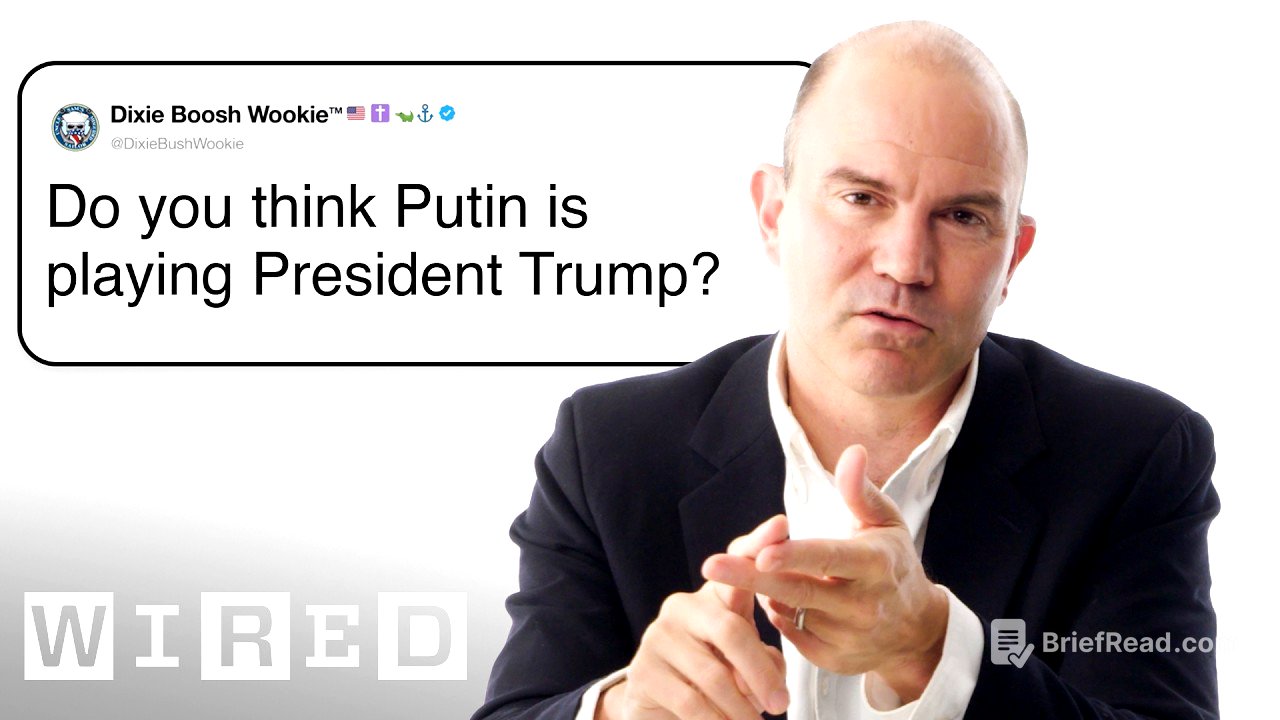
Is Putin playing Trump? [56:08]
Putin is playing Trump by trying to weaken US support for Ukraine and US unity with European allies. Putin is taking more land from the Ukrainians, dividing the US from Ukraine, and dividing the US from Europe. Putin wants the rules-based order run by the US to fall apart and democracy itself to be discredited. Trump is proving to a lot of Russians that Putin's been saying all along is true: that everybody is corrupt and there's no difference between Russia and the West.
Trump’s Greenland aspirations [59:09]
Trump wants Greenland for a combination of reasons, including national security, resource bonanza, and simply wanting a big piece of land. However, Denmark and the Greenlanders have made it clear that Greenland is not for sale and they do not want to be part of the United States. This leaves Trump with no other option than military force to seize the territory.
Trump’s accurate critiques [1:02:25]
Some of Trump's critiques are important and useful, including the damaging effects of globalisation on working-class Americans and the unaccountable national security establishment. However, his solutions to these problems, such as episodic tariffs and bombing more countries, are not the right ones.
Why did the Biden Administration allow so many immigrants to enter the US? [1:03:40]
The Biden administration allowed so many immigrants to enter the US due to a combination of factors, including a desire to be different from Trump, a reluctance to have strict border enforcement policies, and the scale of migration exceeding anything seen before. The immigration system has been broken for a long time, and the problem was exacerbated by governors like Greg Abbott and Ron DeSantis shipping immigrants to other parts of the country. The toxic and conspiracy theory-minded nature of US politics also contributed to the problem.
Maduro [1:08:52]
The kidnapping of Maduro is completely about oil, and the drugs and corruption are just the public pretext. The buildup of US military forces around Venezuela was far beyond anything necessary to deal with drug trafficking, and Venezuela was not a particularly important part of the drug trafficking that reaches the United States. Trump's concerns about democracy and human rights are selective, and he gave up the game when he didn't try to have an election after deposing Maduro.
Who is running Venezuela right now? [1:10:10]
Delcy Rodriguez is the current president of Venezuela. Other than taking Maduro away and abducting him, nothing really changed about the apparatus of the Venezuelan state. Trump's main interests seem to be about oil, but Venezuela's oil infrastructure is incredibly dilapidated. There are a lot of risks ahead, and it may be that all that we're really looking at is Trump occasionally grabbing a bunch of barrels of Venezuelan oil and taking some of the profits.
What does the U.S. actually gain from intervening around the world? [1:11:46]
The US intervenes around the world for a variety of reasons, including resource reasons, national security threats, and a desire to create chaos around the periphery. These interventions often don't make regions more stable and may preserve the US's position as the strongest power in the world.
Another Arab Spring? [1:14:09]
Another Arab Spring is possible due to corruption, repression, and economic mismanagement in countries like Egypt and Jordan. A bigger war in the region could also trigger instability. However, a quick path to a better outcome is unlikely, and power struggles may lead to more military-like governments.
Cyberattacks [1:15:17]
There are all kinds of different cyberattacks that can take place, including espionage, theft, and outright cyber acts of war. There are millions and millions of these attacks a day, and it depends on the outcome of the cyberattack whether it is considered an act of war. The US, Russia, China, Iran, and North Korea are in an ongoing cyber war, and the question is when the outcome of a cyberattack is so significant that it might lead to some other response.
Modi and Trump [1:18:08]
Modi reminds some of Trump because they are both strongmen leaders who intimidate the media, use social media to demonise opponents, and demonise certain opponents. However, there are also important differences, including Modi's deep embedding in traditional Indian Hindu nationalism and the different interests of the US and India.
The geopolitical implications of year round Arctic shipping [1:22:46]
Year-round Arctic shipping lanes have significant geopolitical implications due to climate change. The melting Arctic has opened up access to significant resources and can transform the way the global economy is wired. China is already looking at Arctic shipping ways as a much more efficient and faster way for them to export to places like Europe.